
To Stab or Not to Stab
August 7, 2025

“It became necessary to destroy the town to save it,” said an unnamed U.S. major, as reported by journalist Peter Arnett in 1968, describing the obliteration of more than 5,000 homes in one town, Bến Tre, during the Vietnam War. Widely publicized, though often misquoted, this justification for savagery was soon condemned. But does the same idea, wreck-it-to-save-it, now apply to democracy in America?
With Republicans determined to reshape congressional districts in multiple red states to guarantee their continued dominance of the U.S. House, Democrats are threatening to do the same in reverse in states they control. Is the Democrats’ response justified?
Redistricting—drawing a bunch of district maps to divvy up a state—is a complicated process. Since there are many measures for judging the fairness of a map, there’s usually enough of a fudge factor to allow a pretense of equity even when the results are biased. Not this time. This is pure partisan gerrymandering, all its naked parts hanging out in public view, with not even a scrap of gauzy film for modesty.
Of course, the Republican effort to subvert democracy serves the purposes of the would-be autocrat in the White House, known on this blog as Resident Ronald Rump, a.k.a. the Big Rump or Rumpy. Since he’s already responsible for many thousands of deaths (by decimating U.S AID, cutting Medicaid, supporting genocide in Gaza, etc. etc.), a gerrymandered stab at democracy’s liver seems abstract in comparison. But if he undermines the process, there will be fewer restrictions on him in the future. That’s why this may be a crucial turning point.
So let’s face the question: Is it necessary for Democrats to undercut the democratic process in order to save it? We’re “at war,” says New York’s Democratic governor, Kathy Hochul. And most folks, however pacific their nature, believe that war is sometimes necessary. Or revolution, if the oppression is bad enough. Wars and revolutions kill and injure innocent people, but they are often justified as a way to prevent greater damage.
We firebombed Dresden to stop Hitler (see the photo). We nuked Hiroshima to stop Japan. We set moral doubts aside to be examined later.
This is where we find ourselves as we debate whether to smash democratic norms in order to save them.
Democrats on the “war” footing insist that we can merely suspend democracy, temporarily and in certain places, to keep Republicans from ravaging it permanently. Is that sensible?
To me, the decision depends in part on how dire the danger is.
If, say, it becomes evident that Rumpy and his minions will cancel the presidential election in 2028, then we can’t stand on principle, we have to fight with whatever weapons we can muster. Revolution, if it comes to that.
But suppose we believe that Rumpy’s depredations are reversible. Whatever harm he does, we may think the next president can fix it. Is that a legitimate thought when children are literally dying because of his actions? Dead kids, unfortunately, can’t be resurrected.
But wait, let’s not get distracted by those piles of dead bodies. The issue here is whether Democrats should break their democratic principles to prevent worse injury to our nation. So we have to phrase the question this way: If both parties jointly knife our system in the ribs, will the wounds eventually heal? Is there such a thing as a “temporary” suspension of democracy? How long will that last? What else may be lost along the way?
I confess I’m flummoxed. This issue is too difficult for me to grasp, even aided by a tall glass of whiskey.
Three Truths for the Fourth
July 4, 2025

My typical practice for holidays is to ignore them. As a dedicated melancholic, I’m not big on celebrations of any sort.
Nevertheless, this Independence Day seems worth marking. It’s the day Trump signs his Big Beautiful Bill to benefit the obscenely wealthy while sentencing millions of low-income Americans to death from lack of medical care. Though the bill is unpopular with the public, the political consequences are uncertain. Thus it’s worth asking why politicians who enact unpopular, even disastrous policies gain power in what is supposed to be a democracy.
I won’t rehash the standard answers to that question: big campaign donors, PACs, gerrymandering, etc. etc. But after the 2024 presidential election, it seemed to me that three fundamental lessons were evident. These lessons are pretty much common knowledge, but they tend to be overlooked by party leaders and pundits who focus on strategic and tactical issues.
Since last November we have been buried in endless, detailed analysis of what Biden did wrong, what mistakes Harris made, and how Trump and his minions played on fears of made-up bogeymen like immigrants and socialists. I’m looking instead at long-term qualities of American society, and American voters, that change very little from one election to the next.
1. Americans are still racist and sexist.
True, in presidential voting, we overcame racism twice with Obama, who was an extraordinary politician with relatively weak opposition; and we beat sexism once when Hillary Clinton took the popular vote in 2016. But conquering both prejudices was simply too much for Kamala Harris, as evidenced by the anecdotes about Black men who thought she was incapable of standing up to Putin. (It probably didn’t help that she’s slim and pretty; if she’d been built like Angela Merkel, she might have been judged more formidable.)
The effects of prejudice on a voter can be quite subtle: a slight, unarticulated reluctance to trust a candidate, or an increased willingness to entertain doubts or slanders. In a campaign full of outrageous lies, this can be enough to change a vote or convince a person to skip voting entirely.
I’m not a pollster, but broadly speaking, I’d say the numbers for Democrats look like this: Nationally, about 45% of votes are automatically lost because of the party label. A Black candidate loses another 3%, a woman 2%. It’s only the undemocratic Electoral College that matters, of course; yet it’s clear that any Democrat other than a white male faces long odds.
Make that a white straight male. We haven’t tested the prejudice against LGBTQ+ folks in a presidential election, but I suspect the numbers are about the same.
Would there be a similar bias against a Jewish candidate? My Jewish wife thinks so. As for a Muslim or Buddhist … let’s not even go there.
This is such a terrible state of affairs that I hope my reasoning is wrong. But we need to face the strong possibility that it’s right.
2. Voters are selfish.
Besides being a truism, this is often considered a positive feature of democracy. I vote for what’s good for me, you vote for what’s good for you, and the overall outcome is what’s best for the majority. But we often fail to realize the supreme dominance of selfishness and the narrow way it functions.
Democrats like myself supported Harris for noble reasons that simply didn’t play with the larger public. For instance, we were taken with grand ideas like these:
a. Preserving democracy against an existential threat. This argument was much too abstract for many voters, even those not attracted by strong-man vibes.
b. Maintaining support for Ukraine. Ukraine is too far away. Europe is too far away. Most American voters may support Ukraine in principle, but at least half don’t fundamentally care.
c. Restraining the genocide in Gaza. Though Biden certainly gave Israel a lot of leeway to kill Palestinian civilians, it was clear that Trump would be even less likely to restrain Israeli hardliners. Yet many voters paid little attention to this issue. Dead Palestinians, so what?
Then what did voters care about? “The price of eggs” became the pop shorthand answer.
Think about how deeply, deeply selfish this is. That’s how people tend to vote.
3. American voters are ignorant.
Many Trump voters were not just ill-informed about the issues and the candidates. They were abysmally ignorant. Things they didn’t know included:
- The foreseeable effect of Trump’s tariffs on inflation, raising “the price of eggs.” Economists kept pointing this out, but Trump voters didn’t hear it or didn’t grasp it.
- The predictable effects of implementing Project 2025, decimating the federal programs that benefit most Americans and undermining the economy for many years to come.
- The likely savagery and economic upheaval of Trump’s plan to deport undocumented immigrants.
Zohran Mamdani, running for mayor of New York, tells of speaking to voters who said they supported Trump because, four years earlier, they had less trouble making ends meet. These people aren’t, by and large, stupid, but they reason in an utterly stupid way; they take hold of one salient idea and block out any qualifiers.
Some of the problem can be attributed to the fragmentation of news sources. I’m old enough to remember the angst of intellectuals when Americans began to gather most of their news from short-form TV programs rather than newspapers and magazines. Yet, from our current perspective, the 1960s and 1970s were far more enlightened. The news shows from the three major networks hewed to a fairly centrist line, and when Walter Cronkite concluded his broadcast by saying, “And that’s the way it is,” he was telling the truth: indeed, that was how it was, more or less, and at the peak of network news, more than 50 million Americans heard it from him or his fellow broadcasters. Now, for large portions of the populace, Walter has been replaced by biased, conspiracy-peddling media pundits.
Many Americans, of course, are willfully ignorant, refusing to attend to any media that don’t confirm their ingrained beliefs. I have to admit that I do not, and will not, watch Fox News, so I remain oblivious to any scrap of truth purveyed by that outlet.
Another reason for mass ignorance may be the decline of civics education in schools. That’s something we might tackle, but oops, the folks in power don’t believe in education, do they?
Whatever the origin, ignorant citizens are a condition we must contend with for years, probably decades, to come. Our leaders will be elected in large part by people who don’t know shit. If you think that sounds elitist, I counter by saying that, yes, it’s elitist and also true.
So these three points, I believe, are fundamental lessons for the Democratic party and any other group that would like to preserve what’s left of our democracy. You have to deal with racism and sexism, appeal to narrow selfish concerns, and overcome colossal ignorance. Among our goodhearted compatriots, who’s ready to tackle such a task?
Time to Get Crazy
October 22, 2018
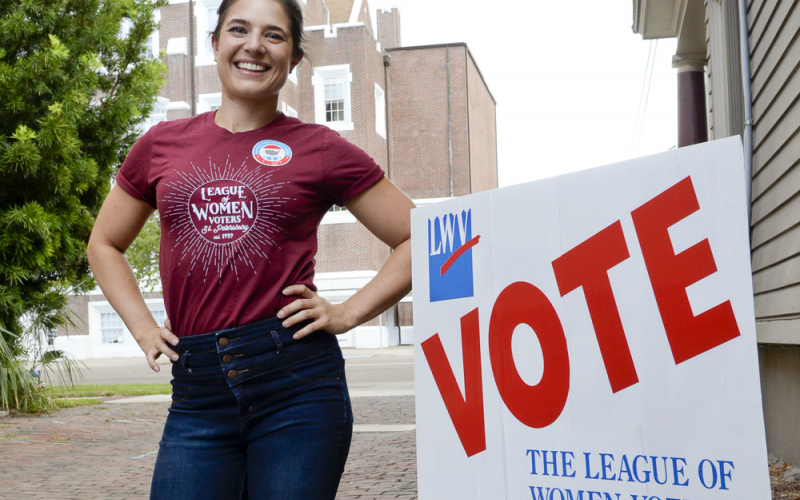 November approaches, and it’s time for one of my periodic screeds about voting. Few things perturb me more than Americans who don’t vote.
Well, President Twitterman gets top rank among bugbears, of course. And there’s the Saudi autocrat who’s finally being bashed in the press for murdering one journalist while his mass slaughter of Yemeni civilians continues to be ignored. Yet I don’t know that princely thug called MBS, he’s never bought me a beer, and my outrage at him merges with my general disgust for the fat-cat gangsters swarming the White House and other seats of government.
In comparison, my displeasure with nonvoters is much more personal. You know the truism that sibling feuds are the worst of all? Americans who don’t bother to vote—especially college-educated, middle-class types like myself—those people are family, and so I get really mad at them. There’s no excuse for their behavior. Voting is so simple—how can they not do it?
Do I sound like somebody’s grumpy old uncle?
I am.
Let’s survey some apparent reasons people don’t vote. I’m excusing, of course, those who are blocked from voting by electoral machinations (“you put a period after your middle initial on one form but not on another; therefore we can’t verify your identity”), and those who juggle three jobs and three children and have no time in between, and those whose polling place is conveniently located 153 miles away. Etc. (Although in the latter cases people might use absentee ballots.) I’m aiming this diatribe at people who could vote easily but somehow don’t. The people who elected Twitterman by abstaining. The people who make the United States notorious as a nonparticipative so-called democracy.
Reason for Not Voting #1: “I don’t like any of the candidates. They’re all flawed.”
My response: I hope you believe in a Messiah. Because your perfect political candidate will come along sometime after the Messiah.
Reason for Not Voting #2: “I’m sick of voting for the lesser evil. I can’t compromise like that anymore. From now on, I’ll stand on principle.”
My response: Congratulations on your moral purity. Have you considered moving to a place where none of your principles will be compromised, such as Antarctica?
Reason for Not Voting #3: “None of the candidates talk about issues important to me.”
My response: If you like that situation, keep on not voting. By not expressing your opinion at the polls, you make certain that candidates will disregard it.
Reason for Not Voting #4: “It makes no difference anyway. In my gerrymandered district, people with my views are so outnumbered that my candidate can never win.”
My response: Gerrymandering is a big, big problem. But the canny politicians who divvy up voters for their own advantage are counting on the continuation of established political patterns, including the pattern of people not voting. A sudden swell in ballots from groups they are trying to marginalize could upset their calculations—and maybe set the stage for legislative action to end gerrymandering.
Reason for Not Voting #5: “Votes change nothing. Politicians do whatever nasty things they like regardless of what the public thinks.”
My response: Um, politicians can’t do that nefarious stuff if they’re not in office. Vote them out and they’ll be reduced to making millions as lobbyists. That’s not quite as bad for the rest of us.
I’ve said all this before, in one way or another. But the other day, inspired by a conversation with a politically involved friend, I turned the problem around in my mind, reflecting on what it takes to become a committed voter, someone who turns out in every election:
- A sense of morality or justice. People are said to vote their pocketbooks, and many do, but in our divided times what seems to drive citizens to the polls is a belief that certain actions and policies are right and others are disastrously wrong.
- Faith. Not religious belief necessarily, but a conviction that there’s some hope left for the world and that human actions—our actions—can make a difference. Admittedly, if science says the Earth is likely to be uninhabitable in a few decades, faith stretches thin; but there have been Doomsday scenarios in the past that we managed to escape, and it wasn’t by hiding under our school desks to avert the atomic bomb. We must believe that our flawed and compromised democracy can be salvaged and that its fate is important to the world.
- Irrationality. In the most local of elections, one vote can actually matter. In a 2017 contest Phillip Garcia won the post of judge of election in a Philly precinct because he wrote in his own name—the only vote cast for that office. Still, I have to admit that one vote, which is all each person can control, will change nothing in a statewide or national election. Making a point of casting a ballot is therefore irrational, or at best a stroking of one’s own moral sensibilities (cf. Reason #2 above).
It seems I’ve put myself in the position of urging people to be irrational. Okay, I’ll own up to that. I’ll double down, as Twitterman always does.
Get out there and go crazy, people! Against all reason, act like it makes a difference what you do. Vote for somebody! If necessary, embrace the lesser evil, the best of the bad choices.
Maybe there’s some hidden good there after all.
Bold Predictions
September 7, 2018
In such unprecedented (or unpresidented) times as ours, it’s difficult to imagine what comes next. But as concerned citizens it’s incumbent upon us to plan for the future. In that vein, here are my carefully reasoned predictions about likely trends in the next decade.
- When the Supreme Court overturns Roe v. Wade and states are once again free to ban abortion, women will migrate en masse from pro-life to pro-choice locales. Mississippi, for example, will empty out and Massachusetts will burgeon.
- In Boston violent fights will erupt over parking spaces, and the city’s parking clerk will have to dodge irate commuters armed with tire irons. Electric bike-sharing companies will make a fortune. So will lawyers.
- As women abandon pro-life states, property values there will plummet—increasingly so as the despondent remaining men litter their yards with empty pizza boxes. Country music will reach new heights of popularity as songwriters exploit the rhyming potential of lonely pepperoni.
- Once property values have tanked in pro-life states, adventurous young gay couples (realizing abortion bans are irrelevant for them) will seize on the opportunity to homestead. They’ll buy houses on the cheap and settle in. They’ll need to acquire weapons to fend off the Klan, but being younger and smarter and unencumbered by clumsy hoods, they are bound to prevail. Within ten years, Mississippi will be the coolest place to live in America.
If any of this comes true, you can count on me to say “I told you so.”
Meanwhile, people who don’t want such things to happen can consider a radical alternative: voting.

Martin Armstrong, “U.S. Voter Turnout In Perspective,” Statistica, Nov. 11, 2016.
Retreat from the Grown-up World
October 31, 2017
In the midst of America’s absurd, untenable political situation, my wife’s refuge is to watch MSNBC every night, where the anchors tell her over and over again how absurd and untenable the situation has become. That has a certain reassuring quality, she finds. For me, it’s just too repetitive and depressing.
 One of my own escapes is to read books that have nothing to do with the present-day USA or its foibles. For instance, I just finished Joyce Cary’s novel-cum-memoir A House of Children (1941), in which he describes vacation stays with relatives in Donegal. Lots of scenes about boating on the water, gossip about the older girls’ suitors, night-time swims in the lough, donkey-cart rides with a hired hand.… A fine respite from the 21st century—until I come upon passages like this one, which describes the children’s reaction after a play they have produced proves hilariously inept:
There was great applause, and Frances came to congratulate us. But we had lost heart. We were not only ashamed and disappointed; we had suffered a shock. Deeper than the sense of failure, there was the feeling that we had misunderstood the situation; that plays were not so easy as they seemed. With this went, as always, the feeling that life, too, was not so easy as it seemed. Like most children when they fail in a grown-up enterprise, we were subdued and secretly frightened; we wanted to get away by ourselves, preferably out of the grown-up world and back into our own refuges, the school-room or the kitchen. [Chapter 48]
Immediately, on reading that, I was back in the USA, wondering how much of our present state could be characterized as shock and shame at the failure of our self-conceived, long-running play called “American Democracy.” Are we frightened that it’s not as easy as we thought? Would we rather retreat to our refuges, like the couch and TV?
Actually, despite time spent on old British novels, I’ve been doing something useful lately, namely, volunteering for Fair Districts PA, an attempt to stop gerrymandering in my fair state of Pennsyltucky. After ranting for years about people who don’t bother to vote, I’ve decided to help address one of the conditions that discourage voting. This does require certain compromises on my part. I’ve always been annoyed with the inefficiency of volunteer organizations. Also, any cause that counts Arnold Schwarzenoodle among its supporters is inherently suspicious to me. But I do believe that if we can do away with legislative districts that look like this—

—we’ll have less need to run away from the grown-up world and hide in our refuges.
By the way, that district shown above, PA’s 7th Congressional District—known as “Goofy Kicking Donald Duck”—is served (if that’s the right word) by the estimable Pat Meehan, who has voted to repeal Obamacare, to defund National Public Radio, and to ignore requests for President Twitterman’s tax returns. With borders drawn so well to suit their needs, he and his fellow Goofies can be re-elected forever.
#WritersResist and Fair Districts
February 6, 2017
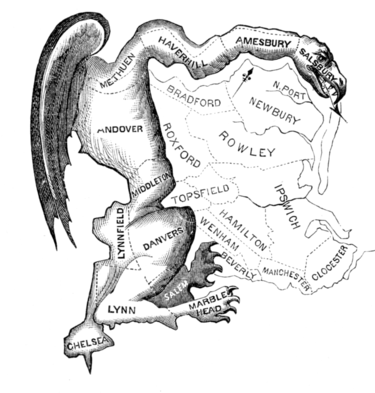
The original gerrymander in Massachusetts
At the second meeting of the #WritersResist group in Philadelphia, I learned about Fair Districts PA, a group determined to convert Pennsylvania to a nonpartisan redistricting process before the 2020 census.
Every ten years, after the national census, states redraw their district lines — both for the state legislature and for the U.S. House of Representatives. Under the current system in most states, those in power in the legislature gerrymander the districts to make sure they stay in power. We get districts shaped like this (from the U.S. Department of the Interior via Wikipedia):

Besides perpetuating one-party control, the “safe seats” contribute to gridlock on both a local and a national scale. If lines are drawn to make sure that those with certain views get reelected (and reelected and reelected and reelected), they have no need to listen to any dissenting voices or consider any compromise.
Although the USA is not the only country to allow gerrymandering, the practice is particularly egregious here, and the Supreme Court’s rulings on the subject have been indecisive.
I’ve long bemoaned Americans’ lax voting habits. There are two principal ways to influence politicians: money and votes. Most of us don’t have the first, and too many of us throw away the second.
Obviously, one way to encourage voting is to make the districts fairer. If we eliminate automatic winners, people will be more inclined to think their votes count for something.
So do check out Fair Districts PA or a similar group in your own state. And vote!
(I’m still fuming at my friends who didn’t bother to vote last November.)
Twitterman Landslide!
January 3, 2017
The results are in from our runoff poll! Our incoming president has his proper moniker:
2,469 votes for “President Twitterman”
1,389 votes for “President Pootinesca”
That’s an overwhelming margin—one might say a mandate—for Twitterman. Henceforth the orange fellow in the White House shall be known by that name.
 However, some members of the Gridleyville Board were disturbed by anomalies in the voting.
For one thing, this blog has a known readership of 11 souls. Even though individuals were allowed to vote multiple times, it’s a bit surprising that 3,858 ballots were cast.
Second, Twitterman’s total amounted to 64%—eerily similar to the percentage won by Vladimir Putin in 2012.
Third, more than 3,000 of the votes have been traced to keyboards using the Cyrillic alphabet. We do have Russian speakers in the USA, but the sheer volume of Cyrillic-flavored votes has raised suspicion.
Finally, our agents have confirmed that one of the Cyrillic keyboards was connected to a monitor with the following sentence on its screensaver:
Умереть, капиталистические собак!
which, loosely translated, means “Die, capitalist dogs!”
Although the evidence is merely circumstantial, we can say with high confidence that certain high-ranking officials in the Kremlin deliberately intervened to sway the election. Apparently they conceived a deep hatred for the name Pootinesca. Perhaps they objected to the conflation of Vladimir Putin’s surname with the noise typically made by old fat men after a heavy meal. Or, if they themselves are fine diners, they may have recognized the similarity to puttanesca, the popular pasta sauce whose designation literally means “in the style of a prostitute.” Whatever the motive, they programmed their system to cast thousands of ballots for Twitterman and approximately half as many (as a cheap cover-up) for Pootinesca.
After deep deliberation, the Gridleyville Board has therefore approved sanctions against the Kremlin. Once each day for the next month, we will send the following stern message to Moscow:
Плохие русские, плохие русские, пло-o-o-o-хо!
which, loosely translated, means “Bad Russians, bad Russians, ba-a-a-a-d!”
Yet—it should go without saying—as true Americans we must honor our democratic process, however corrupted it may be.
Therefore, long live Twitterman!
With dedication and good luck, he may well become the greatest Twit ever to occupy the White House.
Presidential Poll Results: Runoff Needed!
January 2, 2017
 Results are in for the presidential name poll posted on December 30!
In an effort to find a proper moniker for the incoming U.S. president, some voters chose among the options offered, some proposed alternatives. A total of six votes were cast, and since this blog has eleven total readers, including bots, the percentage who bothered to vote was nearly identical to that in the November election itself. We find that encouraging.
The vote resulted in a tie, with two names collecting two votes apiece. This calls for a runoff—also encouraging, because it prolongs the excitement!
Now, the original poll asked participants to vote by comment, which was a bit difficult. To register a vote, you first needed to have a sign-in recorded and recognized by the system. Then you had to go through the elaborate motions of typing a name on your keyboard. The setup deliberately mirrored the two-step process of regular voting, in which you first have to register and then, on the day of the vote, you have to show up, sign in, push some buttons and pull a lever.
In fact, five of our six voters circumvented the standard process, casting their ballots by Twitter, Facebook or, in one case, vocally. We Americans just can’t seem to follow the rules, can we? Nevertheless, in a true spirit of liberality, we decided to count those votes without penalty.
Perhaps the laborious effort required to cast a ballot is what discourages so many American voters. Therefore, for this runoff, we’re experimenting with a simpler poll format, in which you merely have to move your index finger twice. The two remaining candidates are listed below. Remember, the point is to choose a surname that, when combined with the title “President,” won’t make us hyperventilate or curse uncontrollably.
Click the circle next to the name you prefer, then click the Vote button. It’s easy!
Besides its simplicity, you’ll note that our runoff format has other important characteristics:
- It’s like a sports poll in that you can vote as many times as you like. Hence it gives an advantage to fanatics and those with nothing better to do with their time, kind of like a primary election between no-names running for Register of Wills.
- It resembles a Russian election in that, after you vote, the information disappears into the cyberether until the authorities (in this case, the Gridleyville Board of Directors) announce the official results, which may or may not reflect actual votes cast.
- It reflects the typical democratic process in that it makes not one iota of difference for the long decline of Western civilization.
So hurry up and vote now! The polls will be open for an unpredictable amount of time.
We wish the best of luck to both candidates.
A Name (or Icon) for All Seasons
December 30, 2016
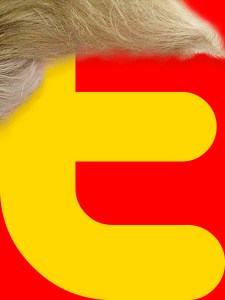 In the spirit of public service, I’ve been working on the proper way to refer to our incoming president, the man gifted to us by the deep wisdom of American nonvoters. Among the great majority of liberals, it seems that his surname can’t be combined with the word president without inducing profound metaphysical shudders as well as clinical symptoms such as hyperventilation and coprolalia. That’s a lot of people who will be getting sick. If you believe the opinion polls (have they ever failed us?), liberals in the broad sense now constitute the mainstream of the U.S. population. Most people won’t accept the dreaded L-word as a label, but they are tolerant and broadminded enough to qualify for it, and hence they may soon display the signs of existential illness.
To avoid traumatizing so many people, we need to find another name for the individual in question, one that will prove appropriate for at least four years.
So far, the principal solutions have come from rhyming slang, to wit, President Drumpf, Dump, Rump, Rumpffff, etc. Even to my 14-year-old mind (a characteristic I share with many of his supporters), this has begun to seem childish. We need a more thoughtful substitute relating to the man’s character, or lack of same.
Along those lines, here are a few possibilities:
- President Biglywiggly
- President Goldilux
- President Nukem
- President Pompadour
- President Pootinesca
- President Twitterman
Let me know your thoughts. Can you suggest any names to add to the list?
Perhaps we should take a vote. If the November pattern prevails, 45 percent of us won’t bother to cast a ballot, but a small, committed minority is all we need to declare a mandate.
As another option, we could use an icon or emoji in place of a name. If Garry Trudeau stays true to his tradition, he’ll come up with a clever one for Doonesbury. In the meantime, my initial graphic suggestion appears at the head of this post. Again, other ideas are welcome. Should we vote on an icon, or fail to vote and let mine win by default?
Election Day
November 8, 2016
Click either sticker for a rant about their meaning.
 The News from Gridleyville