
Three Truths for the Fourth
July 4, 2025

My typical practice for holidays is to ignore them. As a dedicated melancholic, I’m not big on celebrations of any sort.
Nevertheless, this Independence Day seems worth marking. It’s the day Trump signs his Big Beautiful Bill to benefit the obscenely wealthy while sentencing millions of low-income Americans to death from lack of medical care. Though the bill is unpopular with the public, the political consequences are uncertain. Thus it’s worth asking why politicians who enact unpopular, even disastrous policies gain power in what is supposed to be a democracy.
I won’t rehash the standard answers to that question: big campaign donors, PACs, gerrymandering, etc. etc. But after the 2024 presidential election, it seemed to me that three fundamental lessons were evident. These lessons are pretty much common knowledge, but they tend to be overlooked by party leaders and pundits who focus on strategic and tactical issues.
Since last November we have been buried in endless, detailed analysis of what Biden did wrong, what mistakes Harris made, and how Trump and his minions played on fears of made-up bogeymen like immigrants and socialists. I’m looking instead at long-term qualities of American society, and American voters, that change very little from one election to the next.
1. Americans are still racist and sexist.
True, in presidential voting, we overcame racism twice with Obama, who was an extraordinary politician with relatively weak opposition; and we beat sexism once when Hillary Clinton took the popular vote in 2016. But conquering both prejudices was simply too much for Kamala Harris, as evidenced by the anecdotes about Black men who thought she was incapable of standing up to Putin. (It probably didn’t help that she’s slim and pretty; if she’d been built like Angela Merkel, she might have been judged more formidable.)
The effects of prejudice on a voter can be quite subtle: a slight, unarticulated reluctance to trust a candidate, or an increased willingness to entertain doubts or slanders. In a campaign full of outrageous lies, this can be enough to change a vote or convince a person to skip voting entirely.
I’m not a pollster, but broadly speaking, I’d say the numbers for Democrats look like this: Nationally, about 45% of votes are automatically lost because of the party label. A Black candidate loses another 3%, a woman 2%. It’s only the undemocratic Electoral College that matters, of course; yet it’s clear that any Democrat other than a white male faces long odds.
Make that a white straight male. We haven’t tested the prejudice against LGBTQ+ folks in a presidential election, but I suspect the numbers are about the same.
Would there be a similar bias against a Jewish candidate? My Jewish wife thinks so. As for a Muslim or Buddhist … let’s not even go there.
This is such a terrible state of affairs that I hope my reasoning is wrong. But we need to face the strong possibility that it’s right.
2. Voters are selfish.
Besides being a truism, this is often considered a positive feature of democracy. I vote for what’s good for me, you vote for what’s good for you, and the overall outcome is what’s best for the majority. But we often fail to realize the supreme dominance of selfishness and the narrow way it functions.
Democrats like myself supported Harris for noble reasons that simply didn’t play with the larger public. For instance, we were taken with grand ideas like these:
a. Preserving democracy against an existential threat. This argument was much too abstract for many voters, even those not attracted by strong-man vibes.
b. Maintaining support for Ukraine. Ukraine is too far away. Europe is too far away. Most American voters may support Ukraine in principle, but at least half don’t fundamentally care.
c. Restraining the genocide in Gaza. Though Biden certainly gave Israel a lot of leeway to kill Palestinian civilians, it was clear that Trump would be even less likely to restrain Israeli hardliners. Yet many voters paid little attention to this issue. Dead Palestinians, so what?
Then what did voters care about? “The price of eggs” became the pop shorthand answer.
Think about how deeply, deeply selfish this is. That’s how people tend to vote.
3. American voters are ignorant.
Many Trump voters were not just ill-informed about the issues and the candidates. They were abysmally ignorant. Things they didn’t know included:
- The foreseeable effect of Trump’s tariffs on inflation, raising “the price of eggs.” Economists kept pointing this out, but Trump voters didn’t hear it or didn’t grasp it.
- The predictable effects of implementing Project 2025, decimating the federal programs that benefit most Americans and undermining the economy for many years to come.
- The likely savagery and economic upheaval of Trump’s plan to deport undocumented immigrants.
Zohran Mamdani, running for mayor of New York, tells of speaking to voters who said they supported Trump because, four years earlier, they had less trouble making ends meet. These people aren’t, by and large, stupid, but they reason in an utterly stupid way; they take hold of one salient idea and block out any qualifiers.
Some of the problem can be attributed to the fragmentation of news sources. I’m old enough to remember the angst of intellectuals when Americans began to gather most of their news from short-form TV programs rather than newspapers and magazines. Yet, from our current perspective, the 1960s and 1970s were far more enlightened. The news shows from the three major networks hewed to a fairly centrist line, and when Walter Cronkite concluded his broadcast by saying, “And that’s the way it is,” he was telling the truth: indeed, that was how it was, more or less, and at the peak of network news, more than 50 million Americans heard it from him or his fellow broadcasters. Now, for large portions of the populace, Walter has been replaced by biased, conspiracy-peddling media pundits.
Many Americans, of course, are willfully ignorant, refusing to attend to any media that don’t confirm their ingrained beliefs. I have to admit that I do not, and will not, watch Fox News, so I remain oblivious to any scrap of truth purveyed by that outlet.
Another reason for mass ignorance may be the decline of civics education in schools. That’s something we might tackle, but oops, the folks in power don’t believe in education, do they?
Whatever the origin, ignorant citizens are a condition we must contend with for years, probably decades, to come. Our leaders will be elected in large part by people who don’t know shit. If you think that sounds elitist, I counter by saying that, yes, it’s elitist and also true.
So these three points, I believe, are fundamental lessons for the Democratic party and any other group that would like to preserve what’s left of our democracy. You have to deal with racism and sexism, appeal to narrow selfish concerns, and overcome colossal ignorance. Among our goodhearted compatriots, who’s ready to tackle such a task?
Bold, Unsupported Predictions
October 5, 2020

Being a person who knows little about politics and misunderstands much of that little, I feel it’s incumbent upon me to share my predictions about the upcoming U.S. election. Clearly the experts are befuddled, so the responsibility for commentary falls on us ignoramuses.
Here’s what I predict:
- President Twitterman will survive the coronavirus. If he suffers mental impairment from the disease, no one will know the difference.
- He’ll lose the popular vote by a large margin (though not nearly as large as he deserves).
- He’ll lose the electoral vote by a frighteningly small margin.
- While making lots of noise about fraud, he will ultimately retire from the fray rather than mount a coup—because, like a typical bully, he’s a coward at heart.
- Though Biden will promise healing, outrage will continue to multiply on both sides, and some people will get killed.
- Ultimately the deplorables, as Hillary Clinton called them, will fade from sight, skulking underground like cicada nymphs until their next chance to emerge. Which they will do, in time.
Vote and They Will Come: A Rant by No. 19
August 14, 2015
 We had an election this week in Philadelphia. A special election to fill three vacancies in the state House, two of which arose because the incumbents quit after pleading guilty to corruption.
This event produced a grand Y-A-W-N in the city. The media ignored it, and the outcome was predetermined. (Local Democrats, with a huge registration advantage, automatically win any vote with such little publicity.) Besides, most of us don’t even know our representatives in the state House, and as far as we can tell, their only function is to send us a boastful newsletter just before the next election. As for corrupt officials, they’re as common here as in Iraq, and perhaps cheaper, and we don’t expect new ones to be any less venal.
Nevertheless, stifling my Y-A-W-N, I wandered over to my polling place about 11:30 in the morning. It was deserted. They told me I was the 19th person to come in since the polls opened. Explained one attendant who was eating a pastry, “We don’t even call this light turnout. It’s dim turnout.”
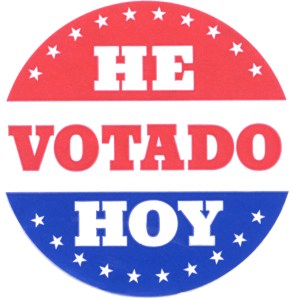
For the 30 seconds I spent in the booth, I received the sticker shown above—a more than adequate reward. I chose the Spanish version because I’m trying to learn the language. Combining this with the sign I encounter frequently, “NO TIRE BASURA,” I’m up to six words total. It’s a start.
But I was upset about being number 19. That’s worse than dim turnout, it’s like Milton’s description of Hell: “No light, but rather darkness visible.”
For an election pitting Luigi’s Pizza against Pete’s Famous Pizza, my neighborhood would have several hundred voters by late morning. Everybody knows Luigi’s would win—it’s predetermined by the crust—but people would show up at the polls anyway.
So I went into my typical funk about the trashing of American democracy. In my view, we can survive Donald Trump and Fox News (which treated the recent Republican debate like a game show), but what we can’t survive is indifference.
Okay, you’re heard that before. Everybody complains about the apathy of the American public. And the counterargument seems like a good one: If the choices are Tweedledum and Tweedledee—or, say, Trumpledump and Christiedweeb—indifference is a rational response, isn’t it?
I disagree, and here’s my reasoning.
Imagine your typical city neighborhood, which averages 60% turnout during presidential elections, 40% in midterms, 20–27% in mayoral elections, and way, way less in off-off-season polls like the one we just had here. On average, then, a lot more than half of the people don’t vote. Now suppose that, in the next election, the neighborhood’s turnout jumps a modest 15% for no obvious reason (no candidate from the dominant ethnic group, no hot-button issue on the ballot). What will happen?
The local politicians will suddenly get very interested in that neighborhood. They’ll start to ask what’s going on there. They’ll stop by and talk to people. They’ll want to know what issues the community cares about.
This imaginary scenario leads to my slogan, with apologies to Field of Dreamers:
VOTE AND THEY WILL COME!
It doesn’t matter if, at the moment, you can’t tell a Fiorina from a Cannoli. Vote in reasonable numbers and they will be forced to address your issues. Vote especially when the slick pols and the talking heads don’t expect you to.
After all, we citizens have just two things politicians care about: (a) votes and (b) money. For those of us with little cash to spare, votes are the only weapon, and if we don’t use that weapon to defend ourselves, we’re choosing to bend over and take it up the … wherever (to use a famous Trumpism).
Sure, I understand all the points about the influence of big money, the rise of the oligarchy or plutocracy or whatever you want to call it. I also sympathize with the rage that leads people into the streets to scream and throw rocks at the cops. But when we throw rocks, we’re not hitting the moneymen and asshole politicians who run the system. As soon as we go home, those bigwigs will go back to ignoring us unless they think they’re losing money or votes.
Thus, no matter how oppressed or depressed the community, I get upset with locals who complain but don’t bother to vote. Despite Republican efforts to suppress turnout, most people wouldn’t have any trouble voting if they made an effort.
It’s the one defense we have left. Nobody’s forcing us to be helpless.
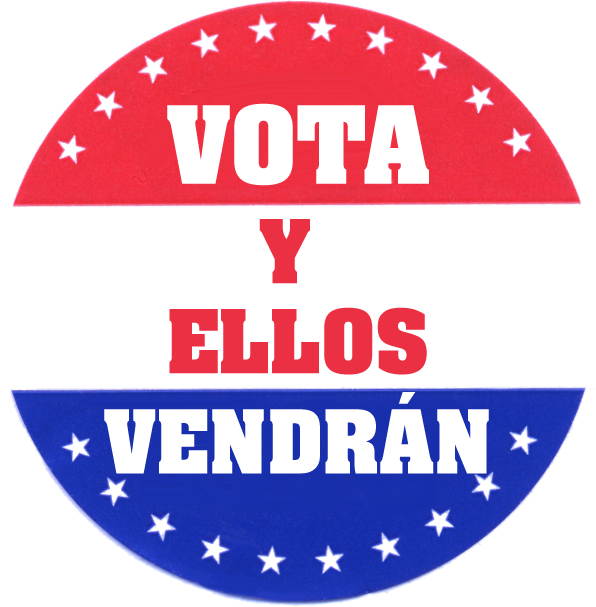
According to Google Translate, the slogan is even simpler in Spanish:
VOTA Y ELLOS VENDRÁN!
Plus, you get a nice sticker. Feel free to print this one and glue it to your shirt. Do correct my Spanish if I got it wrong.
 The News from Gridleyville