
Secrets upon Secrets upon Lies
July 10, 2024

“How can one family have so many problems, especially a Jewish family?” says my wife, who considers her own childhood in a secular Jewish household the model for all such. On my recommendation, she’s been reading Ona Gritz’s memoir Everywhere I Look, in which the author’s family suffers—and creates—multiple disasters.
An accomplished writer in middle age, Gritz sets out to investigate the life of her older sister, Angie, who was murdered as a young woman along with her husband, child, and unborn baby. This was more than 40 years ago. Though she adored Angie, the author had always felt guilty for being the favored child and failing to stand up for her sibling. In a way, Gritz told herself, she was responsible for Angie’s many troubles, from the rebellious childhood to the adult life exposed to drugs, dubious characters, and violence.
It takes courage, then, to probe the family history, and the more Gritz does so, the more secrets emerge, not only about Angie but about their parents, their cousins, their aunts and uncles. All families have secrets, of course, and the sensational ones have driven many a plot in memoir and novel. In Gritz’s case there are indeed some further biggies that come to light—facts not just concealed but deliberately lied about.
The reader wonders, What the fuck could they have been thinking? How did this one family, as my wife mutters, get so screwed up? Gritz does a good job of exploring the characters of these people so capable of neglect, poor decisions, and pernicious deception. Perhaps, as she writes in the final chapter, they were “more ignorant than malicious.”
It’s the kind of question that can’t really be answered. In place of explanation, we have to settle for emotional resolution. The book concludes at the cemetery where Angie is buried. Angie’s name, and that of her young son, are missing from the headstone, and Gritz arranges to fix the engraving. As she has done throughout, she speaks directly to her murdered sister:
“So much had been withheld and taken from you in your brief life, and I’d been incapable of doing anything about it. Now, finally, I’d figured out a way to stand up for you, and soon I’d do it again by writing our story. I’d say that I remember. I’d mark that you were here.”
If you liked DON’T LOOK UP…
February 24, 2022
Kandi Neal has included my novella The Bourgeois Anarchist in a post on the captivating blog shereads. The post is headlined “Books to Read If You Liked Don’t Look Up,” and I’m flattered to be included in the list. Actually, I don’t know whether I liked Don’t Look Up because I haven’t seen it. It’s a movie, right? I continue to struggle to keep up with pop culture.

Anyway, this is what Ms. Neal graciously wrote:
“Instead of moving into her own place after graduating college, Susie chose to live in an anarchist commune, and that’s where she stayed for the next twenty years. Now, at sixty-six years old, she lives a comfortable life and teaches at a high-end private school. Even though her apolitical math-loving son calls her the bourgeois anarchist, she’s still committed to fighting the good fight. When she gets injured at a rally and rescued by a female in Antifa gear, the police interrogate Susie, looking for answers. But it’s her son and his unexpected, hilarious point of view that really put things into perspective.”
I’m glad she found Susie’s son Eric hilarious, as he was intended to be. The blog also promises that the ten books listed are “full of page-turning suspense that will have you on the edge of your seat.” For Susie’s story that may be a bit of exaggeration, but hey, it’s better for an author to have readers on the edge of their seats because of suspense than because they’re impatient to get to the bathroom.

Blurred Choices
November 17, 2021
Ellen Prentiss Campbell, an award-winning fiction writer and member of the National Book Critics Circle, has kindly reviewed The Bourgeois Anarchist in Tiferet Journal. Throughout the novella, she notes, “the lines between good and bad, right and wrong, blur”–proving she firmly grasped the book’s main theme.

Though the magazine is available by subscription only, I can offer a quote from the end of the piece, summarizing her take on the 66-year-old protagonist, Susie Alioto:
Susie is an irresistible force. Readers, especially those of a certain age, aficionados of Anne Tyler’s quirky heroines, will enjoy Susie. She carries the baggage of years of living and experience with almost reckless, youthful abandon. And begins to reckon with some skeletons in her own closet and to figure out what’s next.
You can purchase the novella on Bookshop.org.
Democracy and Frogs
June 29, 2019
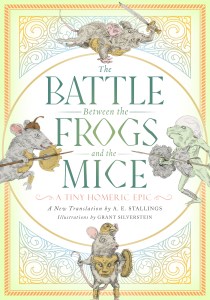
In my day job, I’ve recently had the pleasure of doing layout on a new translation of an ancient Greek mock-epic poem, “The Battle Between the Frogs and the Mice,” a spoof of heroic war sagas. The new translation by A. E. Stallings, with drawings by Grant Silverstein and an introduction by “A. Nony Mouse,” is due out later this year from Paul Dry Books. The text and illustrations are both gruesome and hilarious.
To summarize the poem’s narrative: After committing a selfish and deadly error, the Frog King concocts lies to evade responsibility, and as part of his cover-up he leads his subjects into a war on false pretenses. Things go badly for the amphibians, and the entire race will be wiped out—until the gods intervene to stave off genocide.
Could there be parallels to the current day?
After pondering this matter, I’ve decided conditions are very different in our democratic era. Because we no longer believe the gods will intervene.
The Ordinary and the Weird
August 22, 2016
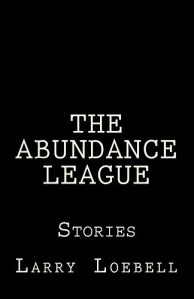 Late in this summer of dismal news, I welcome a chance to leave off my political screeds (four of the last five posts, I’m ashamed to say) to discuss a new book of stories by a friend of mine, Larry Loebell’s The Abundance League.
First, let me say what the book is not. Loebell is old enough to have lived through decades when American fiction has aimed to dazzle readers with stylistic flourishes, inveigle them into literary puzzles, or transport them to fantastic or dystopian worlds that have never existed. There’s none of that here. The book is stubbornly grounded on the earth that we know.
Second, it’s important to state that these stories pull no punches. Don’t let the plain black wrapper fool you. This book is sometimes shocking. That may seem an odd thing to say about contemporary fiction—what could possibly shock today’s reader? Well, how about a disabled woman, a quadriplegic with no feeling below her chest, describing in detail how she pleasures her lover—and insisting that, despite her lack of sensation, it’s fully consensual, not a horrid form of sexual exploitation? If you’re a resolutely PC person, prepare to be scandalized on occasion, not because the author is illiberal but because he’s willing to explore beyond the boundaries where our culture tells us to stop looking and stop talking.
Many of the characters, like the author himself, are close observers, giving lots of attention to small details, the “stuff” of our lives. One, an aspiring choreographer, even creates a dance piece from the movements and sounds of people in airports: “she noticed people parting around a slow moving janitor in a kind of parabola, their speed of movement a contrast of determination to languor, of progress to indolence, travelers heading toward their destinations and a laborer stuck in the routines of boring work.” Similarly, an advertising executive who calls himself “a visual guy” sees a resort’s beach bar as resembling “a Noel Coward play, a tableau of spot-lit gestures, glasses, and cigarettes.” With all the details, these tend to be talky pieces, the opposite of compressed vignettes. Yet the accumulation of particulars fleshes out the author’s rich and unsentimental vision of the way we live in the world.
A number of the protagonists are casual about their relationships, unwilling to be tied down. As the choreographer puts it, “It’s a hook-up world out there. That’s the world I run in.” Another woman, once married and now involved with a married man, “refused to desire or consider more, and she did not miss what she did not have.” Correspondingly, those who experience genuine and lasting affection find themselves obstructed or marginalized by others. They get dumped, discouraged, ignored, and in fact their love often follows paths one might consider weird: profound attachment to a dog, to an ancient carousel in the park, to an ex-partner unseen for decades.
The romantic outlook isn’t 100 percent dismal, though. The title story gives us two characters who do succeed in both physical and emotional commitment: a supermarket butcher and a produce worker. These are ordinary schlubs with no career ambitions, no grand expectations. They agree to a marriage of convenience that over time becomes a union of love. Likewise, the final story describes a slow-moving but ultimately hopeful relationship between two characters in small-town Alaska who have escaped collapsed lives in the lower 48. This story, with the impossible and wonderful title “How We Failed to Stop the War and Other Consequences of the Adolphus, Alaska, Peace March, February 2003,” offers a vision of community and mutual support in sharp contrast to the acquisitive striving of earlier pieces.
Engrossed with our material world and critical of it, focused both on the ordinary and on the weird that lies just below the surface of the ordinary, these are fascinating and unique stories, unlike those I’ve seen from any other contemporary writer.
ABC: Educational Success Stories
September 17, 2015
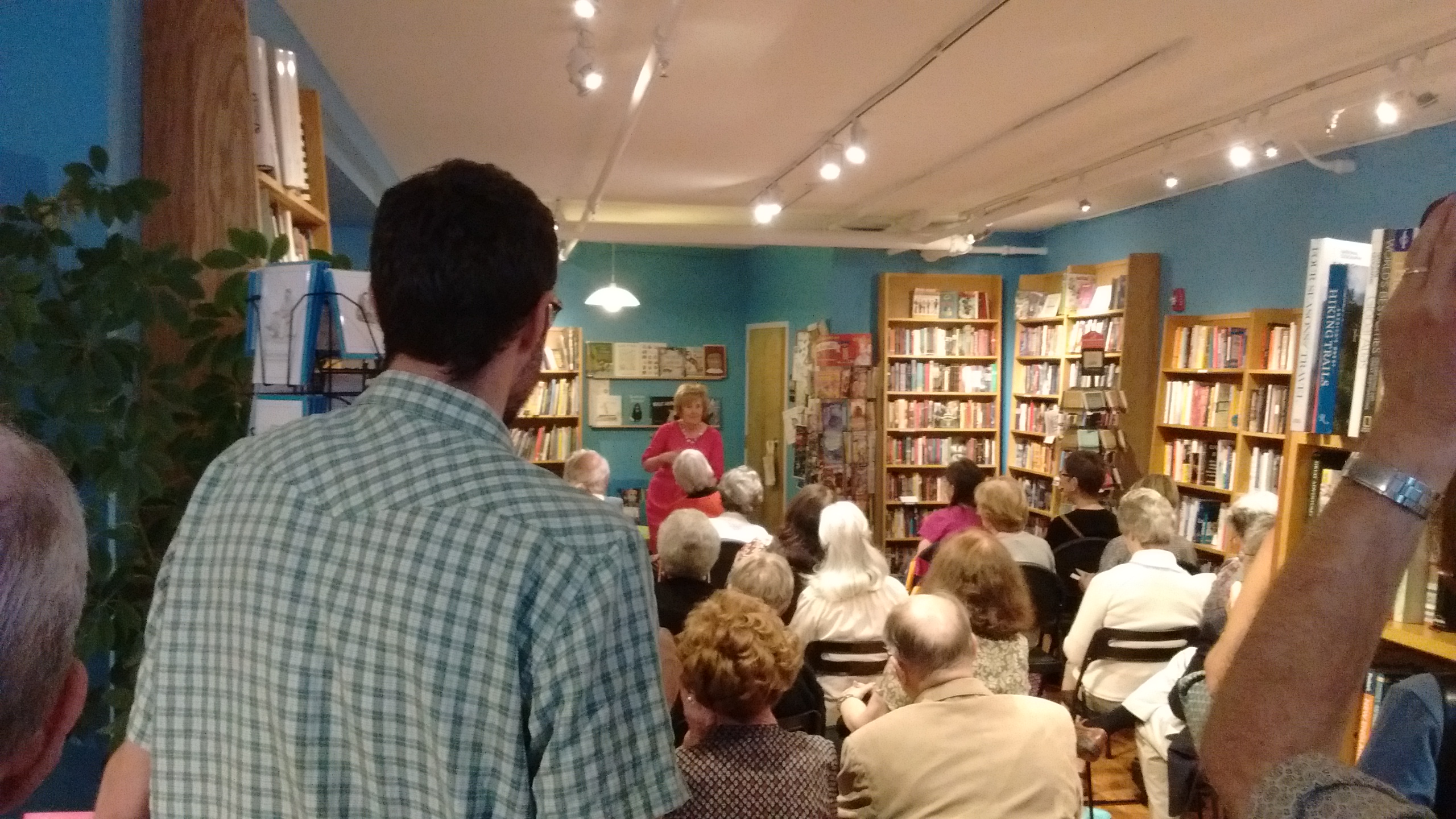 Here’s a photo from another standing-room-only book launch. I like that tall guy’s shirt, but I’ve got to start arriving early enough to grab a seat! Or I should remember to claim a chair before I linger at the wine table.
The book being celebrated, last night at Main Point Books in Bryn Mawr, PA, was A House Alive with Words by Patricia Zita Krisch (the person way up front in the red dress). Subtitled Stories from the ABC Program, a path to college for inner-city youth, it focuses on eight boys from the ABC House in Lower Merion Township, a well-to-do suburb of Philadelphia. Part of a national program called “A Better Chance,” ABC House takes academically talented, economically disadvantaged boys of color and houses
them together while they attend Lower Merion High School. Along with a home, the program provides academic and personal counseling and guidance. The goal is to get the boys into college and on the path to success.
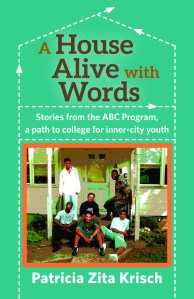 You’ve heard of programs like this. Do they really work? Trained as a sociologist, Krisch understands the social and educational problems the kids face—such as being singled out, in a class of white students, to give the “African American view” on an issue—but she goes beyond those to portray each of the boys as an individual with his own experiences, insights, struggles, and delights. One of her significant observations is that the boys’ greatest resource turns out to be their group itself, the camaraderie they develop and the support they give each other.
Nationally, ABC graduates include well-known people like Tracy Chapman and Deval Patrick. But the program is not about making governors or Grammy winners, it’s about giving ordinary smart kids a chance at a successful life. Krisch’s “stories” from the program, including the tale of one boy who was kicked out, help us comprehend the scale of changes that will be needed for everyone to have a better chance.
The publisher’s site is here, and the book’s Amazon page here.
Walker Evans, Coney Island, and a Fine Novel
February 5, 2015
 Cleaver Magazine has been ramping up its review section, and today there’s an excellent review of a book I love, We’ll Go to Coney Island, a novel in stories by Barbara Scheiber (Sowilo Press, 2014). The reviewer, Ashlee Paxton-Turner, is given plenty of space (more than 1,500 words) to discuss the work in detail, and she’s quite perceptive.
Early on, Paxton-Turner tells the remarkable story of the Walker Evans photo used on the cover. The book’s linked stories are loosely based on the author’s own family history, especially her mother, her charismatic and philandering father, and her stepmother. While she was writing the stories, she happened to see the Evans Coney Island photo in an article about an upcoming exhibition. Though the man in the picture has his back turned to the camera, Scheiber instantly recognized him: her father! with his mistress (later her stepmother)!
That’s a great background tale. The stories in the book itself are just as good, and the arrangement adds to their power. Chapters set in 1915–1916, when the main character Minna is a young girl, interweave with chapters from much later years, in which Minna becomes a mother, grandmother, and great-grandmother. Here is Paxton-Turner’s take on the technique:
Scheiber uses the form to tell two parallel narratives—past and present—that taken separately are rather linear. Once she puts them together, the linearity is distorted. This creates emotional resonance: the past and its formative memories does not yield or relinquish its hold on the present; it continues to resurface, even when Minna, suffering from Alzheimer’s, is left in the barren room of a nursing home.
Right. The past informs the present and vice versa, as much as in any time-travel sci-fi novel.
One other note of interest: The author, a first-time novelist, is in her nineties. I take that to mean that for all of us who have been dull and unimaginative for decades, there is still hope.
The book cover above links to the Amazon page for the book. Here is the link to the Cleaver review.
Descansos
October 16, 2014
 Descansos is the Mexican Spanish term for roadside shrines, the kind long seen along highways in the American Southwest. These small, spontaneous memorials have spread to cities, where people pay respect to a shooting victim or a bicyclist killed by a car with an arrangement of appropriate objects, such as flowers, photographs, signs, teddy bears. We’ve seen them all too often lately on the news if not in our own neighborhoods.
Some of the stories in Mark Lyons’s Brief Eulogies at Roadside Shrines are about descansos, and some are essentially descansos themselves, memorials to all manner of troubled folk, from a hobo to a war vet to a lonely kid who raises pigeons. The settings range all over America, even to Mexico and Japan, and they’re packed with remarkable imagery that made me think, Yes, that’s exactly right. Here’s one example, from a story about a woman whose husband has periodic outbursts of violence:
She can sense the rages coming, the way Seamus [a black lab] knows when a storm is moving in. A certain electricity in the air, a rise in the ozone level, a climb in atmospheric pressure. Then the color goes out of the room, like watching a movie in black and white. And just before—just before is this unbearable quiet, this silence, a space where direction could change, but won’t. [p. 187]
Those instants when the world loses all color and sound… Yes, we’ve all been there.
Though his protagonists are wounded in some way, Lyons resists attempts to sentimentalize or typecast them. For instance, that violent guy who beats his wife? When he’s not in a rage, he rescues wounded animals. And the wife, does she follow the typical pattern of resisting counselors who try to pull her free of the situation? No, she doesn’t bother with counseling; she handles the matter herself, in dramatic fashion. (Sorry, no spoiler.)
Since the author is a friend of mine, I fear that further praise of Brief Eulogies would be sentimental in a way the stories are not. Yet I do want to mention one other feature of this collection: an Afterword that discusses the “seeds” of each story. Normally I’m bored with writers talking about their craft. It’s the fiction I care about, not the mulling over it. In this case, though, the brief personal vignettes the author shares are almost as moving as the stories themselves.
For a quick introduction to Brief Eulogies, here’s a video clip of the author reading at the book launch.
The Rabbi’s Wife’s Choice
June 1, 2014
 While waiting impatiently for the copy of Robin Black’s novel that I preordered last July (damn these publishers and their extended marketing campaigns!), I saw that she’d published a new story on Five Chapters, and I went to it eagerly. Called “The Rabbi’s Wife,” it’s as well-crafted and psychologically complex as the stories in her first book, If I Loved You, I Would Tell You This—and even more provocative.
To talk about it, I have to give away the surprise twist that emerges, so if you haven’t read it yet, go do that now, at this link. Then come back and argue with me about it. Because I’ve been arguing in silence with the author, and the main character, Hannah, and myself for several hours now, and I need somebody else to direct my rantings at.
OK, you’ve read it? So you know the story is about Hannah, nearing 70, widowed a few years ago when Ben, her rabbi husband, died. She stopped going to synagogue after his death and cut her ties with the congregation except for her best friend Myra. She wants to remember Ben as the man she married when they were both “graduate students in psychology, non-believers,” before he betrayed her, in a way, by becoming religious, essentially forcing her—though she agreed to it—into the role of “rabbi’s wife,” with all the public duties that entails: “Part of loving Ben meant accepting a kid of amputation of self.” And yet she realizes that she now is betraying him, in a way, by stripping him in her thoughts of the rabbi-role he cherished.
So far, this is typical of Black’s stories in its subtle moral insight and sharp analysis of the myriad small treacheries of everyday life. I can’t think of any contemporary writer who is better at this kind of vision. But then the story goes to another level as we learn more about Hannah’s current situation.
The immediate occasion of the story is Myra’s funeral—Hannah’s close friend and confidante has died suddenly. At the shiva, the gathering at Myra’s house, Hannah empathizes with Myra’s ex–daughter in law, who recently divorced Myra’s son. The young woman is too good for the son, and Myra had supported her in breaking free. As the story of the young people comes out, we learn more of Hannah and Myra, and we see that Hannah has a breaking-free for herself in mind.
Hannah has been dating a man, Peter, for eight months now. She likes him, even enjoys having him in her bed, where he forges “a shelter into which she, the old tired she, could disappear.” But now he has been diagnosed with lung cancer and given two years to live—the same prognosis her late husband was given. Having suffered through the years of chemo, surgery and radiation with her husband, and then the inevitable grueling death, Hannah doesn’t feel she can do it again with Peter. Myra, her confidante, urged her to break off with him immediately: “The fact that you were sleeping together doesn’t indenture you to him.” He has children, Myra pointed out. You’re not his wife, Myra argued. “He’s a perfectly nice man, but you do not owe him this.”
Now Myra is suddenly dead and Peter is waiting for Hannah to come to him after the funeral. This nice man—a “genial man,” a “gentle being”—expects her to stay with him through his crisis. But as she sits alone in Myra’s bedroom gathering her thoughts, Hannah determines that she will not. She refuses to stomach another excruciating death. Life is unfair, she knows, and “she will conspire in the cruelty it brings.” She marches out on the way to Peter’s house, where her “newly ruthless self” will tell him, no doubt in the kindest possible terms, that she’s through with him and he’ll have to find others to help him die.
Finishing the story, which I read on a printout, I tossed the pages down in a small spasm of disgust. Hannah values her own comfort and sense of identity over the needs of her dying lover. At first thought, this seems too easy an assertion of the primacy of women’s rights over obligations to oppressive males.
But it’s not easy, of course. Hannah wishes deeply that she were not in this position. She doesn’t admire herself for deciding to be selfish for once. Eight months, the length of her relationship with Peter, is a terribly ambiguous amount of time: beyond casual, in our current way of assessing these things, but nowhere near an ironclad commitment.
And I’ve skipped over some of the details that deepen the story: the profusion of funerals that the rabbi’s wife attended over the years, the sense that there was always a death on the horizon; Hannah’s negotiations with Ben about the public role she would play when he became a rabbi; some insights into Myra’s character that enrich the advice she gives to Hannah. But it comes down to Hannah’s choice to stay with Peter or abandon him, a choice fraught with moral and psychological angst.
It’s interesting that when we consider such matters on a large scale, our sense of morality tends to shift. Should a people under the sway of a relatively benign but oppressive foreign power value freedom over loyalty, even if obtaining freedom means cracking some skulls? Yes, we said in the American Revolution. Yes, we would still say today. We will sacrifice lives (especially those of others) for freedom and self-determination. Personally, when I think about matters on this scale, a vague utilitarian calculation prevails: if, in the long run, there will be more happiness with freedom, then…
On the personal level the moral sense doesn’t, and probably shouldn’t, yield to utilitarianism, and it’s harder to see justice in Hannah’s behavior. Yet it’s hard to blame her either. We can line up arguments for and against her:
For Hannah:
She surely doesn’t deserve the agony of nursing Peter to his death. Especially so soon after doing the same for Ben, her long-time husband.
Against Hannah:
Practically no one deserves the suffering life metes out. And Hannah’s total lifetime suffering, added up, doesn’t seem like a horrifying amount. She has had children she loved with a husband she loved; she has had friends in the congregation; she had her special friend, Myra. Yes, she lived a lie in some sense, but who doesn’t, in some sense?
For Hannah:
After surrendering to her husband’s desire to become a rabbi—because it amounts to that, ultimately, a surrender, even though we don’t see what particular dreams of her own she had to give up—she is not required to surrender to any other man’s needs.
Against Hannah:
Of course she’s not required to take care of Peter—and perhaps he’s wrong to assume she will—but we’re talking about what she ought to do. She deliberately chooses to be cruel to him to make her own life easier. She is not being asked to surrender anything except her own pleasure. That is selfishness, not good behavior.
How many more pro-con arguments could we list? Five, ten? Dozens?
I’m irritated with Robin Black for writing this story, and dazzled that she has created a text that provokes such dense reflection. I’ll keep thinking about the rabbi’s wife for a long while, and if I ever meet that old lady, I may scold her or hug her, or both.
Grunge in the Burbs
June 16, 2013
 Conquistador of the Useless, the first novel by Joshua Isard, teems with references to bands I’ve never heard of. The book is also way too cool to use quotation marks around dialogue. All this should annoy me, but I enjoyed the tale anyway.
The story is told in the first person by Nathan Wavelsky, an early-thirties guy with a boring desk job, a nice wife, Lisa, a new home in the suburbs and a passion for grunge and pre-grunge bands that speak to his alienation. How does a grunge couple end up in the burbs? Well, they left the hip inner city because they got tired of the noise and the hipsters’ pretense. Of course, Nathan doesn’t like the pretense of the suburbs either; he’s immediately snarky about the new neighbors who invite them for dinner:
So, Kristy [the neighbor wife], says, how long have you been married?
Four years, Lisa answers.
That’s wonderful, Kristy says, we’ve been married almost eight years now.
She says it like they’d beaten us at some contest.
That’s typical of Nathan’s sarcasm. There aren’t many people he cares for. What he does like is drinking tea in the tree-shaded quiet of his backyard, bothered by no one. He also loves listening to his music, reading his books. He has no ambitions and doesn’t see the need to develop any. Isard sets him up, in fact, as a prototype of his generation. Here’s Nathan describing himself and Lisa during and after college:
Neither of us were National Merit Scholars or Phi Beta Kappa members—we always studied, but refused to end up in the college’s counseling office because we had anxiety attacks over a B.
This is also the way we treated our jobs. We worked hard in the office, but tried not to think about it when we got home.
It wasn’t that we didn’t aspire to a promotion, it’s that we didn’t aspire to anything. We were the kids who heard their public school teachers tell them that they could be anything, even President of the United States; whose parents insisted that we would be the generation to change the world; who grew up in the age where everyone’s special.
Then we looked at the politicians, our teachers, our peers.
And we said, Horseshit.
And we were happy.
With Nathan thus coasting through life, Isard tosses him some trouble. Nathan’s best friend, who has become a rich adventurer, breezes into town and invites him to climb Mt. Everest. The thought intrigues Nathan because he has always liked climbing mountains (though he has no experience on difficult ones) and because he’s drawn to experiences that are “wonderful and useless.” But a trip to Everest, with the real possibility that he might freeze to death there, conflicts with Lisa’s sudden interest in beginning a family. Nathan finally grasps Lisa’s seriousness about nesting when she starts painting the house by herself and buying new furniture:
We’ve been here for five months, Nathan, and until today we had a hobo’s table next to our couch, a bedroom that makes a summer camp cabin look ritzy, and no plan for any of it. We’ve got a stove, a dishwasher, and a washer/dryer that came with the place because the last owners didn’t want them anymore.
Yeah, I say, but those things still work fine.
Who gives a shit if they work, she says, they’re not fucking ours.
It is, at this moment, that I realize the full gravity of the situation.
Nathan also gets into trouble by lending Vonnegut’s Cat’s Cradle to a teenage neighbor girl, Rayanne, a cultural faux-pas worsened by his indifference to propriety. He is shunned by the adult neighbors, who assume he’s been corrupting minors, and again Lisa is not amused:
What kind of relationship do you have with Rayanne?
The kind where I lend her books and music.
And where you think about how hot she’s going to be.
Oh come on—
Is it also the kind where you invite her into our house when I’m not home?
Yeah, I say, to give her a book.
You didn’t tell me that part of the story, she says, you didn’t tell me she came in here with you. How do you think that looks?
I don’t know, I say, polite?
The humor, as should be evident by now, keeps Nathan amusing even when his unwillingness to be impressed with life becomes profoundly unimpressive. Yet, since this is a Serious Novel, Nathan does at last experience Personal Growth—and though I’m capitalizing these concepts to poke fun at them as Nathan himself might, the end is genuinely moving as well as unexpected.
It’s a good read even if you’ve never heard of Pixies, Green Day, Social Distortion, Mudhoney, Screaming Trees, or Jane’s Addiction. Even better, I guess, if you have.
 The News from Gridleyville