
Delicate Sensationalism
January 14, 2012
 In my disorganized reading of found books—volumes that turn up in the house with no invitation on my part, usually left behind by my wife, daughter, or a friend—the most recent was Black Dogs, a 1992 short novel by Ian McEwan, a writer I admire but can imbibe only in small doses. As is typical of McEwan, the story is unconventional, a bit weird, unpredictable. It’s a good read. Yet it indulges in a technique that my purist side deplores.
When pop novelists use bodice-ripping and gruesome slayings to spice up a plot, serious critics can dismiss the effort as mere sensationalism. But what happens when a top-notch literary writer employs similar elements, in a much more skillful way, and presumably to a higher purpose?
In Black Dogs—SPOILER ALERT, if anyone who hasn’t read this 20-year-old novel still plans to—the narrator, Jeremy, is writing a memoir about his in-laws, June and Bernard. The two have long been estranged, in part because of a transforming experience in 1946, on their honeymoon, when June encountered two large dogs in the French countryside. The animals provoked a revelation about good and evil that propelled her into decades of spiritual exploration, at odds with Bernard’s involvement in politics. Tantalizingly, throughout the novel, the author merely alludes to the key event. The explanation arrives in the last chapter with a vivid description of June’s being cornered on a lonely mountain path by feral dogs “of an unnatural size,” as big as donkeys:
she saw them as a juddering accumulation of disjointed details: the alien black gums, slack black lips rimmed by salt, a thread of saliva breaking, the fissures on a tongue that ran to smoothness along its curling edge, a yellow-red eye and eyeball muck spiking the fur, open sores on a foreleg, and, trapped in the V of an open mouth, deep in the hinge of the jaw, a little foam, to which her gaze kept returning. The dogs had brought with them their own cloud of flies. Some of them now defected to her.
The beasts slink forward to attack; June fights them off with rocks, a penknife, a rucksack and a distracting sausage.
But that’s not the real climax.
Later, in the inn where the newlyweds are staying, the proprietress and the mayor explain the dogs’ origin. During the war, the canines were brought to the region by the Nazi Gestapo to terrify the populace, which had supported the Resistance. Left behind when the Germans fled, the dogs have been living off the sheep.
Against the wishes of Mme. Auriac, the innkeeper, the mayor then proceeds with the story of a young woman, Danielle Bertrand, who had moved to the village during the war. She turned up at this very inn one day bleeding and gibbering, with her clothes torn.
Mme. Auriac said quickly, ‘She had been raped by the Gestapo. Excuse me, madame,’ and she placed her hand on June’s.
‘That was what we all thought,” the Maire said.
Mme. Auriac raised her voice. ‘And that was correct.’
‘It’s not what we discovered later. Pierre and Henri Sauvy—’
‘Drunks!’
‘They saw it happen. Excuse me, madame’—to June—‘but they tied Danielle Bertrand over a chair.’
Mme. Auriac slapped the table hard. ‘Hector, I’m saying this to you now. I will not have this story told here.’
But Hector addressed himself to Bernard. ‘It wasn’t the Gestapo who raped her. They used—’
Mme. Auriac was on her feet. ‘You will leave my table now, and never eat or drink here again!’
Hector hesitated, then he shrugged, and he was halfway out of his chair when June asked, ‘They used what? What are you talking about, monsieur?’
The Maire, who had been so anxious to deliver his story, dithered over this direct question. ‘It’s necessary to understand, madame.… The Sauvy brothers saw this with their own eyes, through the window … and we heard later that this also used to happen at the interrogation centers in Lyon and Paris. The truth is, an animal can be trained—’
At last Mme. Auriac exploded.
Though the proprietress goes on to accuse the mayor and his cronies of spreading vicious rumors, the lurid secret is out. The tale is told ever so delicately, with many hesitations by the characters themselves, the culminating words never actually spoken … but it’s sensational nonetheless, and in this moment the titular black dogs acquire their full load of symbolism for June and for the reader.
And at this point in the book, a dozen pages from the end, I was annoyed at McEwan.
Not that I mind hearing about monstrous things in fiction. But there’s a tawdriness in this teasing and titillating of the reader to build toward a revelation of appalling sexual torture. It doesn’t matter how fine the prose—which indeed is brilliant—and it doesn’t matter whether rape by trained dogs was in fact a Nazi method. Nor does the symbolic intention justify this device. The author is playing with the reader’s ability (and willingness) to be shocked, and in my snooty opinion that’s a low-class trick unworthy of the best fiction.
All right, I admit it: in literary terms, I’m a prig.
Now I’ll move on to the next found book, which an unidentified person just slipped through our mail slot: the peculiarly appropriate Dogs for Dummies—a donation inspired, no doubt, by our new terrorist puppy.
Alice Has a Latte
October 20, 2011
 Alice Bliss is now in a very cool place, a Philadelphia coffee shop frequented by theater people, schmoozing professionals, young mothers, wide-eyed kids (the cupcakes in the display case are at eye level for a three-year-old), natural-food and buy-local enthusiasts, and occasional salespeople with BlackBerries who wonder why everyone else has a MacBook or iPhone. Alice is waiting on a table for someone to pick her up—in a totally innocent way, of course, since she’s only 15.
For those who are totally mystified: Alice Bliss, by Laura Harrington, is a “travelling book” that I reviewed in my previous post. My copy is now poised to travel along with anyone else who adopts it. It’s a cool novel, with a winning protagonist, so I hope it/she finds a new home soon. The coffee shop staff has been alerted to assist her in her quest.
UPDATE SIX HOURS LATER: She’s gone—eloped with someone else. We hope she’ll send a postcard.
Travels with Alice
October 12, 2011
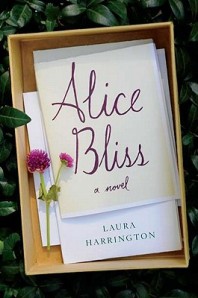 A Bookcrossing “travelling book” recently came my way: a copy of Laura Harrington’s new novel Alice Bliss. Bookcrossing.com encourages readers to pass along their books, either to acquaintances or to strangers, and then track them to see where they end up. The site supplies tracking numbers along with labels to paste inside a book. Harrington’s publisher, Pamela Dorman Books/Viking, has sent out some prelabeled copies to bloggers to begin the process for Alice Bliss. The idea is to give Alice, a 15-year-old from Massachusetts, a tour of the world. Currently, according to the website, she has reached 30 states and five continents. I suspect my handoff won’t add another state or continent, but I will surely pass the book on.
In a reversal of the typical process, this novel grew out of a musical, Alice Unwrapped, a solo piece that has been performed in New York and Minneapolis. Harrington won a 2008 Kleban Award for the libretto. The tale is a modern-day version of the homefront story—what goes on at home when the men march off to war. And indeed it is the man, Alice’s father Matt, who flies off to Iraq, leaving his wife and two daughters to fend for themselves. They have the support of a grandma, an uncle, and various friends, all of whom prove vital to the family’s well-being.
Somewhat alienated from her mother, teenaged Alice is especially close to her father, who has taught her gardening, baseball, roofing, puttering around a workshop, and other important life skills. Once he’s gone, she wears an old shirt of his every day and insists on planting the garden, by herself, exactly as he would have done it. Her mother worries about Alice’s obsessions but clearly has struggles of her own.
During this stressful time, Alice is also developing feelings about boys, two of them in particular, who provide exciting, ambivalent, and incoherent substitutes for her missing father. Unaccustomed to girl-coming-of-age stories, I found it comforting to discover (if Harrington can be believed) that girls are almost as stupid in their first romances as boys. There are many funny, poignant moments as Alice wavers between the nerd she’s known since childhood and the popular hunk who suddenly notices her.
Though the novel dives deep into Alice’s psyche, Harrington skips on occasion into other points of view, and she does this skillfully enough that I didn’t feel jarred. There are bits seen from the viewpoint of Alice’s mother, her comical Uncle Eddie, and her proto-boyfriend Henry. Although a few of these asides seem unnecessary, they generally add to our understanding of the characters.
The novel’s world, rich as it is, is limited in certain ways: Aside from Eddie, a cool variant of everyone’s disreputable uncle, grown men are scarce in this story. Aside from the war overseas, evil is even scarcer. Everybody is well-meaning. All are trying to make things work. Nobody is inordinately selfish. And yet this world seems true to life—even when everybody means well, suffering happens.
Alice Bliss is an accomplished novel, remarkably so for the author’s first effort in this genre. Though the main audience will surely be female, men won’t be injured by perusing the book, I promise. Maybe men with teenaged daughters will even learn something useful.
The Winters’ Suspense
October 2, 2011
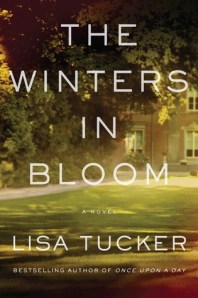 Suspense is just about the oldest trick in fiction. Get the reader on the edge of the seat, demanding to know if the dark figure on the staircase was the villain, if the rescuers will arrive on time, if the assassin will squeeze off his shot—then postpone the revelation till late in the story. Even in literary novels, which presumably have loftier aims than tickling the reader’s thrillbone, prickly suspense is not uncommon. Recently, though, I’ve read a novel that creates suspense at the outset and then downplays it—to the reader’s benefit, I think.
Lisa Tucker’s latest, The Winters in Bloom, begins with the kidnapping of five-year-old Michael, only child of Kyra and David Winter, and both parents quickly and separately assume that their past has come back to haunt them. The suspense is immediate and intense, and we don’t learn the boy’s fate or recognize the kidnapper till the end of the book. You couldn’t ask for a more suspenseful setup.
Nevertheless, early chapters from the boy’s point of view let us know that he’s not in immediate danger, and the author gives us information like this:
“his [the boy’s] assumption that his parents knew this lady would … turn out to be true.… Even his feeling that the lady loved him was true, though her love was a desperate, entirely unexpected response that he couldn’t possibly have made sense of.”
A desperate love—not reassuring, but not likely to lead to murder or abuse, it seems.
The following chapters examine the background of each person in depth, weaving interlocking stories in which the fascination lies not in the plot but in the character development. Though the mystery of the kidnapper’s identity remains strong, the author doesn’t amp up our worry about the boy. The tone is calm, the pace unhurried; it doesn’t feel like the book will end in disaster.
This muting of suspense allows us to pay attention to the characters and to ask, not just who would snatch the boy, but why—what exactly in the past has come back to haunt this family, and how does it make psychological sense? The technique shows a mature author, someone who knows she can hold our interest without sensationalism.
The Winters in Bloom turns out to be a fine novel, both clever and profound, full of subtle characterizations that make sometimes bizarre behavior entirely convincing. I even found myself believing in David, the husband/father of “steady reasonableness” and “cheerful good nature” whose “enormous amount of compassion” leads him time and again to assume the fault is his own. I won’t say whether he proves correct, but on behalf of all husbands I should point out that we aren’t always to blame.
Visiting a Playgroup
September 22, 2011
 Recently I’ve been learning about motherhood. Being a father of two and grandfather of five and a half,* I never expected to study mothering except for the few tricks a man needs to know for self-preservation. But reading Elizabeth Mosier’s The Playgroup (part of GemmaMedia’s Open Door series) was entertaining as well as enlightening.
The novella (110 pages) focuses on a group of women who have set up a Playgroup ostensibly for their infants, but really to give the mothers a chance to schmooze. And their talk, as Mosier details it, is alternately funny, unsettling, profound, trivial, and full of annoying advice about child-proofing the house. What comes through most strongly is an undercurrent of fear—that a mother will fail at her awesome responsibilities or that this carefully arranged but fragile life will take a gruesome turn. The protagonist, Sarah, pregnant with her second child, has a special dread caused by an abnormality in her sonogram, a small spot “shaped like a cashew.” But uncertainty governs even the most outwardly self-confident of the women:
“Motherhood is like a second adolescence, a time when the self a woman thinks she owns is repossessed by the so-called authorities [all the experts, including family members, who tell her how to be a mother]. She’s left naked and defenseless, asking herself questions about purpose, faith and identity she thought she’d already tamed. … At times, we seemed less like mothers than like insecure teenagers at a beer keg tapping liquid courage, though at Playgroup we swilled coffee while we sought each other’s advice.” (pp. 11–13)
“Loss always lurked beneath our conversations in Playgroup, under talk of microdermabrasion, premenopausal symptoms, IRAs and long-term health insurance.” (p. 72)
The book has one symbolically “perfect” mother, Amy Marley (name reminiscent of Jacob Marley, one of the ghosts in Dickens’s A Christmas Carol), who comes back to haunt the others in an unexpected way, and the arc of her life becomes instructive to all.
During a recent reading at Philadelphia’s Musehouse, the author explained that details of the new mothers’ thoughts and emotional swerves are based on notes she took at that stage of her life. She was brutally honest with herself back then, and her readers get the benefit now.
To give us multiple views of the Playgroup in a short space, Mosier employs a clever narrative device. The first-person narrator, Laurie, begins as a relatively undifferentiated member of the group, and as such she gives us the community outlook on the main character, Sarah:
“Sarah led us into the living room, an arrangement of white chairs and a couch on a white pile rug. … Another group, gathered for a different purpose, might have praised the room’s stark furnishings, but we were there to compare and to judge. Sarah waited nervously for our review.”
Soon, however, Laurie becomes a confidante of Sarah’s, able to reveal Sarah’s thoughts and feelings. Though I was a little less than 100% convinced by this dual narrative function, it should work for 99.9% of readers.
The men in these women’s lives are mostly ignored and irrelevant in the story; they pour margaritas and hammer away at construction projects. Yet the only time I wanted to escape the estrogen-laden environment was when the women started scrapbooking—an activity that, to my relief, the narrator treated with irony.
The book is a quick and fascinating read, and I recommend it to all men who are partnered with a mother, who work with mothers, who stumble upon unfathomable claques of mothers and infants at coffee shops, or who wish to understand why mothers behave in an irrational manner so totally unlike our time-honored male form of irrationality.
*Three dogs, one long-term cat, one short-term cat recently expelled from the immediate family (that’s the half), and one snake. At last count.
Busara Road
September 19, 2011
 My friend David Sanders, whom I mentioned in my last post—an excellent writer and all-around good guy—has started a campaign on IndieGoGo.com to support the research for his novel-in-progress, Busara Road. The novel is set in Kenya during the early years after independence—a time when David himself was there, as a child. Now he’s won a prize to help him return to Kenya for a few weeks to work on the novel, meet with leading African writers, and visit the Quaker mission he remembers from childhood.
The great thing about IndieGoGo is that lots of people contribute small amounts to make the project happen. The smallest suggested donation is $10, and you can go even lower than that by clicking on “Other” in the drop-down contribution field. David has listed a variety of creative “perks” for donors, but the main reward is knowing that you gave a little bit to a good artistic cause. So please consider giving the cost of a cappuccino, at least. You’ll be amazed and proud when this novel is published.
Unreliable Narrators
September 16, 2011
On his new blog, David Sanders quotes from J. T. Bushnell’s recent article in Poets & Writers on unreliable narrators. According to Bushnell, even a third-person narrator can be unreliable if the point of view is limited, and he offers this advice:
“you have to know not only who your characters are, but also who they pretend to be, not only what they care about but also what they say they care about, not only what ideas they live by but also how those ideas are false. You have to figure out why your characters are blind, and how they’ve managed to maintain their blindness. And you have to signal these disparities to the reader without revealing them to the character, or straining credibility by making the characters too blind. This creates other dynamics that are necessary in good storytelling, for example, character limitation and unrecognized truth, and moving between the former and the latter helps shape a story’s meaning, or theme.”
I prefer to call a non-personified, third-person narrator a “narrative voice,” and when that voice limits itself to the perspective of a given character, much of what the reader hears can be untrustworthy. However, it’s the character, not the narrative voice, that is unreliable. That’s a trivial distinction, probably—and Bushnell’s summary of what the writer needs to know about each character is certainly a good one.
In a similar vein, Robin Black recently mentioned that the art of writing conversation includes knowing what the people are deliberately not saying. We might add that it also helps to know what the interlocutors are refraining from doing, such as yawning, giving the other person a dope-slap, scratching a devastating itch, and so forth. It’s all in the subtext.
Whipped Cream vs. Hamburgers
September 11, 2011
 It’s ten years after 9/11, and are we still postmodern? You’d think a whack of hard reality would have propelled us into a new literary trend, but Paul Auster’s latest, Invisible, which I read because it was lying around my house, remains as metafictional, elusive, shape-shifting, and frustrating as the best/worst of the genre.
I’m not going to summarize or review the novel, since those tasks have been accomplished so fully elsewhere. You can match a rave from the New York Times
http://www.nytimes.com/2009/11/15/books/review/Martin-t.html
with a pummeling, snarky putdown from The New Yorker
http://www.newyorker.com/arts/critics/books/2009/11/30/091130crbo_books_wood
and end up with the same bemused feeling that I had after finishing the book.
Entertaining as some of Auster’s devices may be, the postmodern conviction that reality is ultimately unknowable doesn’t, in my view, excuse plot turns that are arbitrary and unconvincing or characters who intrigue us into taking an interest but then fizzle out without much development.
This is literary whipped cream. In post-9/11 America, I’d rather have a hamburger.
Rereading Stegner
August 12, 2011
 There’s a nice (repeat) post by Nichole Bernier at Beyond the Margins, about Wallace Stegner and his wife, Mary. She mentions that Stegner is “best known for his environmental writing, which has influenced generations of conservationists, and for his novel Angle of Repose (which won the Pulitzer in 1972), as well as his creative writing program at Stanford University.” If so, it’s a shame that his other novels aren’t more widely read today. Nichole says she is currently rereading All the Little Live Things, one of my favorites, in which he makes the California foothills teem with life—human, animal, vegetable, spiritual.
Sons and Heirs: Lorene Cary’s Latest
August 7, 2011
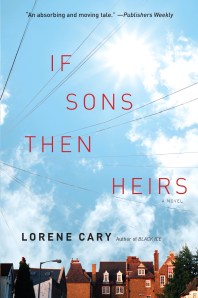 Recently I finished Lorene Cary’s latest novel, If Sons, Then Heirs, another fine and highly readable book from one of Philadelphia’s most respected authors. Lorene is well known locally for her community work with the Art Sanctuary, but as a reader I’m happy to see she’s not neglecting her own writing.
Featuring several generations of a single family, If Sons, Then Heirs combines a fairly simple present-day story with an intricate and complex revelation of the family’s past. The genealogical tree that appears early in the book should help readers keep track of the many characters who roam the pages. Unfortunately, I read the Nook e-book version, on which the chart is illegible, and so I was constantly struggling to remember, for instance, how Binkie is related to Lil Tootchie. (Great names throughout!)
Roughly, the present-day plot goes like this: Rayne, an African American man who runs a construction business in Philadelphia, stands to inherit the old farm on which his great-grandmother, Selma, is living in South Carolina. Yet because of racist property laws and contracts, the ownership of the land is in question. As Rayne begins to tackle this issue, he is contacted by his mother, Jewell, who abandoned him to Selma’s care decades ago. Rayne also faces a decisive point in his relationship with his girlfriend, whose son has just begun to call him “Dad.” That’s four generations right there—or five, if you count the one skipped between Jewell and Selma—and the author will add cousins, aunts, uncles, stepfathers, and more to the troop.
At first, Rayne isn’t particularly interested in digging up his family’s history, but inevitably, in confronting the land issues, he must uncover a good deal more than he ever wanted to know. Having tried my own hand at stories that dredge up the past, I was intrigued with the tone of this book, which strikes me as an interesting mix.
From the start, we know from all the elements that form a tone—the style, the positive resolution of small incidents, the degree of humor and warmth, the preponderance of good people, etc.—that nothing really terrible will happen to the main characters in the present-day story. I refuse to label that comment with a “spoiler alert” because the comfortable tone is evident from the first chapter. Yes, Selma is extremely old and doddering, and Jewell’s husband is sick with cancer. Perhaps one or both of these fine folks will die in the course of the novel—I won’t reveal that; see, I’m being good!—but, even so, that will not make a tragedy. We know that Rayne and Jewell will survive and most likely continue the relationship they have newly established.
The past is another matter. When Rayne descends into the dark cellar of this family’s history, he unearths not skeletons so much as bloody remains—the still-dripping evidence of racial violence. No humor and warmth there, just ugliness and calamity, and the author presents them in gory detail:
He raises the tire iron in his hand and the others stand clear of him, because he is swinging wild, hitting the hood, the car door, hitting [the victim’s] legs, shattering the windows, and grabbing through the window at the great, flailing, dangerous, bloodied body.… [He] cuts up his own arm. It bleeds onto the car door and down his side. He lets out war yells like an Indian.
What’s the effect of such a tragic, violent tale wrapped inside a warm and slightly sentimental one? Though I was interested in the gradual revelations of the past, I can’t say I felt suspense, because the outcome—the contemporary lives of the main characters—is already known. In fact, though the villains of the past have present-day descendants, with whom Rayne has to deal to resolve the land issue, Cary treats that story line summarily. Ultimately the past becomes a vivid, personalized history lesson more than a tension-filled story.
The lack of suspense hardly matters, however. Throughout, the characters are the strength of this work. They are big, passionate people struggling to do the right thing. Bringing the scattered relatives back together and understanding what happened to drive them apart—these are the keys to the family’s redemption, and that theme is what Cary wants us to take away from the novel. I’m taking it, and I won’t soon forget Rayne and Jewell and Selma. Another good read from Lorene Cary.
 The News from Gridleyville