
How Rumpy Surprised Me
September 20, 2025
Liberal types like Yours Truly thought we knew how bad the Big Rump would be when he reclaimed his throne and won control of Congress as well. We knew about Project 2025, and we saw in the latter stages of his first residency that he’d figured out the value of filling key offices with little rumpies (lackeys) who’d do anything he told them. We knew he’d cripple the economy with tariffs, undermine Ukraine, and give Bibi the Nutty Yahoo free rein to kill Palestinians. We guessed that, along the way, he’d enrich himself, his family, his cronies. So we went around muttering darkly about the end of democracy at home and looming disasters abroad; we stared at the sky to find signs it might fall.
But I for one should admit that, so far, it’s been worse than expected. He’s surprised me in a number of ways.
First, his whimsicality and general incompetence haven’t hindered him as much as I presumed, partly because the little rumpies he’s appointed have been so zealous in their destruction of norms and institutions. They too are often incompetent, but their angry persistence helps break through commonsense resistance. I certainly didn’t anticipate that he’d empower a MuskRat to gut scores of government agencies.
Second, he has weaponized Big Gov more than I realized possible. I mean, all those agencies, some of which I’d never heard of, cracking down on everybody? Pulling funding, for one thing, and using threats to pressure even megacorps and major universities? Who knew he could get a comedian fired from a huge broadcast network simply by demanding it?
Third, I didn’t anticipate the abundance of CorCows and UniCows—corporations and universities proving themselves abject cowards when faced with the possibility that he’d block their oligarchic mergers or attack their funding. I would have expected an ounce of self-respect from the leaders, boards, and trustees of these institutions. I was so naïve!
Fourth, his ability simply to break the law without consequences—and often ignore court rulings—has gone beyond my predictions. It’s not just raping the occasional female or scamming the public or committing bribery. It’s deporting immigrants despite a court’s telling him not to, blowing up boats in international waters, sending troops to bully cities with fake claims of an emergency. Granted, he seems to have pulled back lately on outright defiance of court orders, but maybe that’s from confidence that his Supreme cronies will ultimately rule in his favor.
Fifth, I didn’t guess how blatantly out in the open all this would be. Yes, his agencies have banged the shutters against transparency. But in the broadest sense, we’ve seen self-dealing with no sugarcoating, even his own cryptocurrency with no crypt about it. As for the use of power, it’s been an iron fist in an iron glove.
I take a smidgen of comfort in polls that show his popularity is tanking. But will it matter what the public thinks? If it’s still possible to vote freely and meaningfully in 2028—a dubious proposition—will we already be dead from the next pandemic that the decimated CDC didn’t warn us about?
Wait, look up—is that the sky falling?
To Stab or Not to Stab
August 7, 2025

“It became necessary to destroy the town to save it,” said an unnamed U.S. major, as reported by journalist Peter Arnett in 1968, describing the obliteration of more than 5,000 homes in one town, Bến Tre, during the Vietnam War. Widely publicized, though often misquoted, this justification for savagery was soon condemned. But does the same idea, wreck-it-to-save-it, now apply to democracy in America?
With Republicans determined to reshape congressional districts in multiple red states to guarantee their continued dominance of the U.S. House, Democrats are threatening to do the same in reverse in states they control. Is the Democrats’ response justified?
Redistricting—drawing a bunch of district maps to divvy up a state—is a complicated process. Since there are many measures for judging the fairness of a map, there’s usually enough of a fudge factor to allow a pretense of equity even when the results are biased. Not this time. This is pure partisan gerrymandering, all its naked parts hanging out in public view, with not even a scrap of gauzy film for modesty.
Of course, the Republican effort to subvert democracy serves the purposes of the would-be autocrat in the White House, known on this blog as Resident Ronald Rump, a.k.a. the Big Rump or Rumpy. Since he’s already responsible for many thousands of deaths (by decimating U.S AID, cutting Medicaid, supporting genocide in Gaza, etc. etc.), a gerrymandered stab at democracy’s liver seems abstract in comparison. But if he undermines the process, there will be fewer restrictions on him in the future. That’s why this may be a crucial turning point.
So let’s face the question: Is it necessary for Democrats to undercut the democratic process in order to save it? We’re “at war,” says New York’s Democratic governor, Kathy Hochul. And most folks, however pacific their nature, believe that war is sometimes necessary. Or revolution, if the oppression is bad enough. Wars and revolutions kill and injure innocent people, but they are often justified as a way to prevent greater damage.
We firebombed Dresden to stop Hitler (see the photo). We nuked Hiroshima to stop Japan. We set moral doubts aside to be examined later.
This is where we find ourselves as we debate whether to smash democratic norms in order to save them.
Democrats on the “war” footing insist that we can merely suspend democracy, temporarily and in certain places, to keep Republicans from ravaging it permanently. Is that sensible?
To me, the decision depends in part on how dire the danger is.
If, say, it becomes evident that Rumpy and his minions will cancel the presidential election in 2028, then we can’t stand on principle, we have to fight with whatever weapons we can muster. Revolution, if it comes to that.
But suppose we believe that Rumpy’s depredations are reversible. Whatever harm he does, we may think the next president can fix it. Is that a legitimate thought when children are literally dying because of his actions? Dead kids, unfortunately, can’t be resurrected.
But wait, let’s not get distracted by those piles of dead bodies. The issue here is whether Democrats should break their democratic principles to prevent worse injury to our nation. So we have to phrase the question this way: If both parties jointly knife our system in the ribs, will the wounds eventually heal? Is there such a thing as a “temporary” suspension of democracy? How long will that last? What else may be lost along the way?
I confess I’m flummoxed. This issue is too difficult for me to grasp, even aided by a tall glass of whiskey.
Three Truths for the Fourth
July 4, 2025

My typical practice for holidays is to ignore them. As a dedicated melancholic, I’m not big on celebrations of any sort.
Nevertheless, this Independence Day seems worth marking. It’s the day Trump signs his Big Beautiful Bill to benefit the obscenely wealthy while sentencing millions of low-income Americans to death from lack of medical care. Though the bill is unpopular with the public, the political consequences are uncertain. Thus it’s worth asking why politicians who enact unpopular, even disastrous policies gain power in what is supposed to be a democracy.
I won’t rehash the standard answers to that question: big campaign donors, PACs, gerrymandering, etc. etc. But after the 2024 presidential election, it seemed to me that three fundamental lessons were evident. These lessons are pretty much common knowledge, but they tend to be overlooked by party leaders and pundits who focus on strategic and tactical issues.
Since last November we have been buried in endless, detailed analysis of what Biden did wrong, what mistakes Harris made, and how Trump and his minions played on fears of made-up bogeymen like immigrants and socialists. I’m looking instead at long-term qualities of American society, and American voters, that change very little from one election to the next.
1. Americans are still racist and sexist.
True, in presidential voting, we overcame racism twice with Obama, who was an extraordinary politician with relatively weak opposition; and we beat sexism once when Hillary Clinton took the popular vote in 2016. But conquering both prejudices was simply too much for Kamala Harris, as evidenced by the anecdotes about Black men who thought she was incapable of standing up to Putin. (It probably didn’t help that she’s slim and pretty; if she’d been built like Angela Merkel, she might have been judged more formidable.)
The effects of prejudice on a voter can be quite subtle: a slight, unarticulated reluctance to trust a candidate, or an increased willingness to entertain doubts or slanders. In a campaign full of outrageous lies, this can be enough to change a vote or convince a person to skip voting entirely.
I’m not a pollster, but broadly speaking, I’d say the numbers for Democrats look like this: Nationally, about 45% of votes are automatically lost because of the party label. A Black candidate loses another 3%, a woman 2%. It’s only the undemocratic Electoral College that matters, of course; yet it’s clear that any Democrat other than a white male faces long odds.
Make that a white straight male. We haven’t tested the prejudice against LGBTQ+ folks in a presidential election, but I suspect the numbers are about the same.
Would there be a similar bias against a Jewish candidate? My Jewish wife thinks so. As for a Muslim or Buddhist … let’s not even go there.
This is such a terrible state of affairs that I hope my reasoning is wrong. But we need to face the strong possibility that it’s right.
2. Voters are selfish.
Besides being a truism, this is often considered a positive feature of democracy. I vote for what’s good for me, you vote for what’s good for you, and the overall outcome is what’s best for the majority. But we often fail to realize the supreme dominance of selfishness and the narrow way it functions.
Democrats like myself supported Harris for noble reasons that simply didn’t play with the larger public. For instance, we were taken with grand ideas like these:
a. Preserving democracy against an existential threat. This argument was much too abstract for many voters, even those not attracted by strong-man vibes.
b. Maintaining support for Ukraine. Ukraine is too far away. Europe is too far away. Most American voters may support Ukraine in principle, but at least half don’t fundamentally care.
c. Restraining the genocide in Gaza. Though Biden certainly gave Israel a lot of leeway to kill Palestinian civilians, it was clear that Trump would be even less likely to restrain Israeli hardliners. Yet many voters paid little attention to this issue. Dead Palestinians, so what?
Then what did voters care about? “The price of eggs” became the pop shorthand answer.
Think about how deeply, deeply selfish this is. That’s how people tend to vote.
3. American voters are ignorant.
Many Trump voters were not just ill-informed about the issues and the candidates. They were abysmally ignorant. Things they didn’t know included:
- The foreseeable effect of Trump’s tariffs on inflation, raising “the price of eggs.” Economists kept pointing this out, but Trump voters didn’t hear it or didn’t grasp it.
- The predictable effects of implementing Project 2025, decimating the federal programs that benefit most Americans and undermining the economy for many years to come.
- The likely savagery and economic upheaval of Trump’s plan to deport undocumented immigrants.
Zohran Mamdani, running for mayor of New York, tells of speaking to voters who said they supported Trump because, four years earlier, they had less trouble making ends meet. These people aren’t, by and large, stupid, but they reason in an utterly stupid way; they take hold of one salient idea and block out any qualifiers.
Some of the problem can be attributed to the fragmentation of news sources. I’m old enough to remember the angst of intellectuals when Americans began to gather most of their news from short-form TV programs rather than newspapers and magazines. Yet, from our current perspective, the 1960s and 1970s were far more enlightened. The news shows from the three major networks hewed to a fairly centrist line, and when Walter Cronkite concluded his broadcast by saying, “And that’s the way it is,” he was telling the truth: indeed, that was how it was, more or less, and at the peak of network news, more than 50 million Americans heard it from him or his fellow broadcasters. Now, for large portions of the populace, Walter has been replaced by biased, conspiracy-peddling media pundits.
Many Americans, of course, are willfully ignorant, refusing to attend to any media that don’t confirm their ingrained beliefs. I have to admit that I do not, and will not, watch Fox News, so I remain oblivious to any scrap of truth purveyed by that outlet.
Another reason for mass ignorance may be the decline of civics education in schools. That’s something we might tackle, but oops, the folks in power don’t believe in education, do they?
Whatever the origin, ignorant citizens are a condition we must contend with for years, probably decades, to come. Our leaders will be elected in large part by people who don’t know shit. If you think that sounds elitist, I counter by saying that, yes, it’s elitist and also true.
So these three points, I believe, are fundamental lessons for the Democratic party and any other group that would like to preserve what’s left of our democracy. You have to deal with racism and sexism, appeal to narrow selfish concerns, and overcome colossal ignorance. Among our goodhearted compatriots, who’s ready to tackle such a task?
The Fear Election
July 27, 2020

Reading dozens, maybe hundreds, of articles and surveys and projections about the 2020 presidential election, I’ve been battered by waves of hope, apprehension, suspicion, confusion. It feels like trying to surf in a hurricane.
For better or worse (mostly the latter), I have a simplifying type of mind, the kind that searches for a small number of principles to explain a giant mess. This inclination points me to one basic force behind this year’s politics.
Fear.
The 2020 election will turn, I believe, on what the voters, or those in swing states, are most afraid of.
For some, it’s an amorphous but overriding panic that those people—those who differ from traditional Americans—are taking over the country: i.e., non-whites, non-Christians, non-straights, non-English-speakers, non-male-supremacists, non-rugged-individualists. To liberals, that fear seems so absurd as to be unfathomable, and yet it keeps growing like a poisonous mushroom.
As for the liberals, they (or we, for I’m clearly one) believe the country is on the verge of a fascist dictatorship, even though the president and his cronies have proved massively incompetent at pursuing their agenda. We fear they will intensify the destruction of the rights, and the very lives, of people of color, immigrants, gays, and all other historically marginalized groups (and maybe some new ones they invent). Conversely, we fear their incompetence and stupidity will help the coronavirus kill us all. We can’t decide which is scarier, their actions or their inaction.
1968 was a fear election, at least for Nixon voters, but this year seems even more intense. As anxieties on both sides build, there’s talk—and more fear—of a violent takeover by the other guys, a revolution by the left or a coup from the right. The result is a much fiercer test of our institutions than Nixon ever managed.
George Will just published a column contending that 1942 was just as disruptive as 2020. Perhaps luckily for FDR, that wasn’t a presidential election year. America was hardly unified then, Will points out, even with Hitler and Tojo as looming external threats. “In 1942’s off-year elections, the president’s party took a drubbing.”
Still, this year seems worse in at least one respect: Americans can scarcely agree on a single common enemy. My hero is your enemy—and don’t you dare tear down my statue!
So I wonder, is our democracy, which some say no longer deserves the name, resilient enough to survive, or is it already stretched to the snapping point? I admit to being a sucker for traditional American optimism, but this year, I just don’t know …
Editorial: Twitterman’s Progress
December 28, 2019
 According to a news headline today, President Twitterman is breaking from “GOP orthodoxy,” adding a few progressive ideas to his agenda to bolster his chances for reelection. The Gridleyville Editorial Board would like to congratulate him for this evolution in his thought, and specifically for the following new policies he now advocates:
- Ignoring, like other Republican presidents before him, the GOP mantra of a balanced budget, so that the nation’s deficit will soon set a record at over $1 trillion
- Compromising with Congress on money to Build the Wall, instead of stealing it from military funds
- Increasing air holes in children’s cages along the border, for greater comfort and less suffocation
- Compensating property owners whose drinking water has been contaminated by fracking: at least 1 case of Pepsi per family of 4
- Leniency for those who have witnessed war crimes by the U.S. military: they will not be executed for testifying
If the president continues at this rate, he will soon qualify as an ordinary, corrupt, lobbyist-bought politician, the sort with which we have grown quite comfortable. This is progress indeed.
The True Samaritans
December 22, 2019
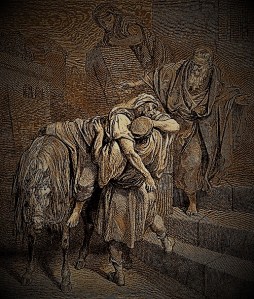 During the holiday season, from Thanksgiving through New Year’s, Americans give a lot of lip service to the values of charity, compassion and care for the less fortunate. A few shining exemplars of these virtues are held up by the media, with cheery pictures and sentimental language. Typically, though, we fail to recognize the most charitable of all, the true Samaritans among us.
Whom do I mean? Which people are the greatest self-sacrificers?
Actually, they are the people you’d least suspect: the white working- and middle-class straight Americans who support conservative politicians and a right-wing agenda. For short, since their current Great Leader in the White House is President Twitterman, I’ll call them the Lesser Twitters, or LTs.
What’s compassionate about their agenda? you may ask. How can people who favor holding immigrant children in cages be considered Samaritans?
Let’s look at what LTs are giving up and on whose behalf.
Obviously, by supporting policies aimed at benefiting the rich, LTs sacrifice their own prosperity, since the idea that wealth trickles down from top to middle to bottom has been proven a hoax. Nor is it possible that obsolescent, polluting industries like coal mining can ever make a comeback. The “jobs” that right-wing politicians claim to preserve or resurrect will never again be a major force in America. If such activities persist at all in the future, they’ll be done by robots.
On the surface many LTs refuse to accept these truths, but in their hearts they understand, and they realize they are making a sacrifice. They don’t believe, of course, that they are giving up their well-being for the sake of obscenely wealthy corporate leaders, hedge fund managers, and lobbyists. No, in their view they are acting to preserve important social values, such as the right to life and the sanctity of marriage, the issues that Republican politicians have played up for at least two generations, since Richard Nixon and Spiro Agnew (both later disgraced and chased from office) began appealing to the “silent majority” in 1969.
What’s interesting is that these so-called family values do not generally affect LTs themselves. If you’re against gay marriage, for example, you won’t marry another person of the same sex, and probably your family members won’t either. Similarly, if you’re against abortion, you don’t have to have one, nor does your partner. These are issues that pertain to other people. By opposing liberal laxity on these matters, LTs are trying to save the rest of us from sin.
Arguably, this is true for even the hottest of hot-button issues, immigration and refugees. Most LTs have scant personal experience with immigrants. Maybe, speeding past in their SUVs, they’ll glimpse a Latino mowing a lawn, or on occasion, through a swinging kitchen door, they’ll catch sight of a swarthy person washing dishes in a restaurant. Hardly a threat in either case. Again, this is a matter that applies to other people, and in screaming their support for cruelty at the border, LTs are acting to save the rest of us who might actually need those jobs mowing lawns or washing dishes, at least until the robots move in.
Let’s take a moment, then, to recognize the LTs as the true Samaritans among us. Yes, they may be rewarded at Armageddon—and at that point they’ll certainly get to shout “I told you so”—but we should offer some appreciation in this life as well.
Let’s each light a holiday candle for the LTs. If you don’t celebrate a holiday involving candles, you can make a cross of two sticks, set it on fire and plant it on a suspicious person’s lawn. It’s the least we can do.
Feelin’ Crabby
July 23, 2017
 Partly because my family was on vacation but more because I’m oblivious, I didn’t notice when a new story of mine was published in early July: “Crabs,” in Wilderness House Literary Review. If you’re feeling crabby in the summer heat, you may want to check it out. Thanks to the editors of WHLR!
Our vacation was to the island I call Mosquitoland USA, and the central image in this story comes from an event during our stay in the same place last year. Usually truth doesn’t make for good fiction (imagine a novel about Donald Trump—would you have the slightest inclination to read it?), but in this case the real incident, which lives up to the adage about truth being stranger than, may amount to a decent metaphor. Or it may make you queasy about seafood. Feel free to let me know.
In the meantime, watch out for the Trumpsquito, whose bite will make you itch uncontrollably for four years.
Evil Erupts in Rabbitville
May 29, 2017

Baby rabbits in nest. (Photo by Karen Foreman; from the National Wildlife Federation.)
A late Saturday afternoon in the suburbs at our daughter and son-in-law’s house, in the backyard with two granddaughters and three dogs, tossing a half-deflated volleyball around (the six-year-old thrashing it wildly), birds chirping, sun beaming, tree branches waggling in the breeze … An American idyll, especially with cold beer on hand. Our dog Fergus, the beagle mix who presides over this blog, plays his favorite game of pretending to dig a hole in the lawn so that we have to chase him away from it, which leads him to dash to another spot and pretend to dig there …
Then a ferocious barking as a neighbor couple and their terrier walk by on the sidewalk. The three dogs in the yard rush through the perimeter of trees and bushes to guard the chain-link fence. The girls run over to talk to the neighbors. Eventually the animals inside realize the one outside is harmless, and Fergus exchanges a snuff through the fence with his terrier counterpart.
But as Fergus strolls away, he steps over a shallow nest hidden in the spotty ground cover around the trees. Nose alerted, he digs in, and suddenly baby rabbits are scrambling in three directions. The girls run after one rabbit. Fergus keeps his nose in the nest, jaw working, until I pull him away.
Last year, when he found a nest in the front yard and emerged with a baby in his mouth, the girls and parents tried to nurse it back to health, unsuccessfully. After a day they buried it with appropriate ceremony. Ever since, Fergus has been watched carefully when he visits Rabbitville.
Yet, once more, he was too quick for us. With the advice of—what else?—Google, we knew this time to leave the babies alone and let the mother find them. In a couple of minutes she duly appeared, hopping with caution across the yard while Fergus hyperventilated in my grip. In the end it appeared that all the bunnies were alive, though one was injured.
The nine-year-old called Ferg’s behavior “evil.” We had to explain that he can’t be blamed because it’s his instinct to catch rabbits, his basic nature. Eventually the girls did accept this.
Yet any quick excuse of that sort makes me question why we reproach humans but not animals. Consider Donald Trump: Isn’t it his nature to get up early in the morning and bark ferociously, via Twitter, in defense of his territory? Isn’t it basic instinct that leads him to keep suspicious foreigners out of his yard? What about amassing great wealth while denying health care to millions—isn’t that like Fergus refusing to share his extra treats after dinner?
True, humans are supposed to have reason and some degree of free will, making them accountable for their behavior. But the more we learn about animals, the more credit they get for having thought, some form of language and a surprising amount of psychological insight. Even plants exchange chemical signals, science tells us. So can we still insist that humans are ethically different?
Whenever I read moral philosophy, its principles seem nice enough but founded on air. Only determinism makes sense to me. While hoping there’s more to our behavior than electrochemical impulses—and contending we should always behave as if there is—I lack faith in a larger paradigm.
Still, still … I do hold Trump more responsible than Fergus. Logic be damned—the guy’s an ass.
Or, at least, if he’s as driven by instinct as a dog, I’d like to believe in the same ultimate recourse. When a pet proves dangerous and incorrigible, we take him to the vet—for a needle.
Don’t worry, Ferg, no such fate for you.
Poland Welcomes the NFL Draft
April 27, 2017
 Here in Poland, formerly known as the Art Museum neighborhood of Philadelphia, we are proud to welcome the NFL Draft Experience Extravapalooza. One in a long series of events that bring us hundreds of thousands of visitors and, in this case, the largest temporary stage ever seen in the city and perhaps the galaxy, this celebration promises days of enjoyment for all.
Already, in the run-up to the event, we’ve savored the following benefits:
- Hundreds of convenient porta-potties installed around the neighborhood
- Closure of major traffic arteries, offering the opportunity to sit meditatively behind the wheel and view the sights of our city through clouds of exhaust
- Attractive military-style trailers and vehicles lining the streets
- Outside security staff warning locals not to walk their dogs in the area
- The sweet thrash and blare of helicopters cruising overhead
- As shown in the picture, the locking of mailboxes, to defend us both from terrorists who hate football and from drunken fans who can’t distinguish a mailbox from a trash can
Some grumps—and I admit to knowing a few—have begun complaining about the frequency with which our neighborhood is rented out to private organizations that want to capitalize on the iconic Parkway and Rocky Steps. But we’re getting an estimated $80 million for this deal!—money that the city, still in many ways the most impoverished in the nation, desperately needs. With this influx of funds, we’ll be able to raise the salaries of our corporate leaders who live in the suburbs, bolster the political clout and intimidation power of union heads like our famous Johnny Doc, and ensure that agencies like our Parking Authority and Housing Authority—national models of featherbedding and corruption—continue their good work.
That is why the residents of our neighborhood have formally agreed to rename the area Poland, in honor of the frequent invasions from outside our borders. The entire city, in fact, has temporarily relabeled itself, as shown by this newspaper headline:

Most amazingly, the fuddy-duddies at the Art Museum, those conservative upper-crusters who have long sneered at the Rocky statue as a mere movie prop and lamented the sacrifice of the Museum steps for TV ratings, are now finally getting with the program. At a recent meeting, the Board of Trustees voted to allow the sale of naming rights for iconic objects in the Museum collections. The first such treasure, formerly known as Fountain by Marcel Duchamp, has now been unveiled in the main lobby with its new corporate moniker:

Trump Hotels® Luxury Visitor Accommodation
Shocked!
February 19, 2017
 Change Seven magazine has posted a guest blog entry of mine about surviving a (Trumpian) shock to the system. Here’s the link.
The general theme, in keeping with the magazine’s name, was “change,” and I started to ponder how our former ideas about change seem both still-relevant and terribly quaint. The old term “future shock” popped into my mind—which was kind of like reading a letter you wrote as a teenager and realizing that, back then, you understood far more than you do now.
 The News from Gridleyville