
Vote and They Will Come: A Rant by No. 19
August 14, 2015
 We had an election this week in Philadelphia. A special election to fill three vacancies in the state House, two of which arose because the incumbents quit after pleading guilty to corruption.
This event produced a grand Y-A-W-N in the city. The media ignored it, and the outcome was predetermined. (Local Democrats, with a huge registration advantage, automatically win any vote with such little publicity.) Besides, most of us don’t even know our representatives in the state House, and as far as we can tell, their only function is to send us a boastful newsletter just before the next election. As for corrupt officials, they’re as common here as in Iraq, and perhaps cheaper, and we don’t expect new ones to be any less venal.
Nevertheless, stifling my Y-A-W-N, I wandered over to my polling place about 11:30 in the morning. It was deserted. They told me I was the 19th person to come in since the polls opened. Explained one attendant who was eating a pastry, “We don’t even call this light turnout. It’s dim turnout.”
For the 30 seconds I spent in the booth, I received the sticker shown above—a more than adequate reward. I chose the Spanish version because I’m trying to learn the language. Combining this with the sign I encounter frequently, “NO TIRE BASURA,” I’m up to six words total. It’s a start.
But I was upset about being number 19. That’s worse than dim turnout, it’s like Milton’s description of Hell: “No light, but rather darkness visible.”
For an election pitting Luigi’s Pizza against Pete’s Famous Pizza, my neighborhood would have several hundred voters by late morning. Everybody knows Luigi’s would win—it’s predetermined by the crust—but people would show up at the polls anyway.
So I went into my typical funk about the trashing of American democracy. In my view, we can survive Donald Trump and Fox News (which treated the recent Republican debate like a game show), but what we can’t survive is indifference.
Okay, you’re heard that before. Everybody complains about the apathy of the American public. And the counterargument seems like a good one: If the choices are Tweedledum and Tweedledee—or, say, Trumpledump and Christiedweeb—indifference is a rational response, isn’t it?
I disagree, and here’s my reasoning.
Imagine your typical city neighborhood, which averages 60% turnout during presidential elections, 40% in midterms, 20–27% in mayoral elections, and way, way less in off-off-season polls like the one we just had here. On average, then, a lot more than half of the people don’t vote. Now suppose that, in the next election, the neighborhood’s turnout jumps a modest 15% for no obvious reason (no candidate from the dominant ethnic group, no hot-button issue on the ballot). What will happen?
The local politicians will suddenly get very interested in that neighborhood. They’ll start to ask what’s going on there. They’ll stop by and talk to people. They’ll want to know what issues the community cares about.
This imaginary scenario leads to my slogan, with apologies to Field of Dreamers:
VOTE AND THEY WILL COME!
It doesn’t matter if, at the moment, you can’t tell a Fiorina from a Cannoli. Vote in reasonable numbers and they will be forced to address your issues. Vote especially when the slick pols and the talking heads don’t expect you to.
After all, we citizens have just two things politicians care about: (a) votes and (b) money. For those of us with little cash to spare, votes are the only weapon, and if we don’t use that weapon to defend ourselves, we’re choosing to bend over and take it up the … wherever (to use a famous Trumpism).
Sure, I understand all the points about the influence of big money, the rise of the oligarchy or plutocracy or whatever you want to call it. I also sympathize with the rage that leads people into the streets to scream and throw rocks at the cops. But when we throw rocks, we’re not hitting the moneymen and asshole politicians who run the system. As soon as we go home, those bigwigs will go back to ignoring us unless they think they’re losing money or votes.
Thus, no matter how oppressed or depressed the community, I get upset with locals who complain but don’t bother to vote. Despite Republican efforts to suppress turnout, most people wouldn’t have any trouble voting if they made an effort.
It’s the one defense we have left. Nobody’s forcing us to be helpless.
According to Google Translate, the slogan is even simpler in Spanish:
VOTA Y ELLOS VENDRÁN!
Plus, you get a nice sticker. Feel free to print this one and glue it to your shirt. Do correct my Spanish if I got it wrong.

Generally Pissed Off
May 18, 2015
I thought people had given up noticing my novel The Shame of What We Are, but it’s found one new reader: Ken Dowell, who blogs at OffTheLeash.net. Dowell seems to think the portrait of the 1950s authentic: “Art Dennison and I did experience a lot of the same things,” he writes, “beginning with a patch on the right eye to keep the weaker left eye from losing interest.”
That patch may have been a metaphor in the novel—I don’t remember. In our current era, however good your eyesight, I think it’s best to squint. Or cover both eyes, which I’ll be doing tomorrow during my city’s primary elections.
Interestingly, of the several passages Dowell quotes from the book, one is about the political outlook of Art Dennison’s father: “People who liked [Adlai] Stevenson were Communists at heart, he said, or else fools, ‘the type that can’t find their own rear end when they are sitting on it.’” And Dowell comments, “His dad’s political views would have produced a knowing nod from my father.” Dowell also notes that the father is “generally pissed off” throughout the book.
I feel like the novel just got a knowing nod from someone who knows what to nod at. Guess I’ll have to stop being generally pissed off for a while.
On My Commitment
April 28, 2015
 No, I haven’t been institutionalized yet, though my family would probably be happy for someone to arrange that.
The headline means that a printed copy of my story “Commitment” has arrived, embedded in the handsome 2014 annual issue of Rathalla Review, a selection of pieces that appeared in the online magazine during the year. I’m honored to have my work included, and it’s made me think once more about the print-vs.-electronic debate.
Though I’ve spent most of my adult life working on physical books printed on paper, I don’t mind reading on screen. Either way is fine. I doubt that e-books will make printed books obsolete, and I’m not worried about the matter. There are bigger issues in the world.
In deciding where to submit my writing, therefore, I tend to choose magazines that people I know will be able to locate and read. Literary magazines that appear only in print are generally seen by only a few hundred subscribers. I can tell my friends I have a story in such-and-such a journal, but they’re unlikely to buy a physical copy even if they can find one. (And I’m too poor to buy copies for all of them.) But if I say the story is free on a website, they’ll check it out. Advantage: electronics.
Still, it’s nice to get a print version as well, and it may survive long after websites are revamped and electronic links go dead. Paper is surprisingly durable for a thin, flimsy medium. There’s a reason we’ve used it for centuries.
I do not love the scent of glue, however. That’s one quality of a contemporary printed book I could do without. Old books that are smyth-sewn smell better as long as you brush off the dust first.
Postscript: After admiring the annual print issue in physical form, I discovered it’s also available online. Click the picture above to go to it. The electronic version has no smell whatsoever.
The Girl Who Did Everything Wrong
March 23, 2015
There’s a forthcoming novel I’m genuinely excited about.
(Stark revelation: People in the literary trades often pretend to be excited when they’re not. Imagine that! But in the above sentence I genuinely mean the word genuinely.)
I happened on the first chapter of this book almost two years ago, on the author’s website. I gave it the first-sentence test:
Once there was a girl who did everything wrong.
Hmm: Good premise, and the tone seems right. Serious, humorous and ironic at the same time. On, then, to the first few paragraphs:
Once there was a girl who did everything wrong. Take the time in 1963 when she took part in a wade-in to desegregate a public pool in Chester, Pennsylvania. She almost drowned. She had been the only white girl in the demonstration. When the crowd took the pool by storm, she flailed and sank, and she was pulled out by a lifeguard who forcibly detained her as her Negro comrades were loaded into vans. The police refused to arrest her. They said she should go home and learn to swim.
“Did she?” Tamara asked. She was sitting in the bathtub, with her knees drawn under her chin. The tub was ancient, and the faucet leaked enough to draw a dull brown line across the porcelain.
“Eventually,” Beth said. “Your daddy taught her.”
So it’s historical, including major political events and social conflicts. But it’s mainly personal, about human beings who “flail” and look ridiculous at times and have to interpret their misadventures for their children. Okay, I was hooked.
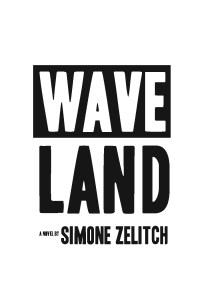 Now that novel, Waveland by Simone Zelitch, has found its publisher, The Head and the Hand Press, and I’ve read the whole thing in galleys. It’s about a young white woman’s experiences during the Freedom Summer of 1964, and about her life afterward—working with the Movement, raising a biracial child conceived during that time, enduring the tragedies, breakups and breakdowns. It’s a complicated journey with many ups and downs and sideways slides.
As soon as Beth Fine arrives in Mississippi, she finds out how dull Freedom work can be: she’s assigned to shelve books and clean the floors. Eventually, though, she gets more involved in the field work, finds love and conflict in equal measure, and has her brushes with violence. When a gun under the bed is mentioned early in the book, you can be sure it will be fired at some point.
The novel jumps around in time, and scattered chapters give us three other points of view, widening our perspective on Freedom Summer, the Democratic convention of that year and the tensions pervading the Movement. Yet the book remains primarily Beth’s story. As it turns out, that phrase she uses to characterize herself, “the girl who did everything wrong,” is more than a joke about her social clumsiness and problems in judgment. She’s a person who can’t be dissuaded from doing what she feels must be done. She has a private sense—of justice, duty, love, whatever you want to call it—that impels her, and at key moments she can’t resist its demands even when her brain knows she’s courting disaster. At one point she quotes from Pascal: “The heart has its reasons, which reason does not know.” She’s stubborn, headstrong and often infuriating to the other characters. If we as readers fully engage with her, she should sometimes infuriate us too. Damn it, Beth, we want to yell, make the sensible choice! No such luck; she’s not going to listen, and that’s her virtue and her fault.
Simone Zelitch, as I discovered by reading her previous works, has a habit of writing provocative historical novels: The Confession of Jack Straw, about the English peasants’ revolt of 1381; Louisa, about two women who roughly reenact the biblical story of Ruth in post-Holocaust Europe and Israel; Moses in Sinai, about—well, the title explains it. Except for Louisa, released by Berkley, these were small-press books, as is the new one. They deserve a big-press readership.
In her next book after Waveland, an already completed novel called Judenstaat, Zelitch tackles an imaginary past—what might have happened after World War II if the Jewish state had been carved out of Germany rather than Palestine. This novel won her an NEA fellowship, and it has recently been signed by Tor/Forge, the Macmillan imprint known mostly for sci-fi and fantasy. It’ll be back to the big presses for this persistent, thought-stirring, hard-to-classify writer.
In the meantime, check out the girl who can’t do anything right. She’ll agitate and charm you in equal measure. If you want to order a copy before the official release date in May, The Head and the Hand Press is offering a prepublication deal.
Novels, Earthworms and Raw Mutton
March 5, 2015
 On this snowy day in March, when my hometown Philadelphia is pretending to be Boston and Boston is pretending to be Baffin Island, I’m taking a break from shoveling two sidewalks (office and home) and inventing ways to torture the groundhog who predicted this weather.
Now would be a perfect time for reading a novel. Lately, though, I’ve been pondering the frequent reactions I get when I recommend a recent novel to friends or acquaintances.
Sometimes it’s a pained, put-upon look, as if I’d suggested they shovel the snow from my 100-foot driveway. (Strictly a metaphor; my driveway is only 6 feet.)
Sometimes it’s an unbelieving, disdainful grimace as if I’d offered tickets to a Justin Bieber concert.
Sometimes it’s even worse: a repulsed glare as if I’d dragged my friend to an expensive restaurant for a feast of earthworms, sycamore bark and raw mutton. (Metaphor again: Philly doesn’t boast such a restaurant—yet.)
The people I’m talking about are urbane, well-educated folk who must, at one time or other, have read a novel. Why does the idea repel them so much now? I’ve come up with several possible explanations.
- Middlebrows like me, they need all their spare time for watching British costume dramas. Maybe, like me, they’re still trying to figure out why any eligible bachelors tolerate Mary Crawley.
- Implying that a friend would read a book for fun is an insult, really. It’s like saying your haircut is so perfectly 1974.
- Given the dire condition of the world, they may agree with Elena Ferrante’s character Franco Mari, a political activist who declares to his ex-girlfriend, “[T]his, objectively, is not the moment for writing novels” (from Those Who Leave and Those Who Stay).
- They may see contemporary novels as gimmicky and trivial. Partly true.
- They may see contemporary novels as wordy, opaque, unfocused and boring. Also partly true.
- It’s a pain to read a lot of text on a phone, and what other way is there to read?
- If the friend is male, he probably views novel-reading as beneath his serious manly dignity, like Mr. Collins in Pride and Prejudice: “Mr. Bennet was glad to take his guest into the drawing-room again, and, when tea was over, glad to invite him to read aloud to the ladies. Mr. Collins readily assented, and a book was produced; but, on beholding it (for everything announced it to be from a circulating library), he started back, and begging pardon, protested that he never read novels.”
Hmmm. …
You know, after all that, I’ve convinced myself it’s foolish to waste time on fiction. I think my companion has a better idea for a wintry afternoon.

Walker Evans, Coney Island, and a Fine Novel
February 5, 2015
 Cleaver Magazine has been ramping up its review section, and today there’s an excellent review of a book I love, We’ll Go to Coney Island, a novel in stories by Barbara Scheiber (Sowilo Press, 2014). The reviewer, Ashlee Paxton-Turner, is given plenty of space (more than 1,500 words) to discuss the work in detail, and she’s quite perceptive.
Early on, Paxton-Turner tells the remarkable story of the Walker Evans photo used on the cover. The book’s linked stories are loosely based on the author’s own family history, especially her mother, her charismatic and philandering father, and her stepmother. While she was writing the stories, she happened to see the Evans Coney Island photo in an article about an upcoming exhibition. Though the man in the picture has his back turned to the camera, Scheiber instantly recognized him: her father! with his mistress (later her stepmother)!
That’s a great background tale. The stories in the book itself are just as good, and the arrangement adds to their power. Chapters set in 1915–1916, when the main character Minna is a young girl, interweave with chapters from much later years, in which Minna becomes a mother, grandmother, and great-grandmother. Here is Paxton-Turner’s take on the technique:
Scheiber uses the form to tell two parallel narratives—past and present—that taken separately are rather linear. Once she puts them together, the linearity is distorted. This creates emotional resonance: the past and its formative memories does not yield or relinquish its hold on the present; it continues to resurface, even when Minna, suffering from Alzheimer’s, is left in the barren room of a nursing home.
Right. The past informs the present and vice versa, as much as in any time-travel sci-fi novel.
One other note of interest: The author, a first-time novelist, is in her nineties. I take that to mean that for all of us who have been dull and unimaginative for decades, there is still hope.
The book cover above links to the Amazon page for the book. Here is the link to the Cleaver review.
The Ape Goes Live
January 5, 2015
A quick post to announce that my novel The Big Happiness is now available as an ebook in Kindle format, presumably readable on any device with a Kindle app. Here’s the link.
 The novel features a brain-damaged alcoholic who calls herself Allison Wonderland, along with her eccentric, half-blind lover Leigh Berry, who speaks in his own semi-invented language. A “normal” friend of theirs, Connie Bowers, tries to guide them through their misadventures, while assorted other colorful and wacky types, including a giant imaginary ape, play supporting roles. (Note the ape peeking out at the bottom of the cover.)
The book is kind of about “disabilities,” in all senses of the word; kind of about spirituality; and kind of just crazy. I hope some readers enjoy it and none accuse me of exploiting innocent apes for commercial gain.
An Early Call
December 31, 2014

On New Year’s Eve, here’s an early summons by the year 2015:
http://flashfictionmagazine.com/blog/2014/12/31/an-early-call/
It’s a very brief story of mine called “An Early Call” in Flash Fiction Magazine.
The first comment, before I even saw the story myself, was from Miles White, who I gather from his blog is a journalist, flash-fiction writer, and ethnomusicologist. He wrote, “Interesting. I think I got it but I’m not sure.”
Miles, I totally agree. If you figure out who’s calling, let me know, but I don’t think we should answer.
Peeping Devin
December 23, 2014
 At the risk of breaking my record for number of posts in a season and thereby alienating all those who count on me for blissful silence, I have to plug my latest publication, which appeared (to my belated surprise) a day after I got the acceptance email.
Called “The Upper Mahoney at Dawn,” the story is a sympathetic account of a man who becomes a Peeping Tom, more or less. His name is Devin, so let’s call him, avoiding stereotypes, the Peeping Devin. Does he really deserve sympathy? That’s for readers to say. Use the comment feature on this blog to let me know what you think.
The story can be found here at Turk’s Head Review, a cool publication that bills itself as “Blog meets literary magazine.” Many thanks to the editors for choosing the story.
Togetherness
December 22, 2014
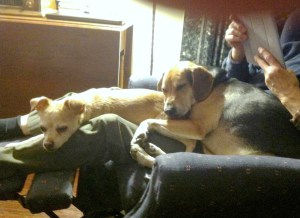 This holiday season I’ve been looking forward to relaxing in bed. Instead, I’ve become popular AS a bed.
This post is dedicated to all who experience the fine line between family togetherness and too much togetherness.
Would anyone like to borrow a dog?
 The News from Gridleyville