
Democracy and Frogs
June 29, 2019

In my day job, I’ve recently had the pleasure of doing layout on a new translation of an ancient Greek mock-epic poem, “The Battle Between the Frogs and the Mice,” a spoof of heroic war sagas. The new translation by A. E. Stallings, with drawings by Grant Silverstein and an introduction by “A. Nony Mouse,” is due out later this year from Paul Dry Books. The text and illustrations are both gruesome and hilarious.
To summarize the poem’s narrative: After committing a selfish and deadly error, the Frog King concocts lies to evade responsibility, and as part of his cover-up he leads his subjects into a war on false pretenses. Things go badly for the amphibians, and the entire race will be wiped out—until the gods intervene to stave off genocide.
Could there be parallels to the current day?
After pondering this matter, I’ve decided conditions are very different in our democratic era. Because we no longer believe the gods will intervene.
Happiness with Snowflakes
May 22, 2019
 Apologies to both of my readers for the infrequency of my posts lately. I haven’t even been able to think of more insults for President Twitterman. I blame the news media for distracting me with genuine tragedies.
But here’s one announcement: My Kindle-format novel The Big Happiness has been featured on the website Snowflakes in a Blizzard, which spotlights writers who supposedly deserve more attention from the public at large. I don’t know how I qualified for this, but here’s the link.
Many thanks to Darrell Laurant, who runs the Snowflakes site.
A Silent Breeze
January 2, 2019
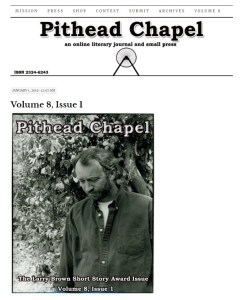
Isn’t it especially creepy when a threat makes no sound?
That’s what the protagonist faces in “A Silent Breeze,” my latest story now up on the Pithead Chapel site. It was a finalist in the magazine’s story contest judged by Silas House.
Sirens
December 21, 2018
On certain days in the city, they seem almost continuous, always in the background, waxing or waning, closing in or fading. Police sirens. Fire trucks. Ambulances. Maybe I imagine them when they aren’t there. But they always have to be there, don’t they?—because at any given moment, there must be an emergency somewhere.
Just as the dog says when he refuses to go out: “I don’t care if the sun is shining here, I hear thunder somewhere.”
Whether the threat is real or imagined, I imagined a character for whom it’s both imagined and real, and she’s in the Adelaide Awards Anthology for 2018, in a story called “Sirens.” If you can tolerate the interface called Anyflip, you can read for free here, starting on p. 77: http://online.anyflip.com/fypa/nifd/mobile/index.html
If you find Anyflip unbearably annoying, just flip it one and go listen to sirens on your own. They’re everywhere, like the thunder. 
Time to Get Crazy
October 22, 2018
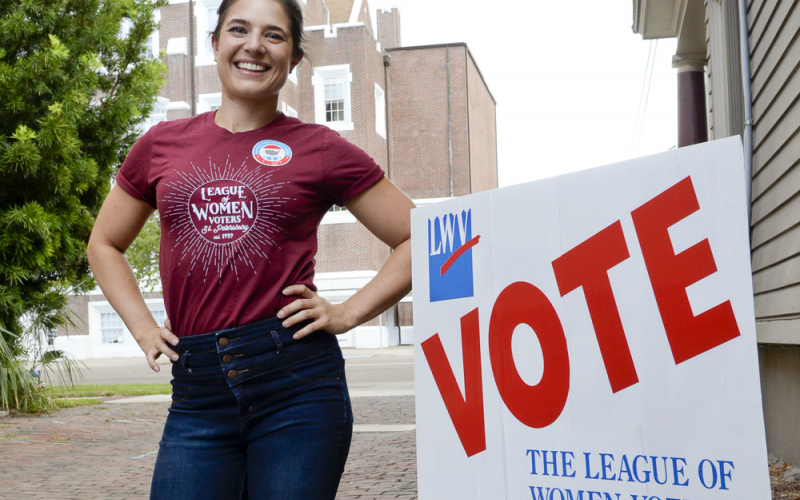 November approaches, and it’s time for one of my periodic screeds about voting. Few things perturb me more than Americans who don’t vote.
Well, President Twitterman gets top rank among bugbears, of course. And there’s the Saudi autocrat who’s finally being bashed in the press for murdering one journalist while his mass slaughter of Yemeni civilians continues to be ignored. Yet I don’t know that princely thug called MBS, he’s never bought me a beer, and my outrage at him merges with my general disgust for the fat-cat gangsters swarming the White House and other seats of government.
In comparison, my displeasure with nonvoters is much more personal. You know the truism that sibling feuds are the worst of all? Americans who don’t bother to vote—especially college-educated, middle-class types like myself—those people are family, and so I get really mad at them. There’s no excuse for their behavior. Voting is so simple—how can they not do it?
Do I sound like somebody’s grumpy old uncle?
I am.
Let’s survey some apparent reasons people don’t vote. I’m excusing, of course, those who are blocked from voting by electoral machinations (“you put a period after your middle initial on one form but not on another; therefore we can’t verify your identity”), and those who juggle three jobs and three children and have no time in between, and those whose polling place is conveniently located 153 miles away. Etc. (Although in the latter cases people might use absentee ballots.) I’m aiming this diatribe at people who could vote easily but somehow don’t. The people who elected Twitterman by abstaining. The people who make the United States notorious as a nonparticipative so-called democracy.
Reason for Not Voting #1: “I don’t like any of the candidates. They’re all flawed.”
My response: I hope you believe in a Messiah. Because your perfect political candidate will come along sometime after the Messiah.
Reason for Not Voting #2: “I’m sick of voting for the lesser evil. I can’t compromise like that anymore. From now on, I’ll stand on principle.”
My response: Congratulations on your moral purity. Have you considered moving to a place where none of your principles will be compromised, such as Antarctica?
Reason for Not Voting #3: “None of the candidates talk about issues important to me.”
My response: If you like that situation, keep on not voting. By not expressing your opinion at the polls, you make certain that candidates will disregard it.
Reason for Not Voting #4: “It makes no difference anyway. In my gerrymandered district, people with my views are so outnumbered that my candidate can never win.”
My response: Gerrymandering is a big, big problem. But the canny politicians who divvy up voters for their own advantage are counting on the continuation of established political patterns, including the pattern of people not voting. A sudden swell in ballots from groups they are trying to marginalize could upset their calculations—and maybe set the stage for legislative action to end gerrymandering.
Reason for Not Voting #5: “Votes change nothing. Politicians do whatever nasty things they like regardless of what the public thinks.”
My response: Um, politicians can’t do that nefarious stuff if they’re not in office. Vote them out and they’ll be reduced to making millions as lobbyists. That’s not quite as bad for the rest of us.
I’ve said all this before, in one way or another. But the other day, inspired by a conversation with a politically involved friend, I turned the problem around in my mind, reflecting on what it takes to become a committed voter, someone who turns out in every election:
- A sense of morality or justice. People are said to vote their pocketbooks, and many do, but in our divided times what seems to drive citizens to the polls is a belief that certain actions and policies are right and others are disastrously wrong.
- Faith. Not religious belief necessarily, but a conviction that there’s some hope left for the world and that human actions—our actions—can make a difference. Admittedly, if science says the Earth is likely to be uninhabitable in a few decades, faith stretches thin; but there have been Doomsday scenarios in the past that we managed to escape, and it wasn’t by hiding under our school desks to avert the atomic bomb. We must believe that our flawed and compromised democracy can be salvaged and that its fate is important to the world.
- Irrationality. In the most local of elections, one vote can actually matter. In a 2017 contest Phillip Garcia won the post of judge of election in a Philly precinct because he wrote in his own name—the only vote cast for that office. Still, I have to admit that one vote, which is all each person can control, will change nothing in a statewide or national election. Making a point of casting a ballot is therefore irrational, or at best a stroking of one’s own moral sensibilities (cf. Reason #2 above).
It seems I’ve put myself in the position of urging people to be irrational. Okay, I’ll own up to that. I’ll double down, as Twitterman always does.
Get out there and go crazy, people! Against all reason, act like it makes a difference what you do. Vote for somebody! If necessary, embrace the lesser evil, the best of the bad choices.
Maybe there’s some hidden good there after all.
Bold Predictions
September 7, 2018
In such unprecedented (or unpresidented) times as ours, it’s difficult to imagine what comes next. But as concerned citizens it’s incumbent upon us to plan for the future. In that vein, here are my carefully reasoned predictions about likely trends in the next decade.
- When the Supreme Court overturns Roe v. Wade and states are once again free to ban abortion, women will migrate en masse from pro-life to pro-choice locales. Mississippi, for example, will empty out and Massachusetts will burgeon.
- In Boston violent fights will erupt over parking spaces, and the city’s parking clerk will have to dodge irate commuters armed with tire irons. Electric bike-sharing companies will make a fortune. So will lawyers.
- As women abandon pro-life states, property values there will plummet—increasingly so as the despondent remaining men litter their yards with empty pizza boxes. Country music will reach new heights of popularity as songwriters exploit the rhyming potential of lonely pepperoni.
- Once property values have tanked in pro-life states, adventurous young gay couples (realizing abortion bans are irrelevant for them) will seize on the opportunity to homestead. They’ll buy houses on the cheap and settle in. They’ll need to acquire weapons to fend off the Klan, but being younger and smarter and unencumbered by clumsy hoods, they are bound to prevail. Within ten years, Mississippi will be the coolest place to live in America.
If any of this comes true, you can count on me to say “I told you so.”
Meanwhile, people who don’t want such things to happen can consider a radical alternative: voting.
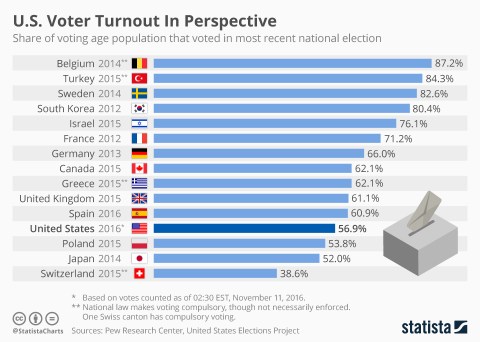
Martin Armstrong, “U.S. Voter Turnout In Perspective,” Statistica, Nov. 11, 2016.
Two new stories
June 1, 2018
Two of my stories are being published this month, both of them somewhat peculiar (of course) but otherwise very different.
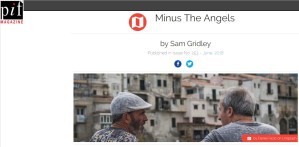
“Minus the Angels,” in Pif Magazine‘s June issue, is what I consider a very short piece, less than 1,500 words, though the magazine calls it “macro” fiction. However they label it, I’m grateful for the publication. It’s about a couple vacationing in Italy while one of them, the narrator, is recovering (or not) from an illness. Interestingly, the sex of the narrator is never specified, but the magazine has a photo of two men in the header. As I wrote the story, I did imagine the narrator as a man; but when I realized on revision that I hadn’t assigned a name or a pronoun, I decided to leave the gender unstated. If you could read the story without seeing the picture, and without knowing that the author is male, what assumption would you make?
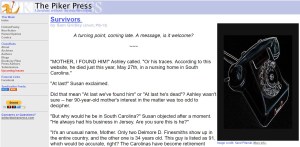 Now, if you want REAL “macro” fiction, my story “Survivors” in The Piker Press is over 10,000 words—or will be, once all three installments are up. This piece is about a long-delayed reunion of a broken family, a get-together that perhaps should have been delayed even longer. I think there should be a prize for readers who survive all the way to the end of the work, but I don’t know what to offer. Maybe, if you contact me, I’ll burden you with another free story.
“Polly wolly doodle all the day”
May 4, 2018
 Yeah, I know, everyone’s been waiting for my latest insightful comments about President Twitterman, Paul Ryan, Steamy Dangles or whatever that porn star’s name is, and all the other pressing issues of the day.
Instead, I’ve published a story with “Polly wolly doodle” in it. Sorry.
If you strain your eyes, you may be able to parse the first lines in the image accompanying this post. And if that doesn’t discourage you, the rest of the piece can be found in the April issue of Adelaide. You have to read a ways into the story before polly and doodle appear, but they do live up to their names.
Many thanks to Adelaide‘s editors, Stevan V. Nikolic and Adelaide Franco Nikolic, for accepting this story for their fine magazine, which is based in both New York and Lisbon. Without leaving my desk, I feel much worldlier.
Rare Public Appearance
March 5, 2018
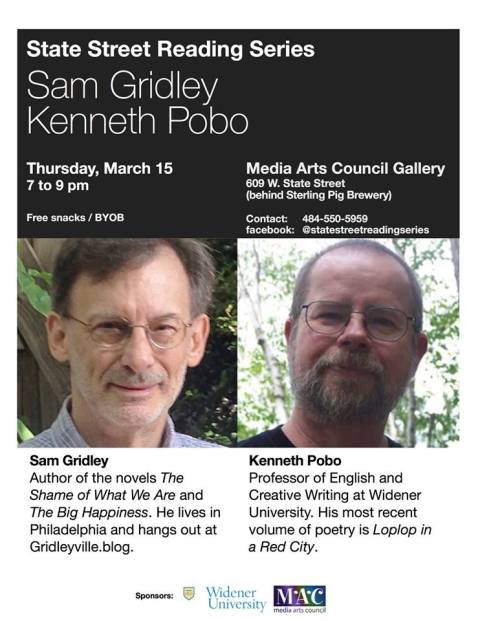 In spite of my satirical diatribes on this blog against the Twitterman administration and all other ANJs (American Nut Jobs), I’ve been invited to participate in the State Street Reading Series in Media, PA. This will be one of my rare public appearances. Don’t worry, I won’t be reading political satire, just fiction.
On the other hand, practically everything we hear today is political satire, isn’t it? Even when it’s meant to be taken seriously.
My partner in crime will be Ken Pobo, a fine poet with at least seven books to his credit. The event is BYOB, but I will bring some wine that I’m more than willing to share.
It’s Thursday, March 15, starting at 7 p.m., and here’s a map:
https://www.google.com/maps/embed?pb=!1m18!1m12!1m3!1d3060.033487255412!2d-75.40024008433988!3d39.91826679372679!2m3!1f0!2f0!3f0!3m2!1i1024!2i768!4f13.1!3m3!1m2!1s0x89c6e9056b04a7f5%3A0xad4c7ec18b5066da!2s609+W+State+St%2C+Media%2C+PA+19063!5e0!3m2!1sen!2sus!4v1520265511856” target=”_blank” rel=”noopener”>http://
 The News from Gridleyville