
Measures of Disobedience
August 30, 2011
 Last night I finished Ru Freeman’s novel A Disobedient Girl, which is composed of two interlocking narratives about Sri Lankan women trying to break loose from the stifling conventions of marriage and caste. This book has a lot to recommend it. To me, one striking feature is not the obvious similarity between the two female protagonists, both of whom are seeking freedom, but rather their difference.
In one story line, Biso, a devoted mother of three, leads her brood in a flight from their abusive father; she’s close to 100 percent good, without a nasty thought in her brain. Though she cheated on her husband, he deserved it. The other protagonist, Latha, a servant girl, whom we follow from childhood to her thirties, is not just “disobedient” as the title proclaims, but genuinely nasty at times; she has a penchant for disloyalty, revenge, sneakiness, and deceit.
With Latha, the author herself is being disobedient to the standard portrayal of a female heroine. True, Latha is no Emma Bovary; she’s more pleasant than Emma, smarter, more honest with herself. Still, we’re asked to admire a character who takes some malicious whacks at those around her—and we do. We like her spirit, and we sympathize with her bondage. Orphaned, she was taken as a young child into an upper-class home, where she was raised with another girl her own age, Thara. She and Thara become close friends, but the caste difference can never be shaken, and ultimately she takes the role of Thara’s servant. Their love/hate relationship forms the core of the novel.
We also admire Latha for her passionate dedication to Thara’s children, whom she treats as her own. Like Biso, she has mothering instincts that are fervent, tough, resilient. In this book, it’s only the spoiled high-caste twits who make bad mothers.
In contrast to the women, the adult males in both story lines tend to be distant and/or beastly, and I found that a bit disappointing. Both plots end melodramatically, too, with some twists that I found unlikely. But the sharp details of Sri Lankan family life more than make up for any distortions of realism in the plotting, as does the complex psychology of the bond between Latha and Thara.
Since I read this book in an electronic version on a Nook (the popular Barnes & Noble e-reader), I have to point out that many of the special characters in the Sri Lankan terms did not translate—they appeared as question marks. They may be fine in the epub file itself, but they don’t display on the Nook. The publisher, Atria, is a division of Simon & Schuster, and with that major house’s resources, the editors ought to be able to pay someone to check a book’s appearance on the most common e-readers. If an accented character doesn’t display properly, a workaround can be found—at the very least, the substitution of a standard keyboard letter.
Swerving from the Hurricane
August 28, 2011
 In the past week, while dealing with earthquakes, hurricanes, tornadoes, floods, a lame dog, and fears of a second recession, I had the chance to read Stephen Greenblatt’s The Swerve: How the World Became Modern. Perhaps this proves that I have the same response to potential calamity as Art Dennison, the protagonist of my most recent novel: hide in a quiet room and read.
After I was intrigued by a piece based on Greenblatt’s book in the August 8 New Yorker (article summary here), a friend kindly passed along an advance reading copy. A Harvard scholar, Greenblatt is known for what I would call crossover works, ones that combine scholarship with popular appeal. His previous book, Will in the World: How Shakespeare Became Shakespeare, made a splash by combining Bard biography with a colorful portrait of Elizabethan England. In The Swerve he takes two historical figures about whom even less is known, the Latin poet Lucretius and the fifteenth-century papal secretary Poggio Bracciolini, and spiraling outward from those two, spins an intriguing tale of Classical philosophy, medieval copyists, Renaissance book hunters, and radical changes in the way we look at the world.
Intellectual history is great fun when written well, and Greenblatt is one of the best at it. His central point is that Poggio’s accidental discovery of a complete version of Lucretius’ De rerum natura (On the Nature of Things)—accidental in that Poggio was combing monastery libraries for copies of ancient texts but not that one in particular—played a central role in breaking down medieval religious thought and freeing the great minds of the Renaissance. It’s long been known that Lucretius influenced the humanists, but Greenblatt implies that this one masterful poem, in which Lucretius expounds on the Epicurean vision of the universe, smashed more barriers than any other Renaissance rediscovery and thus opened a broad road to modernity. Though I don’t know how many scholars of the period will grant Lucretius this extraordinary importance, I’m personally willing to allow it for the sake of the story.
One chapter offers an extended bullet list of the “elements that constituted the Lucretian challenge” to Church-molded thought. Here are some of the bullet points, without the author’s commentary:
- Everything is made of invisible particles. [Lucretius didn’t call them atoms, but he was drawing on the atomism of Democritus and others.]
- All particles are in motion in an infinite void.
- The universe has no creator or designer.
- The universe was not created for or about humans.
- Humans are not unique.
- The soul dies.
- There is no afterlife.
- All organized religions are superstitious delusions.
- The highest goal of human life is the enhancement of pleasure and the reduction of pain.
From a churchman’s point of view, this list moves from suspicious to upsetting to burn-at-the-stake heretical, and of course many humanists played with these notions without committing outright to them. Still, even with clever concealments and subtle emendations, such ideas had the power to swerve society from medievalism toward modernity.
Greenblatt emphasizes that the Lucretian version of Epicureanism, like Epicurus’ own, did not equate living for “pleasure” with pursuing uninhibited passions and impulses. Rather, the highest pleasure comes from philosophical contemplation that “awakens the deepest wonder.” Kind of like hiding in your room to read while the hurricane roars by.
For me, one takeaway from this book is the renewed realization that human thinking goes in cycles, with old notions constantly being resurrected and reshaped. The body and soul may both dissolve into the mud, but ideas get into the water table and seep out in strange new places.
In fact, I’ve recently unearthed in the basement of my ancient house a mildewed manuscript that disintegrated as soon as I touched it. Only a few fragments remain legible, one of which seems to be attributed to a certain Sammus Gridlius, a previously unknown scribe of the first century A.D. Roughly translated from the Latin, it goes like this:
All that’s thunk has been thunk before. All that’s writ has been writ before. Peace, brother.
Circumstantial evidence indicates that a rediscovery of this text by John Lennon in 1968 influenced the late Beatles songs and consequently all of contemporary culture. I’m still working on proof for that theory.
Rereading Stegner
August 12, 2011
 There’s a nice (repeat) post by Nichole Bernier at Beyond the Margins, about Wallace Stegner and his wife, Mary. She mentions that Stegner is “best known for his environmental writing, which has influenced generations of conservationists, and for his novel Angle of Repose (which won the Pulitzer in 1972), as well as his creative writing program at Stanford University.” If so, it’s a shame that his other novels aren’t more widely read today. Nichole says she is currently rereading All the Little Live Things, one of my favorites, in which he makes the California foothills teem with life—human, animal, vegetable, spiritual.
Sons and Heirs: Lorene Cary’s Latest
August 7, 2011
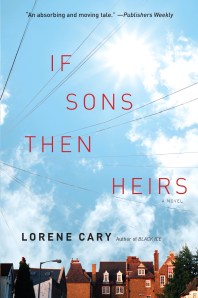 Recently I finished Lorene Cary’s latest novel, If Sons, Then Heirs, another fine and highly readable book from one of Philadelphia’s most respected authors. Lorene is well known locally for her community work with the Art Sanctuary, but as a reader I’m happy to see she’s not neglecting her own writing.
Featuring several generations of a single family, If Sons, Then Heirs combines a fairly simple present-day story with an intricate and complex revelation of the family’s past. The genealogical tree that appears early in the book should help readers keep track of the many characters who roam the pages. Unfortunately, I read the Nook e-book version, on which the chart is illegible, and so I was constantly struggling to remember, for instance, how Binkie is related to Lil Tootchie. (Great names throughout!)
Roughly, the present-day plot goes like this: Rayne, an African American man who runs a construction business in Philadelphia, stands to inherit the old farm on which his great-grandmother, Selma, is living in South Carolina. Yet because of racist property laws and contracts, the ownership of the land is in question. As Rayne begins to tackle this issue, he is contacted by his mother, Jewell, who abandoned him to Selma’s care decades ago. Rayne also faces a decisive point in his relationship with his girlfriend, whose son has just begun to call him “Dad.” That’s four generations right there—or five, if you count the one skipped between Jewell and Selma—and the author will add cousins, aunts, uncles, stepfathers, and more to the troop.
At first, Rayne isn’t particularly interested in digging up his family’s history, but inevitably, in confronting the land issues, he must uncover a good deal more than he ever wanted to know. Having tried my own hand at stories that dredge up the past, I was intrigued with the tone of this book, which strikes me as an interesting mix.
From the start, we know from all the elements that form a tone—the style, the positive resolution of small incidents, the degree of humor and warmth, the preponderance of good people, etc.—that nothing really terrible will happen to the main characters in the present-day story. I refuse to label that comment with a “spoiler alert” because the comfortable tone is evident from the first chapter. Yes, Selma is extremely old and doddering, and Jewell’s husband is sick with cancer. Perhaps one or both of these fine folks will die in the course of the novel—I won’t reveal that; see, I’m being good!—but, even so, that will not make a tragedy. We know that Rayne and Jewell will survive and most likely continue the relationship they have newly established.
The past is another matter. When Rayne descends into the dark cellar of this family’s history, he unearths not skeletons so much as bloody remains—the still-dripping evidence of racial violence. No humor and warmth there, just ugliness and calamity, and the author presents them in gory detail:
He raises the tire iron in his hand and the others stand clear of him, because he is swinging wild, hitting the hood, the car door, hitting [the victim’s] legs, shattering the windows, and grabbing through the window at the great, flailing, dangerous, bloodied body.… [He] cuts up his own arm. It bleeds onto the car door and down his side. He lets out war yells like an Indian.
What’s the effect of such a tragic, violent tale wrapped inside a warm and slightly sentimental one? Though I was interested in the gradual revelations of the past, I can’t say I felt suspense, because the outcome—the contemporary lives of the main characters—is already known. In fact, though the villains of the past have present-day descendants, with whom Rayne has to deal to resolve the land issue, Cary treats that story line summarily. Ultimately the past becomes a vivid, personalized history lesson more than a tension-filled story.
The lack of suspense hardly matters, however. Throughout, the characters are the strength of this work. They are big, passionate people struggling to do the right thing. Bringing the scattered relatives back together and understanding what happened to drive them apart—these are the keys to the family’s redemption, and that theme is what Cary wants us to take away from the novel. I’m taking it, and I won’t soon forget Rayne and Jewell and Selma. Another good read from Lorene Cary.
Adios, Len
August 7, 2011
 The latest issue of Small Press Review contains some painful news for those in the small-press world. The magazine’s founder, Len Fulton, has passed away. Some obituaries appeared in the last week of July, but I missed them.
In addition to SPR, Len’s company, Dustbooks, has for decades published many invaluable reference books for the literary community, including one of my long-time bibles, The International Directory of Little Magazines and Small Presses.
Though I never met Len, I’ve always considered him a fascinating figure. He lived in Paradise, for one thing (Paradise, CA, that is)—uprooted like me from the East Coast. Within the first decade after moving there, he published two fine novels: The Grassman and Dark Other Adam Dreaming—both now available only in used copies, I think. He wrote plays as well, and he had the gumption to get involved in local politics. (Politics in Paradise? Yes, afraid so.)
The current issue of SPR has an obituary by Len’s sister, Susan Fulton Raymond, and a eulogy by Hugh Fox. Among the notices online, here are a couple of good ones:
http://www.newsreview.com/chico/len-fulton-1934-8211-2011/content?oid=2977223
We’ll miss you, Len.
Beyond Bizarre: Karen Russell and the Swamplandish Style
July 27, 2011
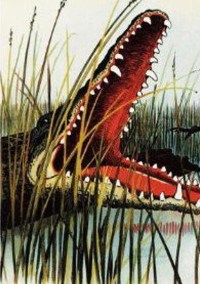
From the cover of SWAMPLANDIA!
Breaking my tradition, I’ve celebrated my return from two months of overwork by reading a best-selling novel less than five years after its publication date. The book is Swamplandia! by Karen Russell, and it’s inspired me to coin a new word for personal use, swamplandish, meaning outlandish/bizarre/wacky in an interesting way.
For those who haven’t read the book, here’s Donna Seaman’s description from Booklist, courtesy of Amazon:
Swamplandia! is a shabby tourist attraction deep in the Everglades, owned by the Bigtree clan of alligator wrestlers. When Hilola, their star performer, dies, her husband and children lose their moorings, and Swamplandia! itself is endangered as audiences dwindle. The Chief leaves. Brother Kiwi, 17, sneaks off to work at the World of Darkness, a new mainland amusement park featuring the “rings of hell.” Otherworldly sister Osceola, 16, vanishes after falling in love with the ghost of a young man who died while working for the ill-fated Dredge and Fill Campaign in the 1930s. It’s up to Ava, 13, to find her sister, and her odyssey to the Underworld is mythic, spellbinding, and terrifying. Russell’s powers reside in her profound knowledge of the great imperiled swamp, from its alligators and insects, floating orchids and invasive “strangler” melaleuca trees to the tragic history of its massacred indigenous people and wildlife. Ravishing, elegiac, funny, and brilliantly inquisitive, Russell’s archetypal swamp saga tells a mystical yet rooted tale of three innocents who come of age through trials of water, fire, and air.
Normally I’d be turned off by the first sentence. I like reading about the world I know, which has never included alligator wrestlers. Normally, too, if I dipped into the book itself, I’d be annoyed by the extreme degree of exaggeration. The book’s literal story line does involve that so-called amusement park named the World of Darkness, where a popular attraction for the Lost Souls (as the customers are called) is a slide down the intestinal tract of the Leviathan. The jingle, sung happily by the Lost Souls, goes like this: “The Leviathan, the Leviathan, what a bargain! All that pain in a single afternoon!” Since it’s not quite satire—or far beyond satire—the tone often strikes me as camp, way-out-there for the amused smirk of being way-out-there.
Yet something kept me going with this novel. Part of it was the verve of the writing. Russell has vast buckets of energy, some of which she splashes into swamplandish metaphors. Here are some examples from early in the book:
Nights in the swamp were dark and star-lepered
dozens of alligators pushed their icicle overbites and the awesome diamonds of their heads through over three hundred thousand gallons of filtered water
I started to miss the same tourists I’d always claimed to despise: the translucent seniors from Michigan. The ice-blond foreign couples yoked into thick black camera straps like teams of oxen. The fathers, sweating everywhere, with their trembling dew mustaches. The young mothers humping up and down the elevated walkway to the Swamp Café, holding their babies aloft like blaring radios.
This style is both brilliant and fraught with contradictions that keep the reader off balance. The brilliance speaks for itself—trembling dew mustaches! But an actual leper doesn’t look at all like a star-spotted sky, and the allusion to a leper in a romantic descriptive passage adds a tonal jolt. An alligator’s teeth have the sharpness and slickness of an icicle but not the coldness or fragility. If the couples are “yoked” like oxen, they are attached to each other by those camera straps, but surely that’s not right. Babies are indeed like blaring radios, but nobody holds radios “aloft”; for that matter, how many mothers hold their babies “aloft”?
It may seem silly to analyze the logic of metaphors, but my point is that Russell must be deliberately keeping us off terra firma. The very style is swampy and ever-shifting underfoot, with beauty and ugliness and romance and weirdness jumbled together, sucking us toward the bottom of solid reality, if not beyond.
And the plot proceeds in a similar way. One could write an outline that would seem simple and realistic; as Janet Maslin said in her New York Times review (2/16/11), “Take away the wall-to-wall literary embellishments, and this is a recognizable story, if not a familiar one.” Yet the tone often verges on the magical. In fact, my favorite part of the novel was 13-year-old Ava’s expedition to Hell to rescue her sister, who has supposedly eloped with a ghost. Ava is accompanied by a strange adult known as the Bird Man, and for a good while, as they approached the doors of Hell in the lonely midst of the incredible wild swamp, I supposed we were heading off into magical realism.
(SPOILER ALERT.) I was rather disappointed, then, when the story crashed back to earth and the magic disappeared. The end, lepered with impossible coincidences, is rather sentimental in its reunion of the splintered family. Yet exactly none of the family’s problems have been solved, and we leave them in a dreary mainland apartment “carpeted and wallpapered in rusty browns, a palette that reminded me of dead squirrels.” It’s a peculiar and off-kilter happy ending.
Maybe that, too—optimism in the face of death, madness and depressing decor—deserves the adjective swamplandish. Thanks to Karen Russell for adding to my vocabulary such a potentially useful word.
Dancing on the Razor’s Edge
May 17, 2011
 In much of the new work I’m seeing, especially for the theatre, preposterous exaggeration seems to be the rule. Many writers seem to believe that the mainstream realistic tradition, loose as it may be, can’t convey the absurd cruelties of our world. So we get blood sprayed all over the stage in a grotesque parody of violence. Or wildly implausible plots, such as the one in which a former Guantanamo prisoner tracks down his ex-interrogator to demand half of her liver.
Most such work, however clever it may be, leaves me cold, or at best tepid. There’s little warmth in my heart for the characters, who often aren’t human enough to care about. The themes have less subtlety than Philadelphia politics.
Western literature has plenty of strong anti-realist precedents to draw on, including recent practitioners like Albee and Stoppard, and revivals of Ionesco or Beckett can still seem fresh and vital. So I’m wondering, what is it that makes some such work provocative, interesting, magical and other stuff just weird and off-putting?
One recent production offers a clue: Inis Nua’s version of Dublin by Lamplight, a play by Michael West written in 2004 to mark the centennial of the Abbey Theatre. Set in 1904, the year it mock-celebrates, the play features characters who are takeoffs on W. B. Yeats, Lady Gregory, and other landmark figures in the Irish cultural/political revival. The main plot, a melodrama, centers on the attempt to found the “Irish National Theatre of Ireland,” a redundantly named group whose first play will be a heroic melodrama about the mythical Irish hero Cúchulainn. Most of the characters fit stereotypes, such as the wardrobe assistant who yearns to be a star and the drunken actor who wants to blow up the British king.
Inis Nua’s staging, modeled on the original version developed by the author and collaborators at Corn Exchange Theatre Company in Dublin, is as exaggeratedly nonrealistic as anything else I’ve seen. The actors wear painted whiteface masks with grotesque features. They move in a jerky, staccato manner, and when one speaks, the others snap their heads toward the speaker like puppets on strings. In addition to overplaying all their emotions, the characters describe to the audience what they are doing and feeling.
The original director at Corn Exchange, Annie Ryan, is known for her commedia dell’arte style, and in Tom Reing’s version at Inis Nua many other influences could be pointed out: vaudeville, kabuki, physical theatre, “metatheatre,” Charlie Chaplin, you name it.
These techniques are played for broad comedy, and the script is indeed hilarious—lots of one-liners, not to mention the ludicrousness of the plot lines. Even with no more than a rudimentary knowledge of Irish history, the audience understands the satire on a romanticized, pretentious, knee-jerk, and ultimately violent form of nationalism.
If it stopped there, the play would be a reasonable success in a Brechtian way. The audience, fully conscious of the actors as actors and the play as an artifice, gets the intellectual point. And yet this work manages something more. After all the farce and ridiculous melodrama, the bomb goes off, the police retaliate, and it turns out that the wrong people are killed. As the Sunday Independent put it in reviewing the Corn Exchange production, “The laughter is effectively and sharply choked into silence, the actors’ white faces, clown mouths, and marionette movements serving only to heighten the sense of loss and futile violence.”
I came away feeling the play’s meaning as much as thinking it, and I could tell that most others in the audience did the same. How was that possible when we had been kept so deliberately at an emotional distance?
I can pick out a few possible reasons: (1) Because the play was so funny, the audience was hanging on every line; even if we were “alienated” in a Brechtian sense, we were mega-attentive. (2) Audiences have become accustomed to rapid switches between comedy and tragedy, as in the evening news. (3) The real tragedy dawned in one fine moment, almost understated; no fake blood splashed around the stage. (4) One character who died—I won’t say who it was—was actually, in spite of all the stylization and stereotyping, rather likeable as an individual, although I didn’t realize this until the body hit the boards.
“The mantra of Corn Exchange,” says Tom Reing in a video clip, is that “you have to dance on a razor’s edge between the grotesque, the heartfelt, and anything-for-a-cheap-gag. That makes it limitless.” Yeah, and that dance suits an age when reality seems inconceivable and our best heroes come from comic books. But if you don’t get the dance steps just right, the “limitless” turns into the merely ludicrous or gruesome. All those involved in Dublin by Lamplight, from the original creators to the new American troupe, deserve a tip of Charlie Chaplin’s absurd little hat.
Though the run in Philadelphia has ended, Inis Nua will remount Dublin by Lamplight in New York at the First Irish Festival in September.
Flash! It’s Fiction
May 5, 2011
 Recently I finished Randall Brown’s Mad to Live, a collection of flash fiction—a total of 22 stories in a well-spaced 69 pages. The book has been described as “edgy” and “postmodern,” and both of those terms are understatements. The book opens, for instance, with a pregnant woman eating ants, a craving that doesn’t faze her husband, who runs to the pet store to buy her a bag of crickets:
At home, in the garage, I hold up the bag. A cricket stares back; all eyes, bugs are. Crunchy. Gooey in the middle. Like pretzel snacks with cheese in the center.
Late in the book, a man gets the sudden feeling that people are pointing at him, accusing him of something. Searching the Internet, he finds no clues but determines to fight back:
I get the sense it’s more ridiculous than horrible, what I’ve done, the bad kind of fame, but the kind that goes away, like colds. I’ll wait it out.… When I find it, I’ll post a picture on lampposts and store windows and telephone poles and I’ll write in black permanent strokes “I’m not him,” and then they’ll know. Everyone will know.
This is highly skilled writing, but for my tastes too surreal, so I can’t pretend to review the stories as such. It’s an occasion, though, to think about the nature of the very short story that we now call flash fiction or microfiction. The editor of the Journal of Compressed Creative Arts and FlashFiction.net, Brown has pondered the essence of the form, blogged about it extensively, and predicted its “imminent rise to power.”
Though definitions of the form differ, all the ones I’ve seen are based on length. Perhaps 50 words is the typical limit for “micro,” a few hundred words for “flash.” In Mad to Live, the shortest story falls just short of 200 words. The genre perfectly suits our short-attention-span, click-through, multitasking world, though it’s ironic that the Web, where this kind of fiction thrives, is also suited for long work that might be too expensive to print.
Many readers may assume, as I’ve always done, that a story so minimal in length must be more like a still shot than a video: zeroing in on one scene, one moment, with little scope for development or change. My own recent, semi-accidental foray into the short-short form falls roughly into that category:
TWO DEPARTURES
Each weekday morning when Dermot’s father left for work, he’d reach down to where the boy’s head drooped over a cereal bowl, ruffle his hair and mumble a slang farewell: “Later, kiddo,” or “Seeya, champ.” One day it was different. The boy finished breakfast and wandered into the living room to watch his mother and father loosely hugging at the front door. Setting out on a business trip, the man hefted his suitcase and called across the room, “Goodbye, Dermot.” The phrase, uttered through a tight grin, had such an oddly formal ring that Dermot cocked his head in surprise. When his father failed to return, joining instead a new family on the opposite coast, the words hardened in his memory like a thin layer of cement.
Skip ahead 27 years to a morning when Dermot’s live-in girlfriend Celeste stands at their apartment door with a carry-on slung over her shoulder. She is interviewing for a prestigious residency in a hospital 853 miles away (exact distance courtesy of Internet maps), and they have quarreled not about this subject, but around this subject, for the past two weeks, with the dispute so entangled in other matters that for much of the time he has lost track of the issues. As her glance angles up at him from under finely tilted brows—an expression that suggests a bemused take on her own irony—he briefly sees what she does: an unshaven, unshowered, slightly overweight academic holding a lukewarm mug of coffee that has slopped onto the sleeve of his tartan pajamas. An impulse moves him to beat her to the punch: “Goodbye, Celeste,” he says, with what he supposes is polite, forgiving affection. She nods, loses the ironic tilt, starts to speak and checks herself, and slips out the door.
Dermot returns to the kitchen. Above the sink a small window overlooks a courtyard where forsythia branches curl under a thin layer of ice. He has a sudden image, or fantasy, of his mother looking out a window like this. A flick of movement catches his eye, but when he tries to make out the bird or squirrel, nothing appears. With a jerk of the wrist Dermot pitches his coffee down the drain. “So long, kiddo,” he mutters, and heads to the bathroom.
[published in the July 2009 issue of decomP]
If we count generously, that story has three scenes, one in each paragraph, and the reader understands (I hope) that the first scene governed the last two, but there’s no character development except what is implied in the child’s progression to the man, nor is there significant plot.
Some practitioners of flash fiction don’t seem to accept such restrictions. They claim to be creating a story with conventional elements, just extremely compressed. Detailing how he critiques a flash story, Richard Grohowski writes: “Have the events in the story changed anyone? Is there a logical, or at least reasonable, progression from beginning to end?” (For more such theorizing about the way flash works, see the Flash Craft section of FlashFiction.net.)
Taking Brown’s stories as an example, some plot, or concentrated action at least—progression from beginning to end—does seem achievable. His story “Early Man” starts with a boy and his father finding a big wad of cash on the ground, and then proceeds to detail what they do with it, ending on the fourth page when the money is gone. Another story, “Good Kid,” is all action, its four pages describing an attempted robbery at a store and the fight that ensues as a boy and his grandfather resist the bad guys.
As for character change, there can be hints of that. “Good Kid” ends with a projection into the kid’s future, telling us that when bad dreams come, the boy will fight them off with memories of the moment of triumph with his grandfather.
Still, I don’t believe that real character development—important changes in essential traits or understandings—can be achieved in a couple of hundred words. Nor do I think that ultra-compressed plots can have the same kind of arc as a longer story or novel in which the characters’ motivation is integral to the buildup, the complications, the climax, and the dénouement.
If anyone can find a strong example contradicting these views, please share.
Celebrating Death?
May 3, 2011
If we’re done chanting “USA! USA!” in response to the death of Osama bin Laden—as Phillies fans did during an otherwise frustrating game Sunday night—maybe it’s time to do some serious reflection, as Annette John-Hall does in her column in today’s Philadelphia Inquirer. “I simply can’t celebrate death,” she writes, “even if it’s the demise of a despot who orchestrated the deaths of so many innocent people.”
Revenge tastes good but is less filling.
Strawberries, Pies, Books
April 28, 2011

Pie Eating in Seattle (from Wikimedia Commons, uploaded by Jmabel)
This weekend I’ll be visiting the Strawberry Festival at Peddlers Village in Lahaska, PA. Fran Grote and I will be hawking our novels at a table outside the Canterbury Tales Forever Bookstore, 10:00–1:00 on Saturday and 1:00–4:00 on Sunday. Come for the pie-eating contests, stay for the books. Note that Pennsylvanians will certainly be more refined than the Left Coasters in the picture. Feeding the authors is encouraged, but please do not throw pies.
 The News from Gridleyville