
Guns and Cheesesteaks
November 22, 2015
![s[r]headline](https://gridleyville.blog/wp-content/uploads/2015/11/srheadline.jpg?w=300&h=268) I have a new guest post on the “s [r] blog” from Superstition Review. Here’s the link.
I have a new guest post on the “s [r] blog” from Superstition Review. Here’s the link.
The post is titled “Guns and Cheesesteaks,” and it’s probably not quite as silly as the title suggests. In fact, I believe it’s as meaningful as any recent utterances by Donald Trump.
Welcoming Pope Francis to Our Neighborhood
September 28, 2015
This past weekend, my neighborhood in Philadelphia had the privilege of hosting Pope Francis. The Pope’s outdoor mass took place roughly two city blocks from my house. What a momentous celebration!
Reporters and bloggers have already published hundreds of commentaries and thousands of pictures about his visit (see, for instance, this post by the inimitable Liz Spikol), so I won’t attempt to talk about the religious, social or political aspects. This essay offers a micro view, focusing on snapshots taken within one block of my house—some within a dozen steps of my front door—to show how we readied the place for the pontiff. I hope our way of honoring a great dignitary will become a model for other localities.
Because this was the largest National Special Security Event (NSSE) ever, we took extra care to make our little community safe and appropriate for the Pope and his million-odd admirers. To begin, we closed the streets to traffic and towed away any parked cars left behind:

Above: Before the preparations began. Below: Afterward.

We installed extra trash cans, and they were prettier than our usual ones:

We removed the mailbox, which might conceal bombs, weaponized hoagies or other dangerous objects:

The sign says: “Please be advised that this collection box will be removed on Thursday, September 24th, 2015 and will be reinstalled on Monday, September 28th, 2015. This is Due to the Papal visit to Philadelphia.”
We blocked access from side streets:
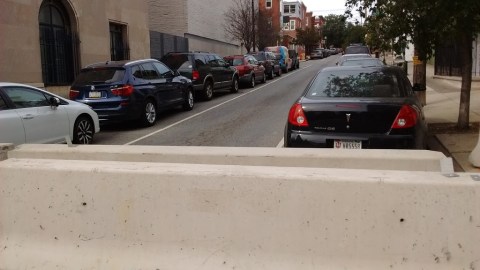

We also blocked the sidewalks of intersecting streets, leaving just enough room for pedestrians to squeeze through. This was to prevent terrorists from swooping in on golf carts or riding mowers:

We installed air-quality monitors to warn of chemical and radiation attacks (though some residents who tend to be gaseous worried about setting them off accidentally):

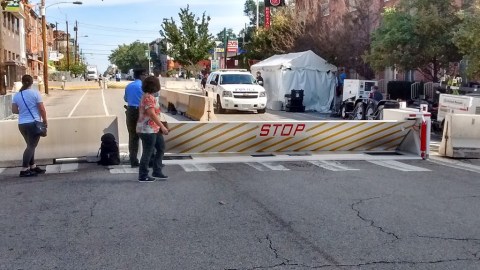
We set up checkpoints:
We placed sharpshooters on rooftops. (Sorry, no picture. You know what guys with high-powered rifles look like.)
We brought in large groups of friendly young men in camouflage uniforms:

We conducted constant surveillance from helicopters:

Looks like a spider up there, but it was much louder.
A little farther from our house, I spotted one low-flying Osprey, barely a hundred yards over the rooftops. This is an aircraft used only by the Marines and Air Force. Even the National Guard guys stared up at it in wonder, perhaps worried about its notorious crash record.
Of course we closed our schools and most of our small businesses. We detoured or stopped buses. To make room for the faithful, about half of our residents left town. Restaurants, if they stayed open, were empty.
Even the multigenerational Catholic family next door—a family that’s lived in the neighborhood for more than half a century—departed when they were unable to get tickets to the event. They planned to watch on TV from the Jersey shore.
So our neighborhood was all prepared to welcome Pope Francis. Proud of our efforts, we were ready to celebrate with him.
The only problem?
Our neighborhood wasn’t here anymore.

Our thriving city block
Tzapping the Borders
August 31, 2015
I’ve never before used this blog to endorse a commercial product—other than my own books, of course—but a special case has arisen concerning the very integrity of our country, and I feel I must alert my fellow Americans to what I’ve discovered.
We’ve all listened to the proposals from presidential candidates to build a wall along the Mexican border to stem illegal immigration, and Governor Scott Walker of Wisconsin has logically extended the proposal to the Canadian line as well. There is nothing hysterical or paranoid about these concerns. Just pause a moment to think what would become of this country if we allowed the Mexican-Canadian rapist-murdering-drug-dealers to steal the lawn-care jobs of American workers!
There is a major problem, however, that none of the candidates has addressed. The barriers would be enormously expensive to construct, possibly requiring a rise in taxes that no patriotic American would support. (Those who suggest that cinder block and labor could be imported cheaply from Mexico miss the point entirely.)
Moreover, the Great Wall advocates have overlooked thousands of miles of other entry points: the Gulf Coast, the Great Lakes and the Atlantic and Pacific oceans. Who knows when Mediterranean people-smugglers will invest in better boats so they can drop off Syrian refugees on the Boardwalk in Atlantic City? There’s also the possibility, remote at this time but certainly a concern for the future, that alien shark-creatures might swarm ashore and apply for work cooking fish fillets at McDonald’s. And what about mutant penguins? Has anyone considered the mutant penguins?
Thus it’s apparent that the political debate has been riddled with gaps in logic as huge as the holes in Carly Fiorina’s resume. Luckily, technology—American technology, best in the world!—can again save our butts as well as our souls. A leading innovator in the security industry, Pharr Integrated Security Solutions of southern Texas, is now marketing the Tzapp Total Border System, and this is the product I’m compelled to tell you about.
Based on the groundbreaking work of legendary physicist Seymour Tzapp, the laser-based system is both efficient and economical. One relatively inexpensive laser weapon, adjusted properly, can protect 425 miles of border or coastline; hence a complete system would cost a fraction of a Great Wall.

One unit of the Tzapp Total BS
How does it work? When any object larger than a hare begins to move across the secured line, the Tzapp Total BS delivers a pulsed, narrow-beam wallop strong enough to enforce immediate retreat. In tests conducted in the Rio Grande Valley, the system has scattered deer, terrified ocelots and caused skunks to spray themselves uncontrollably. The Texas tortoise (Gopherus berlandieri), once Tzapped, has been timed at 30 mph, outrunning a raccoon.
One additional feature: The Total BS leaves a prominent raised scar, curved like a Nike swoosh in bright orange. This will prove as embarrassing to a Mexo-Canadian rapist-murderer as to a nefarious opossum, and a single Tzapp will be enough to discourage future transgressions, especially if the lasers are aimed to strike a delicate part of the anatomy. During the beta test, the tortoise was so mortified he never came out of his shell again.
I would supply a link to further information about the Tzapp system, but in its haste to bring this amazing product to the American public, the company has not yet developed an online presence. However, all interested parties—politicians, military officers, gun freaks and ordinary citizens—are invited to visit corporate headquarters in Pharr, a lovely community just a few miles from the McAllen Miller International Airport. Although it’s a small and unprepossessing city, you can’t miss the signal that you’ve arrived: a sign at the border tells you that you’ve gone to Pharr.
Vote and They Will Come: A Rant by No. 19
August 14, 2015
 We had an election this week in Philadelphia. A special election to fill three vacancies in the state House, two of which arose because the incumbents quit after pleading guilty to corruption.
This event produced a grand Y-A-W-N in the city. The media ignored it, and the outcome was predetermined. (Local Democrats, with a huge registration advantage, automatically win any vote with such little publicity.) Besides, most of us don’t even know our representatives in the state House, and as far as we can tell, their only function is to send us a boastful newsletter just before the next election. As for corrupt officials, they’re as common here as in Iraq, and perhaps cheaper, and we don’t expect new ones to be any less venal.
Nevertheless, stifling my Y-A-W-N, I wandered over to my polling place about 11:30 in the morning. It was deserted. They told me I was the 19th person to come in since the polls opened. Explained one attendant who was eating a pastry, “We don’t even call this light turnout. It’s dim turnout.”
For the 30 seconds I spent in the booth, I received the sticker shown above—a more than adequate reward. I chose the Spanish version because I’m trying to learn the language. Combining this with the sign I encounter frequently, “NO TIRE BASURA,” I’m up to six words total. It’s a start.
But I was upset about being number 19. That’s worse than dim turnout, it’s like Milton’s description of Hell: “No light, but rather darkness visible.”
For an election pitting Luigi’s Pizza against Pete’s Famous Pizza, my neighborhood would have several hundred voters by late morning. Everybody knows Luigi’s would win—it’s predetermined by the crust—but people would show up at the polls anyway.
So I went into my typical funk about the trashing of American democracy. In my view, we can survive Donald Trump and Fox News (which treated the recent Republican debate like a game show), but what we can’t survive is indifference.
Okay, you’re heard that before. Everybody complains about the apathy of the American public. And the counterargument seems like a good one: If the choices are Tweedledum and Tweedledee—or, say, Trumpledump and Christiedweeb—indifference is a rational response, isn’t it?
I disagree, and here’s my reasoning.
Imagine your typical city neighborhood, which averages 60% turnout during presidential elections, 40% in midterms, 20–27% in mayoral elections, and way, way less in off-off-season polls like the one we just had here. On average, then, a lot more than half of the people don’t vote. Now suppose that, in the next election, the neighborhood’s turnout jumps a modest 15% for no obvious reason (no candidate from the dominant ethnic group, no hot-button issue on the ballot). What will happen?
The local politicians will suddenly get very interested in that neighborhood. They’ll start to ask what’s going on there. They’ll stop by and talk to people. They’ll want to know what issues the community cares about.
This imaginary scenario leads to my slogan, with apologies to Field of Dreamers:
VOTE AND THEY WILL COME!
It doesn’t matter if, at the moment, you can’t tell a Fiorina from a Cannoli. Vote in reasonable numbers and they will be forced to address your issues. Vote especially when the slick pols and the talking heads don’t expect you to.
After all, we citizens have just two things politicians care about: (a) votes and (b) money. For those of us with little cash to spare, votes are the only weapon, and if we don’t use that weapon to defend ourselves, we’re choosing to bend over and take it up the … wherever (to use a famous Trumpism).
Sure, I understand all the points about the influence of big money, the rise of the oligarchy or plutocracy or whatever you want to call it. I also sympathize with the rage that leads people into the streets to scream and throw rocks at the cops. But when we throw rocks, we’re not hitting the moneymen and asshole politicians who run the system. As soon as we go home, those bigwigs will go back to ignoring us unless they think they’re losing money or votes.
Thus, no matter how oppressed or depressed the community, I get upset with locals who complain but don’t bother to vote. Despite Republican efforts to suppress turnout, most people wouldn’t have any trouble voting if they made an effort.
It’s the one defense we have left. Nobody’s forcing us to be helpless.
According to Google Translate, the slogan is even simpler in Spanish:
VOTA Y ELLOS VENDRÁN!
Plus, you get a nice sticker. Feel free to print this one and glue it to your shirt. Do correct my Spanish if I got it wrong.

Novels, Earthworms and Raw Mutton
March 5, 2015
 On this snowy day in March, when my hometown Philadelphia is pretending to be Boston and Boston is pretending to be Baffin Island, I’m taking a break from shoveling two sidewalks (office and home) and inventing ways to torture the groundhog who predicted this weather.
Now would be a perfect time for reading a novel. Lately, though, I’ve been pondering the frequent reactions I get when I recommend a recent novel to friends or acquaintances.
Sometimes it’s a pained, put-upon look, as if I’d suggested they shovel the snow from my 100-foot driveway. (Strictly a metaphor; my driveway is only 6 feet.)
Sometimes it’s an unbelieving, disdainful grimace as if I’d offered tickets to a Justin Bieber concert.
Sometimes it’s even worse: a repulsed glare as if I’d dragged my friend to an expensive restaurant for a feast of earthworms, sycamore bark and raw mutton. (Metaphor again: Philly doesn’t boast such a restaurant—yet.)
The people I’m talking about are urbane, well-educated folk who must, at one time or other, have read a novel. Why does the idea repel them so much now? I’ve come up with several possible explanations.
- Middlebrows like me, they need all their spare time for watching British costume dramas. Maybe, like me, they’re still trying to figure out why any eligible bachelors tolerate Mary Crawley.
- Implying that a friend would read a book for fun is an insult, really. It’s like saying your haircut is so perfectly 1974.
- Given the dire condition of the world, they may agree with Elena Ferrante’s character Franco Mari, a political activist who declares to his ex-girlfriend, “[T]his, objectively, is not the moment for writing novels” (from Those Who Leave and Those Who Stay).
- They may see contemporary novels as gimmicky and trivial. Partly true.
- They may see contemporary novels as wordy, opaque, unfocused and boring. Also partly true.
- It’s a pain to read a lot of text on a phone, and what other way is there to read?
- If the friend is male, he probably views novel-reading as beneath his serious manly dignity, like Mr. Collins in Pride and Prejudice: “Mr. Bennet was glad to take his guest into the drawing-room again, and, when tea was over, glad to invite him to read aloud to the ladies. Mr. Collins readily assented, and a book was produced; but, on beholding it (for everything announced it to be from a circulating library), he started back, and begging pardon, protested that he never read novels.”
Hmmm. …
You know, after all that, I’ve convinced myself it’s foolish to waste time on fiction. I think my companion has a better idea for a wintry afternoon.

Elvis and the Season of Light
December 16, 2014

Photo by Ed Roberts via Wikimedia Commons
I’m pretty much a bah-humbug person, especially now that Santa sends me spam emails. (Really, Big Guy? I’m much more likely to open an offer of gifts from someone called Ashley or Courtney or Svetlana. Try changing your name.) Yet, though I refuse to celebrate in an outward fashion, I do love the so-called “spirit” of the winter holidays. Last year about this time I wrote a little essay about the “season of depression,” which ended up on the Superstition Review blog in February. That post mentioned in passing a church tradition of lighting candles on Christmas Eve, typical of the way many (or most?) religions counter the winter darkness by celebrating light. In fact, Chanukah, the Festival of Lights, begins tonight.
This year, then, I’ll post a passage relating to our reverence for light and all that it suggests. What follows is an excerpt from my novel The Big Happiness, which I’m preparing for republication as a Kindle ebook. A kind of warped love story, the novel features two protagonists who are each disabled in some way. Allison Roarty (a.k.a. Allison Wonderland) is a 45-year-old, divorced, wacky, sexually adventurous, somewhat overweight alcoholic with brain damage. By sheer accident she meets Leigh Berry, a gangling, half-blind, reclusive, 62-year-old devotee of ancient music. She seduces him and the novel is off and running—or rambling, stumbling and blundering after these weird characters.
Leigh’s language, like his mind, is often archaic and tortured. Through his relationship with Allison he has to learn to communicate again. He also has to deal with the “light,” both literal and figurative, that she insists on shining into the dim haunts of his life. One of her first acts is to throw open his curtains, and being an oddly mystical sort—though an atheist—he begins to suspect that the Light he encounters has meaning for him. On Christmas morning in Allison’s apartment, he wakes before she does and senses rays of a peculiar color—a silvery, otherworldly blue-white—on the windowsill. He’s intrigued and also scared, afraid he won’t live up to what Allison, and the God he doesn’t believe in, are demanding of him.
Then Allison wakes up. The two exchange presents, fool around in bed and listen to Elvis Presley’s recording of “White Christmas.” (It’s Allison, of course, who’s an Elvis fan—she “loved him even before he was dead.”) At last the lovers decide to venture outside:
She yawned, stood up, kissed him and proposed breakfast. “What say we splurge, sweetie? You think that coffee shop around the corner’s open today? Let’s go look. I could use a huge stack of pancakes and I think my Aunt Jemima mix has bugs in it—at least it did a few months ago.”
She dressed quickly and they bundled in their coats and gloves. Down the steps they went, arm in arm, out the door to the sidewalk. But there Allison jerked to a stop and grabbed him with both hands. “My God, look what happened! Careful, don’t fall—there’s ice all over. See it? The whole street’s coated! The rain must’ve froze, why didn’t somebody tell us?”
Leigh tried to peer about but he had forgotten his opticals. That odd silver light glittered everywhere.
“See the streetlight pole? That’s ice on it all the way up, like a, like a real cold condom, honey. It’s beautiful. The city’s deserted, no one’s going out in this. It’s all ours! Let’s pretend everybody else is dead. I mean, except the cook who’s gonna make our pancakes, he better be alive and working today or I’ll kill him.”
She nudged Leigh a step or two forward and pointed. “Look, right next to the building it’s dry, so if we take it real slow and stay close to the wall we can walk. You grab me and I’ll hold you. Those sparkly humps are parked cars, baby. That one that’s like a frozen little man, it must be the fire hydrant ’cause I don’t remember any midgets on this block. This is so cool! Hey, it’s a white Christmas, or close to white, just like Elvis said, sugar.”
The slicing crystal light reverberated in Leigh’s eyes, producing scattered bright spots, ghosts, shadows. He was reassured to learn of a meteorological explanation for the disconcerting rays through the curtains, but the direct glare was most confusing. He crept along beside the building with one arm up to shield himself.
Unearthly quiet in the city. The still air wrapping him in its cloak of silver wintriness. A dream of the afterlife come to this planet in overpowering brilliance.
“Neat-o,” exclaimed Allison when they eased round the corner. “That tree’s got, like, every tiny branch covered in ice.” She was suddenly gone a moment, during which he closed his eyes tight and faced the wall. Then she was back, tugging on one of his hands. “Here, feel this, slip off the glove so you can touch it, it’s so perfect. Trust me, Leigh, take your glove off, it won’t bite you.”
In his hand he felt a thin, hard, angular shape, sucking frostily at his fingers.
“It’s just a twig,” she said. “Off the tree. But see how perfect the ice coats it? It sparkles like diamonds. Or rhinestones anyway.”
The sharp light winked up from his palm, teasing him. A blued bodiless light of the soul—was it indeed God’s own?
“Now you have to admit,” she said, “Elvis can do magic, honey.”
Whether from heaven, humans or the spirit of Elvis, the lights of this season can indeed be magical—and challenging. May we all try to live up to their promise.
Election Results
November 8, 2014
On a truly bad night, with so much
at stake, after particularly ugly
activity in the worst possible group
of states, the voting culture conceded
that cynicism had won the day.
Doomed from the start, both sides
are strongly discouraged from taking
any such action. Stay tuned for updates.
That little “found poem” was constructed from phrases in online reports. Sorry, I was too depressed to do more.
The Inequality Debate
April 27, 2014
For the past few weeks I’ve been vaguely following the Inequality Debate, that is, the controversy surrounding arguments by Paul Krugman and others that economic inequality in the United States is worse than ever, that we live in a new Gilded Age, that our government is essentially an oligarchy rather than a democracy, and that presuming those at the top “earned” their way up the ladder is ludicrous.
I agree with all these ideas—actually I’ll call them facts. And none of them is new. But while the right wing panics because people are saying these things, and the left wing panics because they are true, I’m stuck as usual in a middle position. My heart is with the left but my head insists on caveats. The complicated sentiments that keep me in the middle can perhaps be reduced to a series of propositions—call them facts if you will.
- Although the wealthy have inordinate influence in America, our state and national governments are still run by elected officials.
- Our elections are, by and large, fair and honest. That is, votes are counted accurately, and despite conservatives’ efforts to shorten the voting rolls, people who make an effort to vote generally can.
- Among the candidates who run for office, some are considerably more sympathetic than others to the 99 percent of us who aren’t wealthy, and it is usually easy to identify these more sympathetic types.
- Although voting districts have been gerrymandered (by both sides), they are not so skewed that 99 percent could not outvote 1 percent.
- Therefore, if we the 99 percent voted consistently in our own interests, we’d have a hell of a lot more influence over policy than we do now.
- The fact that we don’t vote in our own interests cannot be blamed on anyone else. Sure, the right wing will try to con us into believing the latest version of the trickle-down theory, and a car salesman will try to con us into buying a gas-guzzling SUV, but whose fault is it if we let ourselves be deceived? As adults, shouldn’t we know better?
I propose adopting the following simple declaration:
We the 99 Percent of the United States, in Order to form a more perfect Union, establish Justice, insure domestic Tranquility, provide for the common defence, promote the general Welfare, and secure the Blessings of Liberty to ourselves and our Posterity, do ordain and establish this rule: that we will vote in every election, and vote smart, and not let the fucking bastards con us anymore.
Literature and the Season of Depression
February 9, 2014
A rambling piece of mine on winter, depression, literature, religion, and my grandmother—how are those subjects linked?—appears as a guest post on the Superstition Review blog:
It talks about books by Lauren Grodstein and Joan Didion, among many other topics. Thanks to Superstition Review for inviting me to contribute.
We the People and the System
January 20, 2014

Howard Zinn speaking in 2009
I’ve been reading a book my daughter lent me, Howard Zinn’s The Twentieth Century: A People’s History, which consists of the latter parts of his well-known A People’s History of the United States with additional chapters extending the story into the 1990s.
Because the People’s History has been on my reading list ever since it first came out—a mere 34 years, so I can be excused for not getting to it yet—I’ve been eager to open this more condensed version, and thus it’s sat on my dresser for half a decade at most. It’s not, in fact, what I expected—not an overall history from a populist point of view but essentially a summary of protest and resistance movements over the ages. That’s interesting enough in itself, but Zinn’s bias annoys me at times. For instance, there’s a running implication that, when piecemeal reforms were implemented, the business and political classes, including liberals and progressives, saw these primarily not as extensions of human rights, justice and compassion but as ways of easing the pressure for more radical change.
Throughout the book, there’s a tendency to refer to “the government” or “the system” as a unified entity that acts in a concerted and deliberate way to preserve class privilege. Here are some passages (with boldface added by me) from Chapter 6, which focuses on what liberals call the civil rights movement and Zinn calls “the black revolt of the 1950s and 1960s”:
[re the shooting of Black Panther leaders by Chicago police] “Was the government turning to murder and terror because concessions—the legislation, the speeches, the intonation of the civil rights hymn “We Shall Overcome” by President Lyndon Johnson—were not working?” [This use of a question to propose a radical conclusion without quite advocating it is another characteristic of the book.]
“The system was working hard, by the late sixties and early seventies, to contain the frightening explosiveness of the black upsurge.”
“The use of busing to integrate schools—sponsored by the government and the courts in response to the black movement—was an ingenious concession to protest. It had the effect of pushing poor whites and poor blacks into competition for the miserable inadequate schools which the system provided for all the poor.”
If “the government” and “the system” were really so cohesive and purposeful, we might have fixed them by now—or at least our protests would be a hell of a lot more focused.
Zinn is highly selective, too, in the facts he chooses to present. Here’s an early passage about expansionist nationalism at the turn of the twentieth century, featuring Teddy Roosevelt:
“Roosevelt was contemptuous of races and nations he considered inferior. When a mob in New Orleans lynched a number of Italian immigrants, Roosevelt thought the United States should offer the Italian government some remuneration, but privately he wrote his sister that he thought the lynching was ‘rather a good thing’ and told her he had said as much at dinner with ‘various dago diplomats … all wrought up by the lynching.’” (Chap. 1)
I wouldn’t defend the bully Roosevelt or his offensive speech, but to understand his reaction, the reader should be told that the New Orleans affair began with the assassination of the city’s police chief in 1890, and the perpetrators were assumed to be members of a well-known Italian criminal gang. This was the era when the word “Mafia” surged into public consciousness, and the jurors who acquitted the accused were popularly thought to have been bribed with Mafia money. None of this background excuses the lynching, of course, or Roosevelt’s ethnic disdain, but when we take the context into account, he becomes less of a caricature. Maybe he believed that all eleven men lynched were hardened criminals; I don’t know, but I wish Zinn had taken the time to fill in some gray shadings on his black-and-white sketch.
In spite of these reservations, I’ve been enjoying the book a lot, and learning from it. We tend to forget how persistently, throughout American history, citizens have resisted the governing elite, even in times we imagine as quiescent. “The memory of oppressed people,” Zinn writes, “is one thing that cannot be taken away, and for such people, with such memories, revolt is always an inch below the surface” (Chap. 6).
Some of the historical descriptions sound like they could have been written about the past few years:
“There was a deepening economic insecurity for much of the population, along with environmental deterioration, and a growing culture of violence and family disarray. Clearly, such fundamental problems could not be solved without bold changes in the social and economic structure. But no major party candidates proposed such changes. The political tradition’ held fast.” (Chap. 10)
That passage describes the period right after the Vietnam War, 40 years ago now. Here’s another timeless passage, characterizing the “double line of defense of the American Establishment”:
“The first defense is to deny the truth. If exposed, the second defense is to investigate, but not too much; the press will publicize, but they will not get to the heart of the matter.” (Chap. 10)
All too true—though not, I think, uniquely American.
Again and again Zinn makes his essential point that “endless ‘reforms’ [have] changed little” (Chap. 8). And some of his passages hit home with a visceral punch:
“given the nature of modern warfare, the victims, by a ratio of 10:1, have been civilians. To put it another way, war in our time is always a war against children.” (Chapter 12)
Defenders of our clumsy foreign wars might dispute the ratio, but the point is inescapable.
Those are the depressing aspects of the book. The positive? Zinn’s conviction, expressed in the final chapter, that more substantial change may be on the horizon:
“With the Establishment’s inability either to solve severe economic problems at home or to manufacture abroad a safety valve for domestic discontent, Americans might be ready to demand not just more tinkering, more reform laws, another reshuffling of the same deck, another New Deal, but radical change.”
That passage was written in the 1990s, and it rings even truer today. Yet my pessimism argues that we’ll never progress beyond the “might be ready” stage.
It’s difficult, as a contemporary American, to have faith in either “the system” or “the people”—and most of us belong to both. Or as Pogo said, “We have met the enemy and he is us.”
 The News from Gridleyville