
Rereading Stegner
August 12, 2011
 There’s a nice (repeat) post by Nichole Bernier at Beyond the Margins, about Wallace Stegner and his wife, Mary. She mentions that Stegner is “best known for his environmental writing, which has influenced generations of conservationists, and for his novel Angle of Repose (which won the Pulitzer in 1972), as well as his creative writing program at Stanford University.” If so, it’s a shame that his other novels aren’t more widely read today. Nichole says she is currently rereading All the Little Live Things, one of my favorites, in which he makes the California foothills teem with life—human, animal, vegetable, spiritual.
Sons and Heirs: Lorene Cary’s Latest
August 7, 2011
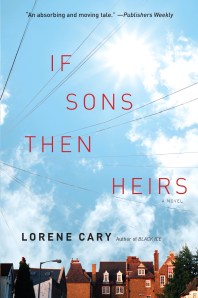 Recently I finished Lorene Cary’s latest novel, If Sons, Then Heirs, another fine and highly readable book from one of Philadelphia’s most respected authors. Lorene is well known locally for her community work with the Art Sanctuary, but as a reader I’m happy to see she’s not neglecting her own writing.
Featuring several generations of a single family, If Sons, Then Heirs combines a fairly simple present-day story with an intricate and complex revelation of the family’s past. The genealogical tree that appears early in the book should help readers keep track of the many characters who roam the pages. Unfortunately, I read the Nook e-book version, on which the chart is illegible, and so I was constantly struggling to remember, for instance, how Binkie is related to Lil Tootchie. (Great names throughout!)
Roughly, the present-day plot goes like this: Rayne, an African American man who runs a construction business in Philadelphia, stands to inherit the old farm on which his great-grandmother, Selma, is living in South Carolina. Yet because of racist property laws and contracts, the ownership of the land is in question. As Rayne begins to tackle this issue, he is contacted by his mother, Jewell, who abandoned him to Selma’s care decades ago. Rayne also faces a decisive point in his relationship with his girlfriend, whose son has just begun to call him “Dad.” That’s four generations right there—or five, if you count the one skipped between Jewell and Selma—and the author will add cousins, aunts, uncles, stepfathers, and more to the troop.
At first, Rayne isn’t particularly interested in digging up his family’s history, but inevitably, in confronting the land issues, he must uncover a good deal more than he ever wanted to know. Having tried my own hand at stories that dredge up the past, I was intrigued with the tone of this book, which strikes me as an interesting mix.
From the start, we know from all the elements that form a tone—the style, the positive resolution of small incidents, the degree of humor and warmth, the preponderance of good people, etc.—that nothing really terrible will happen to the main characters in the present-day story. I refuse to label that comment with a “spoiler alert” because the comfortable tone is evident from the first chapter. Yes, Selma is extremely old and doddering, and Jewell’s husband is sick with cancer. Perhaps one or both of these fine folks will die in the course of the novel—I won’t reveal that; see, I’m being good!—but, even so, that will not make a tragedy. We know that Rayne and Jewell will survive and most likely continue the relationship they have newly established.
The past is another matter. When Rayne descends into the dark cellar of this family’s history, he unearths not skeletons so much as bloody remains—the still-dripping evidence of racial violence. No humor and warmth there, just ugliness and calamity, and the author presents them in gory detail:
He raises the tire iron in his hand and the others stand clear of him, because he is swinging wild, hitting the hood, the car door, hitting [the victim’s] legs, shattering the windows, and grabbing through the window at the great, flailing, dangerous, bloodied body.… [He] cuts up his own arm. It bleeds onto the car door and down his side. He lets out war yells like an Indian.
What’s the effect of such a tragic, violent tale wrapped inside a warm and slightly sentimental one? Though I was interested in the gradual revelations of the past, I can’t say I felt suspense, because the outcome—the contemporary lives of the main characters—is already known. In fact, though the villains of the past have present-day descendants, with whom Rayne has to deal to resolve the land issue, Cary treats that story line summarily. Ultimately the past becomes a vivid, personalized history lesson more than a tension-filled story.
The lack of suspense hardly matters, however. Throughout, the characters are the strength of this work. They are big, passionate people struggling to do the right thing. Bringing the scattered relatives back together and understanding what happened to drive them apart—these are the keys to the family’s redemption, and that theme is what Cary wants us to take away from the novel. I’m taking it, and I won’t soon forget Rayne and Jewell and Selma. Another good read from Lorene Cary.
Beyond Bizarre: Karen Russell and the Swamplandish Style
July 27, 2011
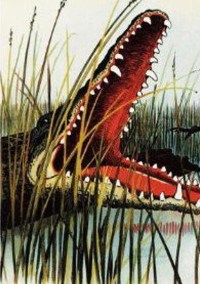
From the cover of SWAMPLANDIA!
Breaking my tradition, I’ve celebrated my return from two months of overwork by reading a best-selling novel less than five years after its publication date. The book is Swamplandia! by Karen Russell, and it’s inspired me to coin a new word for personal use, swamplandish, meaning outlandish/bizarre/wacky in an interesting way.
For those who haven’t read the book, here’s Donna Seaman’s description from Booklist, courtesy of Amazon:
Swamplandia! is a shabby tourist attraction deep in the Everglades, owned by the Bigtree clan of alligator wrestlers. When Hilola, their star performer, dies, her husband and children lose their moorings, and Swamplandia! itself is endangered as audiences dwindle. The Chief leaves. Brother Kiwi, 17, sneaks off to work at the World of Darkness, a new mainland amusement park featuring the “rings of hell.” Otherworldly sister Osceola, 16, vanishes after falling in love with the ghost of a young man who died while working for the ill-fated Dredge and Fill Campaign in the 1930s. It’s up to Ava, 13, to find her sister, and her odyssey to the Underworld is mythic, spellbinding, and terrifying. Russell’s powers reside in her profound knowledge of the great imperiled swamp, from its alligators and insects, floating orchids and invasive “strangler” melaleuca trees to the tragic history of its massacred indigenous people and wildlife. Ravishing, elegiac, funny, and brilliantly inquisitive, Russell’s archetypal swamp saga tells a mystical yet rooted tale of three innocents who come of age through trials of water, fire, and air.
Normally I’d be turned off by the first sentence. I like reading about the world I know, which has never included alligator wrestlers. Normally, too, if I dipped into the book itself, I’d be annoyed by the extreme degree of exaggeration. The book’s literal story line does involve that so-called amusement park named the World of Darkness, where a popular attraction for the Lost Souls (as the customers are called) is a slide down the intestinal tract of the Leviathan. The jingle, sung happily by the Lost Souls, goes like this: “The Leviathan, the Leviathan, what a bargain! All that pain in a single afternoon!” Since it’s not quite satire—or far beyond satire—the tone often strikes me as camp, way-out-there for the amused smirk of being way-out-there.
Yet something kept me going with this novel. Part of it was the verve of the writing. Russell has vast buckets of energy, some of which she splashes into swamplandish metaphors. Here are some examples from early in the book:
Nights in the swamp were dark and star-lepered
dozens of alligators pushed their icicle overbites and the awesome diamonds of their heads through over three hundred thousand gallons of filtered water
I started to miss the same tourists I’d always claimed to despise: the translucent seniors from Michigan. The ice-blond foreign couples yoked into thick black camera straps like teams of oxen. The fathers, sweating everywhere, with their trembling dew mustaches. The young mothers humping up and down the elevated walkway to the Swamp Café, holding their babies aloft like blaring radios.
This style is both brilliant and fraught with contradictions that keep the reader off balance. The brilliance speaks for itself—trembling dew mustaches! But an actual leper doesn’t look at all like a star-spotted sky, and the allusion to a leper in a romantic descriptive passage adds a tonal jolt. An alligator’s teeth have the sharpness and slickness of an icicle but not the coldness or fragility. If the couples are “yoked” like oxen, they are attached to each other by those camera straps, but surely that’s not right. Babies are indeed like blaring radios, but nobody holds radios “aloft”; for that matter, how many mothers hold their babies “aloft”?
It may seem silly to analyze the logic of metaphors, but my point is that Russell must be deliberately keeping us off terra firma. The very style is swampy and ever-shifting underfoot, with beauty and ugliness and romance and weirdness jumbled together, sucking us toward the bottom of solid reality, if not beyond.
And the plot proceeds in a similar way. One could write an outline that would seem simple and realistic; as Janet Maslin said in her New York Times review (2/16/11), “Take away the wall-to-wall literary embellishments, and this is a recognizable story, if not a familiar one.” Yet the tone often verges on the magical. In fact, my favorite part of the novel was 13-year-old Ava’s expedition to Hell to rescue her sister, who has supposedly eloped with a ghost. Ava is accompanied by a strange adult known as the Bird Man, and for a good while, as they approached the doors of Hell in the lonely midst of the incredible wild swamp, I supposed we were heading off into magical realism.
(SPOILER ALERT.) I was rather disappointed, then, when the story crashed back to earth and the magic disappeared. The end, lepered with impossible coincidences, is rather sentimental in its reunion of the splintered family. Yet exactly none of the family’s problems have been solved, and we leave them in a dreary mainland apartment “carpeted and wallpapered in rusty browns, a palette that reminded me of dead squirrels.” It’s a peculiar and off-kilter happy ending.
Maybe that, too—optimism in the face of death, madness and depressing decor—deserves the adjective swamplandish. Thanks to Karen Russell for adding to my vocabulary such a potentially useful word.
Strawberries, Pies, Books
April 28, 2011

Pie Eating in Seattle (from Wikimedia Commons, uploaded by Jmabel)
This weekend I’ll be visiting the Strawberry Festival at Peddlers Village in Lahaska, PA. Fran Grote and I will be hawking our novels at a table outside the Canterbury Tales Forever Bookstore, 10:00–1:00 on Saturday and 1:00–4:00 on Sunday. Come for the pie-eating contests, stay for the books. Note that Pennsylvanians will certainly be more refined than the Left Coasters in the picture. Feeding the authors is encouraged, but please do not throw pies.
The Literary Hibiscus: A Complaint About Symbolism
February 19, 2011
Back from the near-dead. Seventy-hour work weeks, snow, freezing temperatures, lack of sun, topped off by a virulent head-and-chest virus that apparently laid waste to Baltimore before attacking Philadelphia—all have made this a miserable winter. Granted, we’re sissies here in the mid-Atlantic, and I admit that I could never live in Minnesota, even if Garrison Keillor dropped by nightly to tell stories. Still, I enjoyed pitying myself, and if this is the only happiness one gets for months at a time, that qualifies as misery, doesn’t it?
In these lost months I’ve managed to read just one book, Chimamanda Adichie’s first novel, Purple Hibiscus. I haven’t yet tried her second novel, Half of a Yellow Sun, or her story collection, The Thing Around Your Neck.
Purple Hibiscus, as the reviewers said, is a classy debut. Though the background is the Nigerian political scene, the focus is on a single family with a domineering father, passive mother, and two children trying to cope with the impossible situation created by the parents—something that should hit home for me, since I’ve written an American novel with the same setup. And I did respond acutely, enjoying even the long stretches when it seems the teenage narrator-protagonist, Kambili, will never get up the gumption to strike out for freedom from the oppressor. Adichie gives her characters enough complexity to challenge our simple presumptions: the abusive father has many good points, and the more attractive characters, while never verging on evil, have quirks to keep us interested.
She’s good at description, offering simple but vivid detail about daily life:
Obiora was pounding a yellow mango against the living room wall. He would do that until the inside became a soft pulp. Then he would bite a tiny hole in one end of the fruit and suck it until the seed wobbled alone inside the skin, like a person in oversize clothing. Amaka and Aunty Ifeoma were eating mangoes too, but with knives, slicing the firm orange flesh off the seed.
And a moment later, when flying termites course past the apartment complex:
The air was filling with flapping, water-colored wings. Children ran out of the flats with folded newspapers and empty Bournvita tins. They hit the flying aku down with the newspapers and then bent to pick them up and put them in the tins. Some children simply ran around, swiping at the aku just for the sake of it. Others squatted down to watch the ones that had lost wings crawl on the ground, to follow them as they held on to one another and moved like a black string, a mobile necklace.
It helps that the scenes are exotic to Western readers. We can read a sentence like
Lunch was jollof rice, fist-sized chunks of azu fried until the bones were crisp, and ngwo-ngwo.
with a fascinated hunger that we might not feel if the ingredients were more familiar:
Lunch was baked beans, fist-sized chunks of breaded chicken deep-fried until crisp, and cole slaw.
Still, the power of description is in the vivid, accurate details, and Adichie gets those right—as far as this Western reader can tell. (The azu does sound good, whatever it is. Wikipedia says it’s a Japanese R&B singer.)
The one crispy bone I have to pick with Adichie concerns the purple hibiscus, the title flower. In the novel’s extended family, Aunty Ifeoma, the liberal, liberating force, happens to grow an unusual purple hibiscus that her neighbors all admire. The narrator’s brother, Jaja, takes some of Ifeoma’s purple flowers to plant in the garden by his own house, and soon afterward he plucks up the courage to defy his father. At the end of the first section, the narrator makes sure we see the connection: “Jaja’s defiance seemed to me now like Aunty Ifeoma’s experimental purple hibiscus: rare, fragrant with the undertones of freedom. … A freedom to be, to do.”
I’m on a bit of a crusade against standard literary devices, which seem to me all too pervasive in contemporary writing, and this kind of heavy-handed symbolism, which I suspect Adichie absorbed from evil Western influences, ticks me off. The innocent hibiscus plant itself plays little role in the novel; it’s there just to be loaded down with symbolism. Let it go free, I say, free from the burden of representing freedom! Liberate it from the novelist’s manipulation. And don’t make those flying termites into symbols either. If you build the meaning into the action, the characters, the setting—as Adichie has done so admirably—we readers don’t need symbols as a side dish with our crispy azu.
The Importance of Place
December 18, 2010
Years ago, when I was reading a lot of Western writing—meaning books by authors of the American West, not genre “Westerns”—there was much talk about the importance of place in literature. This somewhat vague concept includes not just the physical attributes of a place but the meanings humans bring to the locale. American writers of the twentieth-century West became especially sensitive to place and its implications. Why? Several reasons come quickly to mind:
(1) Western writers shared a sense of outsiderness, feeling isolated from the supposed cultural centers of the East. For them, making place important was a form of self-assertion.
(2) Western landscapes are so dramatically different from those of the East—often harsh, dry, empty—that it seems they must intrude on a story, affecting the thoughts and emotions of the characters.
(3) Some Western experiences just don’t exist in the East. In Vermont you’ll never encounter a grizzly bear or a surfer, unless s/he’s on vacation.
(4) Because of Western geographic and climatic conditions, patterns of settlement differ. Could a suburban Connecticut tale, with neighbors right next door, be transplanted to a desert region of Arizona where you have to drive an hour to find a dentist?
(5) The West, being the new region, lacked the traditions of the East. It had little history, at least as far as Euro-American settlers from the East were concerned, and much of its real history was soon distorted into myth. Hence it was a locale, as Gertrude Stein remarked of Oakland, with no there there. Western writers focused on the sense of place in part because of the lack of human depth to their place.
(6) With open land for the taking, the West is where our migrants traditionally headed, and once there, they typically kept on moving. Even in the late twentieth century it was a territory where humans seemed more restless than mountain goats. Again, Western writers sensed what was missing, the deep rootedness that comes from staying in one spot for year after year, slowly changing with the neighbors, the growing tree in the backyard, the buildings that rise and fall, the succession of tragedies and comedies that give a place its character.
That last point resonates with me personally. My own family, like the Dennisons in my novel The Shame of What We Are, bounced around the East Coast until I was about eight, then skipped across the continent to southern California, where we continued bouncing and skipping. If that sun- and smog-blasted area could ever have felt like home to me, my family’s continuous uprooting made that impossible. The experience has been shared by many Americans, for whom dissatisfied wandering is a quintessential characteristic:
“Indifferent to, or contemptuous of, or afraid to commit ourselves to, our physical and social surroundings, always hopeful of something better, hooked on change, a lot of us have never stayed in one place long enough to learn it, or have learned it only to leave it.”
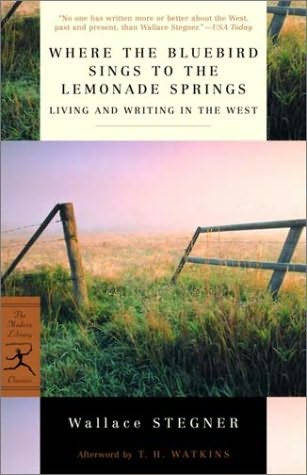 That’s Wallace Stegner in “The Sense of Place,” an essay included in his 1992 collection Where the Bluebird Sings to the Lemonade Springs. He also quotes Wendell Berry’s famous line, “If you don’t know where you are, you don’t know who you are.”
These matters came to mind the other morning when, stumbling up the sidewalk on my way to work, I noticed a neighbor decorating her sidewalk tree. In our ultra-urban locale, holiday decorations tend to be muted. First off, if you put a Santa on your stoop, someone will steal him, which might bring a lawsuit by the elves for reckless endangerment of an icon. (Certainly the elves have powerful sway over the politicians and mega-lawyers downtown; there’s no other explanation for much of what happens here.) Second, since the houses are three stories high and joined to the neighbors’ in a block-long row, the notion of stringing bulbs or reindeer across the roofline is best left to a few crazy drunks or professional roofers. Even the people who bang on your door after a snowstorm and offer to shovel the sidewalk for $5 do not offer to hang Christmas lights.
So it was unusual that my neighbor—I’ll call her Martha—would be decking an outside tree, and her style of doing so seemed even less common: a three-foot cone of green boughs around the tree’s base. Insensitive as usual, I teased her that she was perverting nature by turning the poor maple upside down—bare at the top, pine-green at the bottom. Martha explained that she and her daughter had seen holiday decorations like this on a trip to Vienna, and they had agreed to do something similar at home. The daughter had taken photos as a reminder.
When I made it to the office and slurped my second cup of coffee, an appreciation of this slight interchange began to dawn on me, and it had to do with a slowly emerging sense of place. After the dozens of relocations of my early years, I’ve become firmly rooted in this neighborhood, so much that I don’t even like to leave for vacations. Though writer friends go away on “residencies” at “colonies” or “centers” in order to escape the daily mess and concentrate on their work, I’ve no interest in doing that. My only request is that someone get my daughter’s dog to stop barking at the empty sidewalk. (Shut UP, Alfie!)
Thus I could fit Martha’s behavior into its social and environmental context in a way not possible in my wandering early years, when I was always a tourist. I could smile about bringing a taste of aristocratic Vienna to working-class Fairmount, Philadelphia. More important, though, was the personal context, and that’s the crux of this tiny story.
Martha’s daughter, who had traveled to Vienna with her and taken the souvenir photos of the outdoor trees, died this past summer. A woman in her thirties with a young child. A mysterious stroke, then another, then a diagnosis of a cancer that had supposedly precipitated the strokes, then debilitating chemotherapy, then weeks of bedridden suffering, then another stroke that killed her.
Martha and her husband had been devastated by their daughter’s quick decline. Clearly the sidewalk tree, with its small tepee of greens and a ribbon near the top, was a memorial. Martha didn’t have to say that, and I didn’t remark on it. But I understood and appreciated, and she knew that I did, and this constituted a brief and very human moment in our cold winter season.
In its essence, the sense of place is about this sort of connectedness—to the environment, the society, the neighborhood, and most of all the people. Architects and planners have latched onto the concept, and there’s even a blog about it by Marilyn Finnemore. But I’m still not very good at connecting; distracted, hurried, impatient, I walked past Martha’s tree several more times before noticing it again.
My lifelong symptoms of displacement are widely shared by Americans, I suspect, even those who weren’t hauled from place to place as children, and I worry about what this means for our cultural future.
Nostalgia, Part 3: Clouds of Glory
November 2, 2010

William Wordsworth, from Wikimedia Commons
“. . . trailing clouds of glory do we come
From God, who is our home . . .”
Wordsworth’s “Ode: Intimations of Immortality from Recollections of Early Childhood” offers perhaps the strongest explanation of the types of nostalgia that I’ve been exploring in recent posts.
Wordsworth’s poem is famous because he describes a universal sensation, the inkling that once—when?—we connected more deeply with life’s mysteries. That time at the beach, holding Mom’s hand, when we clambered out over the rocks—why is that scene stuck in the mind? what was it we saw or said? Or on that summer sidewalk in a far-off city, in the flickering leaf-shadows under a street lamp, we felt a stirring that seemed almost to tell us—
Uh-huh. Wherever quavers like that were tugging us, most of us never quite made the connection, and in time we got busy and ceased to think about it. That’s certainly true of me. In fact, I discount most of my adolescent mysticism as the fumes of an overheated sexual furnace. And yet, when I take time to reflect, I miss feeling that way. In my notes for a recent story, I jotted that the protagonist was “yearning for yearning,” that is, wishing he could once more experience the unfulfilled urges that drove him crazy as a young man.
Recently I had a chance to read a draft of Byblos, an extraordinary novel-in-progress by a friend, Miriam Seidel. It tells two stories that on the surface seem widely disparate: the burning of the great Alexandria library in the time of Caesar and Cleopatra (and, yes, those characters appear in the novel); and the personal travails of Nina, a female dot.com entrepreneur in the early twenty-first century. The modern-day plot takes Nina back to her childhood home in upstate New York, where she experiences mystical connections not only to her younger self but also to a kind of spiritual zone that ultimately connects the two plots. She realizes that, in some way, numinous sensations like these sustained her through her difficult years of growing up in a discombobulated family.
Normally I have minimal tolerance for mysticism, especially if it comes too easily (see my grumpy comments about “Suzanne” in “Nostalgia, Part 1”). But Miriam grounds her spiritual flights in a deep sensory appreciation of the earth and its creatures. At the old homestead, we get a vivid sense of the tangled trumpet vines, the pallid mushrooms, the worms, the stones, the mucky pond with its slimy frogs, the cicadas screeching in the summer heat—along with Nina’s attempt to rediscover something important from her childhood that has gone missing. Heading for the pond, she rips her legs on a patch of brambles. Opening herself to all of this, she reaches out tentatively to sense the hidden links that bind the people and animals and rocks and plants together. She can’t name or describe these links, but she ends up putting her sensations to use by—well, I’m not going to reveal the end of the novel.
This kind of mysticism is grounded enough, literally and figuratively, for me to appreciate, and I believe that Miriam’s version is truer than Wordsworth’s because it blends the ugly with the pleasant, the hostile with the welcoming, the scummy pond with the pretty trees.
Old Willie did have talent, though, and I don’t mean to diss him. He’s worth quoting for the final words on the subject:
There was a time when meadow, grove, and stream,
The earth, and every common sight,
To me did seem
Apparell’d in celestial light,
The glory and the freshness of a dream.
It is not now as it hath been of yore;—
Turn wheresoe’er I may,
By night or day,
The things which I have seen I now can see no more.
Nostalgia, Part 1: Diaries and Heroes
October 30, 2010
After Marcy Casterline O’Rourke posted a rave review of my novel The Shame of What We Are on Amazon, I wondered who she was and why she liked the book so much. Exploring her own blog entries, I realized that we’ve both been pondering the past lately, and maybe that’s what first attracted her to Shame, which is set in the 1950s and 1960s. (Though this doesn’t explain her lofty rating of the novel; for that, we’d need to know what she was smoking.)
One of Marcy’s blogs focuses on her late husband, the actor Tom O’Rourke, and she talks about reading a diary he left behind, using it to fill in details of his life before she met him and puzzle out facets of his character that, after decades of marriage, she still didn’t understand. “The Great Mystery of Tom,” she titles one post. Her musings are both pointed and poignant.
Oddly (or perhaps not) I’ve just finished the first draft of a short story about a man who rediscovers his own adolescent diary. This proved difficult to write, because for me nostalgia is often painful. Beyond the poignancy and bittersweet pang, it leads to a deep sense of embarrassment about my younger self, and that happens in this new story, in which the character becomes ashamed of the young man he unearths.

Joanie & Bobby in 1963
Here’s another—not fictional but all-too-real—case in point: Last night I reconnected with a major icon from my youth. Our niece Anna, for no reason that we can fathom, has become a fan of folk music, and her greatest star, higher in the pantheon even than Pete Seeger, is Joan Baez. Hence we went with Anna and her family to Joanie’s concert last night in Philadelphia. Anna wore a handmade T-shirt with a 1960s image of our favorite folk diva; it must have taken her hours to draw with permanent markers.
So, there was the bittersweet sensation of remembering when Joanie (who looked a bit stiff and sore) was a young barefoot maid, and we too were young, and the music meant that the times they were a-changin’, that the deep achy yearning that swelled in our souls could find its place in the world and we would somehow connect not only with the zeitgeist but with the oversoul, the mystery at the heart of things.
It’s bad enough remembering inchoate hopes like that. But here’s where it gets really rough for me. The first time I saw Joan Baez in concert, she was indeed in her barefoot-maid stage, and a heckler yelled at her from the audience, “Why don’t you wear shoes?” She shot back, “That would spoil my image.” Today that seems a perfectly apt, funny reply. To my idealistic younger self, however, it was like a slap in the face. I wanted to believe, I guess, that she chose to go barefoot in the simple, honest, pure way in which I might grab a jacket out of the closet: “Hmm, it’s over 65 degrees and I’ll be on stage most of the night, so I won’t need shoes.” To realize that she might consider something as crass and commercial as her “image,” even with an ironic twist, shocked my entire belief system.
It’s painful to remember being that naive, that stupid. And to make matters worse, Joan sang the Leonard Cohen song “Suzanne.” Not only was that once my favorite song, but I considered it truly poetic, profound, inspirational. A woman who dresses in rags and feathers and leads you to a mysterious river/harbor where you meditate upon Jesus walking on the water—heavy stuff, man! But today when I hear lines like “you know that you can trust her / For she’s touched your perfect body with her mind,” I feel the opposite of trust. Sloppy, simple-minded, juvenile, semi-fake spiritualism, I call it now.
So, picture me at the concert in a balcony cheap seat, uncomfortable with memories of idealizing Joanie, growing more restive as Cohen’s pseudo-poetry wafts in ethereal waves over the rapt audience. … My wife reaches over and lays her hand on mind. I squeeze back in reluctant acknowledgment. Then she leans in and whispers, “Remember when you used to sing ‘Suzanne’ to me? Will you sing it to me tonight?”
I want to hide under my chair.
Luckily, though, we’re old enough that, after the long concert, a bus ride to our neighborhood, a short hike to our door in the brisk fall air, we fall harmlessly asleep.
Of Zweig and Patience
October 18, 2010
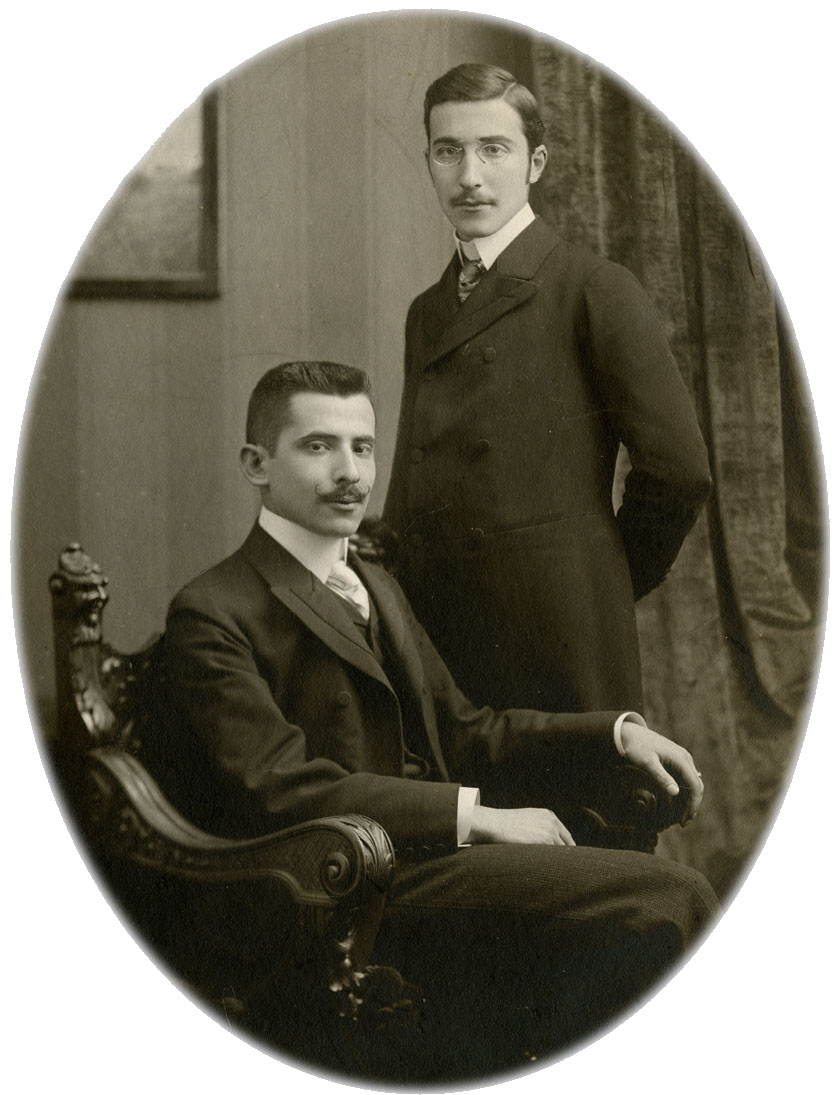
Stefan Zweig (standing) with his brother Alfred
A year or two ago my wife and I discovered Stefan Zweig (1881–1942), an Austrian writer whose memoir The World of Yesterday paints a lively picture of Europe before, during, and after World War I. Zweig knew every poet, novelist, dramatist, and artist on the scene; a devoted pan-Europeanist, he translated dozens of his friends’ works and wrote biographies of cultural figures ranging from Erasmus to Nietzsche to Balzac. In 1942, shortly after he finished the memoir, in exile in Brazil and despairing as Europe dove deep into another round of self-butchery, he and his wife took their own lives.
In the memoir’s last chapters, he speaks of the disbelief and agony that he and others like him experienced as they witnessed Hitler’s rise. On a Sunday morning he hears the radio news of the declaration of war, “a message which meant death for thousands of those who had silently listened to it, sorrow and unhappiness, desperation and threat for every one of us.”
After reading the memoir, we were moved enough to explore his other work. Despite his vast output of nonfiction and drama, Zweig found time for a number of novels, stories, and novellas—intense psychological works that examine the characters’ thoughts and emotions in exquisite, sometimes excruciating, detail. His writing is marvelous, his characters strange enough to feel very contemporary. And yet I have the typical problem of our A.D.D. age: attention span.
Look at the following passage from The Post-Office Girl (trans. Joel Rotenberg, New York Review Books, 2008). The title character, Christine, a penurious young woman from a small town, has been invited by a rich aunt to visit a magnificent resort in the Alps. When her aunt tells her to “freshen up” before lunch, Christine is amazed, bewildered, awed, and humbled by the luxurious hotel room she is given. We join the action, if it can be called that, about halfway through a two-page paragraph:
Discovery upon discovery: the washbasin, white and shiny as a seashell with nickel-plated fixtures, the armchairs, soft and deep and so enveloping that it takes an effort to get up again, the polished hardwood of the furniture, harmonizing with the spring-green wallpaper, and here on the table to welcome her a vibrant variegated carnation in a long-stem vase, like a colorful salute from a crystal trumpet. How unbelievably, wonderfully grand! She has a heady feeling as she imagines having all this to look at and to use, imagines making it her own for a day, eight days, fourteen days, and with timid infatuation she sidles up to the unfamiliar things, curiously tries out each feature one after another, absorbed in these delights, until suddenly she rears back as though she’s stepped on a snake, almost losing her footing. For unthinkingly she’s opened the massive armoire against the wall—and what she sees through the partly open inner door, in an unexpected full-length mirror, is a life-sized image like a red-tongued jack-in-the-box, and (she gives a start) it’s her, horribly real, the only thing out of place in this entire elegantly coordinated room. The abrupt sight of the bulky, garish yellow travel coat, the straw hat bent out of shape above the stricken face, is like a blow, and she feels her knees sag. “Interloper, begone! Don’t pollute this place. Go back where you belong,” the mirror seems to bark. Really, she thinks in consternation, how can I have the nerve to stay in a room like this, in this world! What an embarrassment for my aunt! I shouldn’t wear anything fancy, she said! As though I could do anything else! No, I’m not going down, I’d rather stay here. I’d rather go back. Bur how can I hide, how can I disappear quickly before anyone sees me and takes offense? She’s backed as far as possible away from the mirror, onto the balcony. She stares down, her hand on the railing. One heave and it would be over.
This scene goes on for another long paragraph in which Christine frets over what to wear, worries what the maid will think, and finally “scurries down the stairs with downcast eyes.”
I admire this writing tremendously—“timid infatuation,” a carnation like a trumpet’s salute—but at some point in the piling of detail upon detail, I become impatient. “I get the point!” my inner voice yells at the author; “let’s move on, OK?”
Then I remember what Stanley Fish once said to a seminar of undergraduates. The more the culture emphasized reading fast, he declared, the slower he read. He engaged us in examining Milton line by line, word by word, almost syllable by syllable.
I try to keep that perspective in mind. No, I lecture myself, don’t read Stefan Zweig while you’re simultaneously watching baseball, checking e-mail, and snacking on the delicious nut-cranberry mix from Trader Joe’s. Both hands on the book, please. Both eyes on the text. Slowly, patiently. Writers as good as Zweig deserve this much from us, and more.
Fishing for Readers: The Apostles Creed of Literature
October 15, 2010

“The two young men—they were of the English public official class—sat in the perfectly appointed railway carriage.”
We hear so much about the need for a “hook,” something to grab the reader immediately, that I take more and more pleasure in authors who ignore that dictum, or who wrote before it became the Apostles Creed of Literature.
The sentence quoted above opens Some Do Not…, the first novel in Ford Madox Ford’s magnificent trilogy Parade’s End. Does anything, other than the balance and rhythm of the style, hook us? What are the men doing? Merely sitting. Who are they? Members of a humdrum group of bureaucrats. Where are they? In a railway car whose principal attribute is that it has no faults. This is an anti-hook.
As those who’ve read the trilogy will remember, Ford’s purpose here is to establish the stasis of pre–World War I English society—a stability that will soon be rudely interrupted. Hence the men are seen first as unmoving stereotypes. But even after establishing their stillness, Ford is in no hurry to bring us action. Not until deep in Chapter IV do we reach the scene when Valentine Wannop alters Christopher Tietjens’ life forever by barging up to him on a golf course to demand that he save her friend and fellow suffragette from being manhandled. In the meantime, Ford treats us to, among other things, a description of Tietjens’ companion Macmaster, including his origins, current position, aspirations, and the thesis of the new book whose proofs he has been correcting on the train; a brief history of Tietjens’ disastrous marriage, which leads to an explanation of why the two friends have embarked on a golf outing; a mention of Tietjens’ pastime of finding errors in the Encyclopaedia Britannica; a philosophical discussion of monogamy; a long chapter with the wife, her mother, and a priest, who utters such observations as “’It’s a good maxim that if you swat flies enough some of them stick to the wall”; and, immediately after the opening quoted above, a leisurely survey of that boring railway carriage:
“The leather straps to the windows were of virgin newness; the mirrors beneath the new luggage racks immaculate as if they had reflected very little; the bulging upholstery in its luxuriant, regulated curves was scarlet and yellow in an intricate, minute dragon pattern, the design of a geometrician in Cologne. The compartment smelt faintly, hygienically of admirable varnish; the train ran as smoothly—Tietjens remembered thinking—as British gilt-edged securities. It travelled fast; yet had it swayed or jolted over the rail joints, except at the curve before Tonbridge or over the points at Ashford where these eccentricities are expected and allowed for, Macmaster, Tietjens felt certain, would have written to the company. Perhaps he would even have written to The Times.”
The writing is confoundedly leisurely, as Tietjens himself might have said. It’s also brilliant, pointed, and amusing.
No hooks. The reader isn’t treated as a fish. I admire that, and envy Ford for living in a time when it was possible.
I first read Ford when I was quite young, and now I’m wondering if my convictions about him would change during a new read. By accident in browsing, I discovered one person who has recently come to Parade’s End for the first time and finds it fascinating: see the entry in Hannah Stoneham’s Book Blog, http://hannahstoneham.blogspot.com/2010/04/read-along-of-ford-madox-fords-parades.html.
 The News from Gridleyville