
Secrets upon Secrets upon Lies
July 10, 2024

“How can one family have so many problems, especially a Jewish family?” says my wife, who considers her own childhood in a secular Jewish household the model for all such. On my recommendation, she’s been reading Ona Gritz’s memoir Everywhere I Look, in which the author’s family suffers—and creates—multiple disasters.
An accomplished writer in middle age, Gritz sets out to investigate the life of her older sister, Angie, who was murdered as a young woman along with her husband, child, and unborn baby. This was more than 40 years ago. Though she adored Angie, the author had always felt guilty for being the favored child and failing to stand up for her sibling. In a way, Gritz told herself, she was responsible for Angie’s many troubles, from the rebellious childhood to the adult life exposed to drugs, dubious characters, and violence.
It takes courage, then, to probe the family history, and the more Gritz does so, the more secrets emerge, not only about Angie but about their parents, their cousins, their aunts and uncles. All families have secrets, of course, and the sensational ones have driven many a plot in memoir and novel. In Gritz’s case there are indeed some further biggies that come to light—facts not just concealed but deliberately lied about.
The reader wonders, What the fuck could they have been thinking? How did this one family, as my wife mutters, get so screwed up? Gritz does a good job of exploring the characters of these people so capable of neglect, poor decisions, and pernicious deception. Perhaps, as she writes in the final chapter, they were “more ignorant than malicious.”
It’s the kind of question that can’t really be answered. In place of explanation, we have to settle for emotional resolution. The book concludes at the cemetery where Angie is buried. Angie’s name, and that of her young son, are missing from the headstone, and Gritz arranges to fix the engraving. As she has done throughout, she speaks directly to her murdered sister:
“So much had been withheld and taken from you in your brief life, and I’d been incapable of doing anything about it. Now, finally, I’d figured out a way to stand up for you, and soon I’d do it again by writing our story. I’d say that I remember. I’d mark that you were here.”
One Reason I Like Fiction
December 18, 2013
My wife recently read Blue Nights by Joan Didion, a moving memoir about the author’s loss of her 39-year-old daughter. Like many other readers, Peggy admired the book but remained puzzled about what exactly killed the still-youngish woman. The memoir is “a little less than clear on the events that took place.”
I haven’t read the book myself and have little right to comment on it. The link on the quotation above leads to an article that discusses the possible diseases involved and reasons why Didion may have dodged the issue—if indeed “dodged” is an appropriate word for a deliberate decision by a well-respected writer whose recent work has courageously been “turning the scalpel on herself.”
My point here is that, in a novel, the author would not have been able to conceal or evade such a basic fact. If the daughter were a fictional character, readers would demand to know what was going on, and editors would demand that readers be satisfied. Perhaps one could structure a novel so that the mystery itself, the unknowability, became a central theme, but that’s a different question.
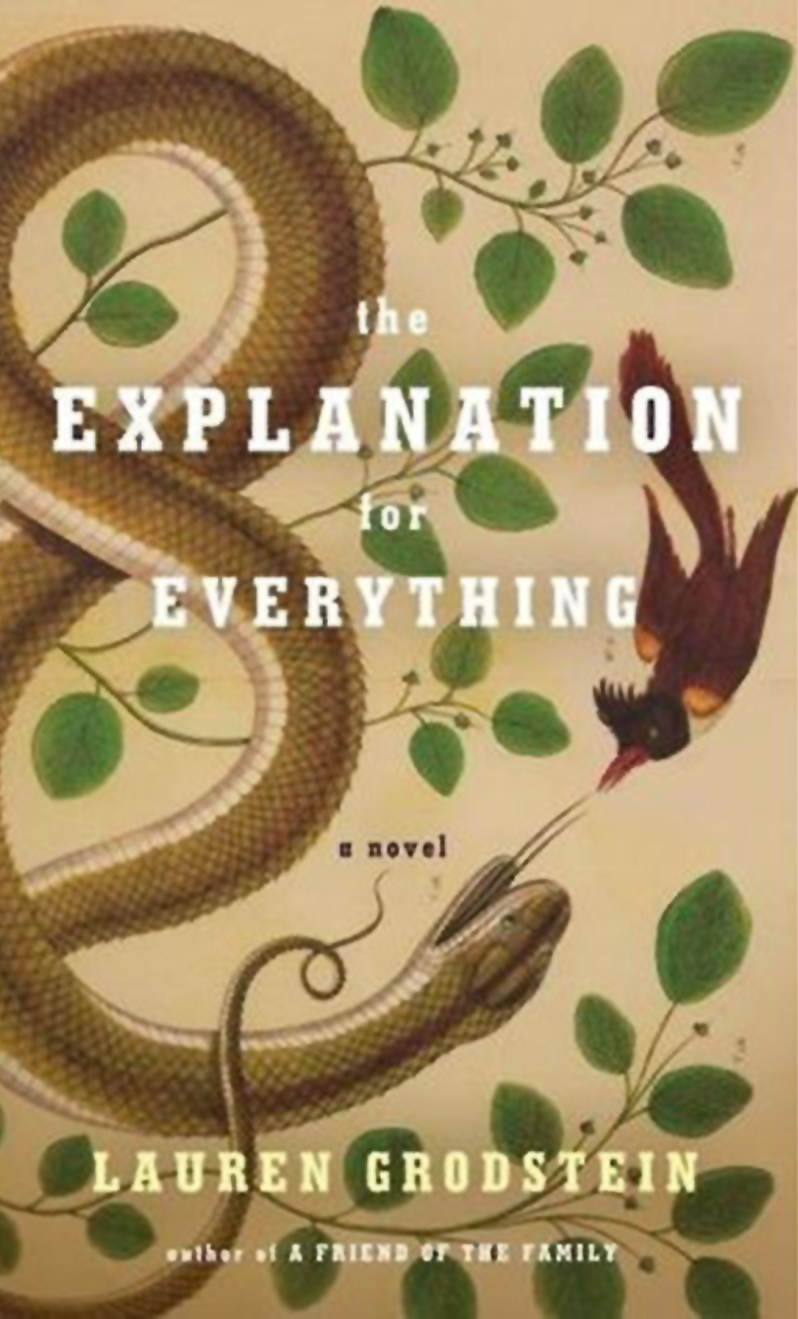 I’ve been pondering this matter in connection with two Philadelphia-area authors who will be reading at Musehouse in January: Lauren Grodstein and Susan Barr-Toman. Both tackle difficult subjects without flinching from the details. Grodstein’s 2009 novel A Friend of the Family centers on a suburban doctor who has clear and reasonable ideas about right and wrong and who gets into deep trouble, personal and moral, when he tries to act on those notions. Her latest novel, The Explanation for Everything, features a widowed biologist whose trust in science is challenged by a student who believes in God. Not the usual pattern of religious faith undermined by science, but the reverse—and though there’s plenty of humor in the situation, the novel takes the challenge by faith quite seriously. The protagonist’s science begins to fail him; his experiments go wrong, and his Darwinist convictions bring him little solace for the death of his wife. Enter a Christian student—a nubile female, no less—who offers both personal and spiritual comfort…
 Susan Barr-Toman’s novel When Love Was Clean Underwear, winner of the Many Voices Project award, was published by New Rivers Press in 2009. It begins with an elderly, terminally ill woman demanding that her live-at-home daughter help her commit suicide. The mother prepares a series of index cards with detailed instructions for each step: “Number One: Place pillow over my face and apply firm but gentle pressure for a minimum of five minutes.” After the suicide/murder in the first chapter, the introverted and now-culpable daughter has to make a life for herself—and that’s the story for the rest of the book.
Most fiction writers choose easier topics, of course. But the genre allows us—indeed, challenges us—to explore the hardest truths in depth, without flinching. And that’s why I think fiction is often truer than memoir, truer perhaps than what we call real life, which for many of us teems with artificialities.
 The News from Gridleyville