
Adios, Len
August 7, 2011
 The latest issue of Small Press Review contains some painful news for those in the small-press world. The magazine’s founder, Len Fulton, has passed away. Some obituaries appeared in the last week of July, but I missed them.
In addition to SPR, Len’s company, Dustbooks, has for decades published many invaluable reference books for the literary community, including one of my long-time bibles, The International Directory of Little Magazines and Small Presses.
Though I never met Len, I’ve always considered him a fascinating figure. He lived in Paradise, for one thing (Paradise, CA, that is)—uprooted like me from the East Coast. Within the first decade after moving there, he published two fine novels: The Grassman and Dark Other Adam Dreaming—both now available only in used copies, I think. He wrote plays as well, and he had the gumption to get involved in local politics. (Politics in Paradise? Yes, afraid so.)
The current issue of SPR has an obituary by Len’s sister, Susan Fulton Raymond, and a eulogy by Hugh Fox. Among the notices online, here are a couple of good ones:
http://www.newsreview.com/chico/len-fulton-1934-8211-2011/content?oid=2977223
We’ll miss you, Len.
Flash! It’s Fiction
May 5, 2011
 Recently I finished Randall Brown’s Mad to Live, a collection of flash fiction—a total of 22 stories in a well-spaced 69 pages. The book has been described as “edgy” and “postmodern,” and both of those terms are understatements. The book opens, for instance, with a pregnant woman eating ants, a craving that doesn’t faze her husband, who runs to the pet store to buy her a bag of crickets:
At home, in the garage, I hold up the bag. A cricket stares back; all eyes, bugs are. Crunchy. Gooey in the middle. Like pretzel snacks with cheese in the center.
Late in the book, a man gets the sudden feeling that people are pointing at him, accusing him of something. Searching the Internet, he finds no clues but determines to fight back:
I get the sense it’s more ridiculous than horrible, what I’ve done, the bad kind of fame, but the kind that goes away, like colds. I’ll wait it out.… When I find it, I’ll post a picture on lampposts and store windows and telephone poles and I’ll write in black permanent strokes “I’m not him,” and then they’ll know. Everyone will know.
This is highly skilled writing, but for my tastes too surreal, so I can’t pretend to review the stories as such. It’s an occasion, though, to think about the nature of the very short story that we now call flash fiction or microfiction. The editor of the Journal of Compressed Creative Arts and FlashFiction.net, Brown has pondered the essence of the form, blogged about it extensively, and predicted its “imminent rise to power.”
Though definitions of the form differ, all the ones I’ve seen are based on length. Perhaps 50 words is the typical limit for “micro,” a few hundred words for “flash.” In Mad to Live, the shortest story falls just short of 200 words. The genre perfectly suits our short-attention-span, click-through, multitasking world, though it’s ironic that the Web, where this kind of fiction thrives, is also suited for long work that might be too expensive to print.
Many readers may assume, as I’ve always done, that a story so minimal in length must be more like a still shot than a video: zeroing in on one scene, one moment, with little scope for development or change. My own recent, semi-accidental foray into the short-short form falls roughly into that category:
TWO DEPARTURES
Each weekday morning when Dermot’s father left for work, he’d reach down to where the boy’s head drooped over a cereal bowl, ruffle his hair and mumble a slang farewell: “Later, kiddo,” or “Seeya, champ.” One day it was different. The boy finished breakfast and wandered into the living room to watch his mother and father loosely hugging at the front door. Setting out on a business trip, the man hefted his suitcase and called across the room, “Goodbye, Dermot.” The phrase, uttered through a tight grin, had such an oddly formal ring that Dermot cocked his head in surprise. When his father failed to return, joining instead a new family on the opposite coast, the words hardened in his memory like a thin layer of cement.
Skip ahead 27 years to a morning when Dermot’s live-in girlfriend Celeste stands at their apartment door with a carry-on slung over her shoulder. She is interviewing for a prestigious residency in a hospital 853 miles away (exact distance courtesy of Internet maps), and they have quarreled not about this subject, but around this subject, for the past two weeks, with the dispute so entangled in other matters that for much of the time he has lost track of the issues. As her glance angles up at him from under finely tilted brows—an expression that suggests a bemused take on her own irony—he briefly sees what she does: an unshaven, unshowered, slightly overweight academic holding a lukewarm mug of coffee that has slopped onto the sleeve of his tartan pajamas. An impulse moves him to beat her to the punch: “Goodbye, Celeste,” he says, with what he supposes is polite, forgiving affection. She nods, loses the ironic tilt, starts to speak and checks herself, and slips out the door.
Dermot returns to the kitchen. Above the sink a small window overlooks a courtyard where forsythia branches curl under a thin layer of ice. He has a sudden image, or fantasy, of his mother looking out a window like this. A flick of movement catches his eye, but when he tries to make out the bird or squirrel, nothing appears. With a jerk of the wrist Dermot pitches his coffee down the drain. “So long, kiddo,” he mutters, and heads to the bathroom.
[published in the July 2009 issue of decomP]
If we count generously, that story has three scenes, one in each paragraph, and the reader understands (I hope) that the first scene governed the last two, but there’s no character development except what is implied in the child’s progression to the man, nor is there significant plot.
Some practitioners of flash fiction don’t seem to accept such restrictions. They claim to be creating a story with conventional elements, just extremely compressed. Detailing how he critiques a flash story, Richard Grohowski writes: “Have the events in the story changed anyone? Is there a logical, or at least reasonable, progression from beginning to end?” (For more such theorizing about the way flash works, see the Flash Craft section of FlashFiction.net.)
Taking Brown’s stories as an example, some plot, or concentrated action at least—progression from beginning to end—does seem achievable. His story “Early Man” starts with a boy and his father finding a big wad of cash on the ground, and then proceeds to detail what they do with it, ending on the fourth page when the money is gone. Another story, “Good Kid,” is all action, its four pages describing an attempted robbery at a store and the fight that ensues as a boy and his grandfather resist the bad guys.
As for character change, there can be hints of that. “Good Kid” ends with a projection into the kid’s future, telling us that when bad dreams come, the boy will fight them off with memories of the moment of triumph with his grandfather.
Still, I don’t believe that real character development—important changes in essential traits or understandings—can be achieved in a couple of hundred words. Nor do I think that ultra-compressed plots can have the same kind of arc as a longer story or novel in which the characters’ motivation is integral to the buildup, the complications, the climax, and the dénouement.
If anyone can find a strong example contradicting these views, please share.
Crossing Borders, Fictionally
April 9, 2011

Recently I went to an interview and reading by Elise Juska, author of three novels published so far and a fourth almost complete. Afterward, since I hadn’t yet read one of her books, I used my new Nook to download One for Sorrow, Two for Joy, the story of a woman who walks out of her uninspired marriage and then spends the rest of the novel trying to figure out what to do next. Though I got a bit impatient for something to happen, I admired the writing style—vivid but not flashy—the depth of the characters, and the play with multiple languages (American, Irish, academese, and crossword-puzzle-ese).
Talking about her novel in progress, Elise mentioned that, for the first time in her work, a male character is becoming one of the central figures. He’s also 63 or 64, I think she said, a good deal older than Elise herself, and she was working hard to imagine this guy’s life and mentality.
The comment got me thinking about the many borders that fiction writers need to cross. Unless we want to write book after book about people exactly like us, we’re forced to stretch our imaginations into regions we don’t know firsthand. Well, maybe Hemingway knew a lot firsthand, but most of us haven’t been involved in a foreign civil war and two world wars, hung around with bullfighters, shot big game in Africa, and gotten soused in Cuban bars.
For me, the gender border, about which Elise was concerned, is among the easiest to pass over. I don’t know why, but a woman’s POV seems not that difficult to imagine, and so far none of my female friends has chastised me unduly for failing to understand female characters. Of course I haven’t a clue what makes my wife tick, but that’s different.
Class and ethnic borders are much tougher for me. Say, for instance, that my plot needed a tattooed tough guy from Chechnya who dropped out of school at age eight, helped bomb Russian military outposts, then fled to America to join a crime gang. I could probably describe him externally. (Let’s see, try Googling “Chechen tattoo”? I think he has to be bald, right, with a close-cropped fringe? Raw-boned, smooth-shaven face. Six-one, waist size 40? Slightly faded red T-shirt. Uh-oh, I think we’ve created a stereotype.) Getting inside his head, though, would be tricky; even after a lot of reading about every related subject, I might end up with a miscellaneous bunch of traits rather than a whole, breathing, cussing character.
When ethnic boundaries become “racial” ones, we also face social/political restrictions, real or imagined. Not being a Native American myself, do I dare use one as a main character? Even if I think I can understand him or her, would I be transgressing? How much should I care?
Oddly, too, borders of place are hard for me to cross, even in our globe-trotting times. It’s not the look of a far-off place that’s the problem; it’s understanding what it feels like to be there every day. If I lived in northern Siberia for a year, how would the cold and darkness affect my psyche? What does the Arizona desert smell like to someone who’s been there her whole life? If I stayed for a decade in the Northwest, would the rains depress me, fertilize my brain, or merely make me guzzle more coffee and start a garage band?
It’d be interesting to hear from a number of fiction writers about the metaphorical borders that trouble them most. As for Elise’s concern about her 64-year-old male, I think she can safely assume there’s an infinite variety of individuals in that category, probably even some bald Chechens. Her bountiful imagination is the only visa she needs.
The Literary Hibiscus: A Complaint About Symbolism
February 19, 2011
Back from the near-dead. Seventy-hour work weeks, snow, freezing temperatures, lack of sun, topped off by a virulent head-and-chest virus that apparently laid waste to Baltimore before attacking Philadelphia—all have made this a miserable winter. Granted, we’re sissies here in the mid-Atlantic, and I admit that I could never live in Minnesota, even if Garrison Keillor dropped by nightly to tell stories. Still, I enjoyed pitying myself, and if this is the only happiness one gets for months at a time, that qualifies as misery, doesn’t it?
In these lost months I’ve managed to read just one book, Chimamanda Adichie’s first novel, Purple Hibiscus. I haven’t yet tried her second novel, Half of a Yellow Sun, or her story collection, The Thing Around Your Neck.
Purple Hibiscus, as the reviewers said, is a classy debut. Though the background is the Nigerian political scene, the focus is on a single family with a domineering father, passive mother, and two children trying to cope with the impossible situation created by the parents—something that should hit home for me, since I’ve written an American novel with the same setup. And I did respond acutely, enjoying even the long stretches when it seems the teenage narrator-protagonist, Kambili, will never get up the gumption to strike out for freedom from the oppressor. Adichie gives her characters enough complexity to challenge our simple presumptions: the abusive father has many good points, and the more attractive characters, while never verging on evil, have quirks to keep us interested.
She’s good at description, offering simple but vivid detail about daily life:
Obiora was pounding a yellow mango against the living room wall. He would do that until the inside became a soft pulp. Then he would bite a tiny hole in one end of the fruit and suck it until the seed wobbled alone inside the skin, like a person in oversize clothing. Amaka and Aunty Ifeoma were eating mangoes too, but with knives, slicing the firm orange flesh off the seed.
And a moment later, when flying termites course past the apartment complex:
The air was filling with flapping, water-colored wings. Children ran out of the flats with folded newspapers and empty Bournvita tins. They hit the flying aku down with the newspapers and then bent to pick them up and put them in the tins. Some children simply ran around, swiping at the aku just for the sake of it. Others squatted down to watch the ones that had lost wings crawl on the ground, to follow them as they held on to one another and moved like a black string, a mobile necklace.
It helps that the scenes are exotic to Western readers. We can read a sentence like
Lunch was jollof rice, fist-sized chunks of azu fried until the bones were crisp, and ngwo-ngwo.
with a fascinated hunger that we might not feel if the ingredients were more familiar:
Lunch was baked beans, fist-sized chunks of breaded chicken deep-fried until crisp, and cole slaw.
Still, the power of description is in the vivid, accurate details, and Adichie gets those right—as far as this Western reader can tell. (The azu does sound good, whatever it is. Wikipedia says it’s a Japanese R&B singer.)
The one crispy bone I have to pick with Adichie concerns the purple hibiscus, the title flower. In the novel’s extended family, Aunty Ifeoma, the liberal, liberating force, happens to grow an unusual purple hibiscus that her neighbors all admire. The narrator’s brother, Jaja, takes some of Ifeoma’s purple flowers to plant in the garden by his own house, and soon afterward he plucks up the courage to defy his father. At the end of the first section, the narrator makes sure we see the connection: “Jaja’s defiance seemed to me now like Aunty Ifeoma’s experimental purple hibiscus: rare, fragrant with the undertones of freedom. … A freedom to be, to do.”
I’m on a bit of a crusade against standard literary devices, which seem to me all too pervasive in contemporary writing, and this kind of heavy-handed symbolism, which I suspect Adichie absorbed from evil Western influences, ticks me off. The innocent hibiscus plant itself plays little role in the novel; it’s there just to be loaded down with symbolism. Let it go free, I say, free from the burden of representing freedom! Liberate it from the novelist’s manipulation. And don’t make those flying termites into symbols either. If you build the meaning into the action, the characters, the setting—as Adichie has done so admirably—we readers don’t need symbols as a side dish with our crispy azu.
SHAME on Saturday
December 1, 2010
Click image to enlarge
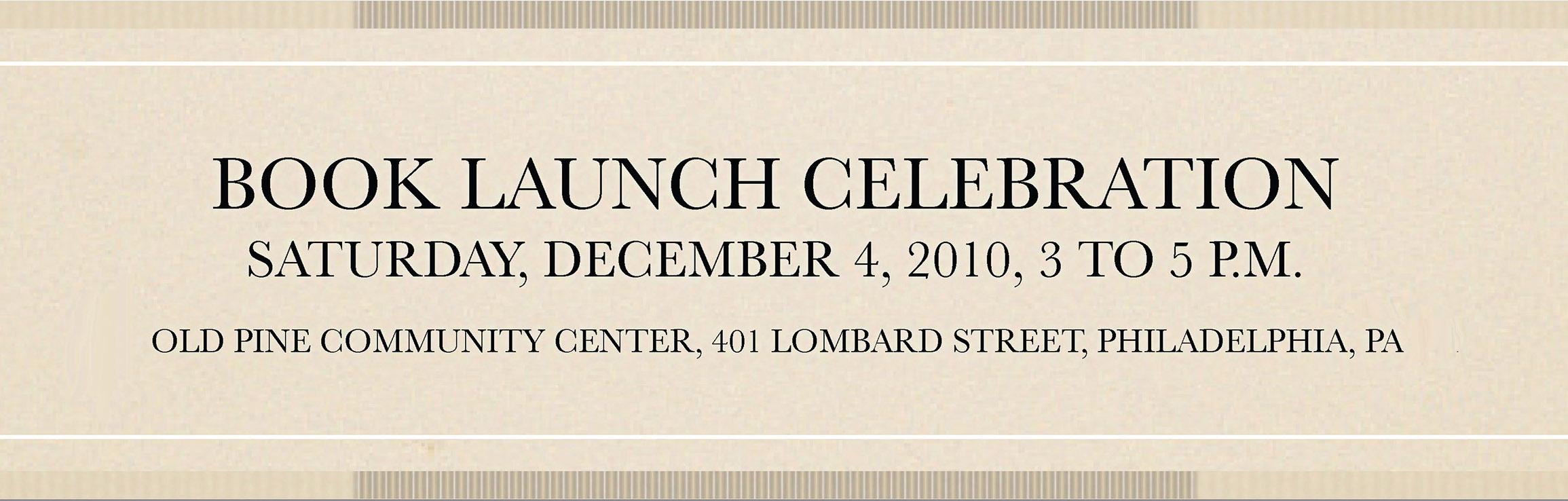
It’s not such a bad day usually, Saturday, and for some it’s even a sabbath,* but this coming one, December 4, will be smudged by the official launch of my novel, The Shame of What We Are. The publisher is planning a joint celebration with Sowilo Press, which is launching my friend Debra Leigh Scott’s marvelous collection Other Likely Stories. Everyone who occasionally reads a book is welcome to stop by.
Debra’s book picks up in the 1960s, where mine leaves off, and ends with the fall of Saigon in 1975. Together the two books portray a troublesome quarter-century in American life, when we engaged in a nuclear arms race; persecuted our own citizens; fought in mysterious places in Asia; assassinated political leaders; invented, perfected, and then (in my opinion) destroyed rock ’n’ roll—and, somewhere along the way, undermined the traditional nuclear family. How much connection was there between public misadventures and private confusion?
I’m told the party will feature live music appropriate to the time period. If it’s disco, I’ll be hiding under a table.
*Which reminds me: Hanukkah has just begun here on the East Coast. To all who celebrate it, or wish they did, have a joyful one.
In All Candor
November 30, 2010
 On my other, more static website, Gridleyville.com, I’ve long concluded the introduction with a joke:
“It should be obvious by now that this website has nothing to do with the hamlet of Gridleyville, situated near Candor, New York. Sam Gridley greatly admires the name of that town but, in all candor, has never been there.”
The pun always makes me laugh rather than groan, which is all anyone needs to know about my sense of humor. As my wife often grumbles, no one else finds it funny.
But, come to discover, the jest has a deeper layer of meaning. It seems that about 1919 the eminent writer and philosopher Kenneth Burke rented a summer cottage in Candor for $5, from a man named Sam Gridley.
Although the price matches my idea of good commerce, that wasn’t I. Nor was it an ancestor of mine, I don’t think. We’ve never had real estate moguls in the family.
But wait, there’s more: In 2007 the U.S. Navy commissioned a ship named the USS Gridley, and it belongs to the Burke class of destroyers.
This is enough for a conspiracy theory.
But the truth remains: I still haven’t set foot in the real Gridleyville. Perhaps I will, though, to see whether the Burkean aura suffuses visitors with a deeper understanding of human nature—and of weird coincidence.
Fondness for a Show
November 27, 2010

Archduke Franz Ferdinand
A press of work in the day job has kept me from this blog awhile. Looking back, I see that my last post was a frivolous one on November 11, Veterans née Armistice Day. In my own defense I can point out that I’m frequently unaware of the date and even the day of the week. On holidays I look around and wonder why the office is empty. My cell phone, which displays date and time, tells me as I begin writing that it’s 11/27 and 12:06, and only by close attention to the punctuation marks can I figure out which is which.
Thus a much-too-late note for Armistice Day, or perhaps an early post for Chanukah-Christmas. (Thanksgiving gets ignored, I’m afraid. Football and food induce sleep, not bloggery.)
In earlier posts I’ve mentioned the Austrian Jewish writer Stefan Zweig, who, though personally safe from the Holocaust, killed himself in despair in 1942, soon after finishing his memoir The World of Yesterday. Below is an excerpt from his chapter about the onset of World War I, the war to end wars that brought us the Veterans Day that we now use to remember many subsequent wars. What’s striking is the innocent belief that things were going to be all right, even after the assassination of Franz Ferdinand that sparked the conflagration.
The coffins of the murdered royalty were quietly taken to Artstetten and interred there. Vienna, whose perpetual fondness for a show was thus deprived of a great opportunity, had already begun to forget the tragic occurrence. … In less than a week, however, attacks suddenly began to appear in the newspapers, and their constantly mounting crescendo was regulated too consistently for them to have been entirely accidental. The Serbian government was accused of collusion in the assassination, and there were veiled hints that Austria would not permit the murder of its supposedly beloved heir-apparent to go unavenged. One could not escape the impression that some sort of action was being prepared in the newspapers, but no one thought of war. Neither banks nor business houses nor private persons changed their plans. Why should we be concerned with these constant skirmishes with Serbia which, as all knew, arose out of some commercial treaties concerned with the export of Hungarian pigs? My bags were packed so that I could go to [poet Emile] Verhaeren in Belgium, my work was in full swing, what did the dead Archduke in his catafalque have to do with my life? The summer was beautiful as never before and promised to become even more beautiful—and we all looked out upon the world without a care. I can recall that on my last day in Baden I was walking through the vineyards with a friend, when an old wine-grower said to us: “We haven’t had such a summer for a long time. If it stays this way, we’ll get better grapes than ever. Folks will remember this summer!”
He did not know, the old man in his blue cooper’s smock, how gruesomely true a word he had spoken.
(Bison Books edition, Lincoln: University of Nebraska Press, 1964)
What would Zweig make of today’s maneuvering in the Mideast and the Korean peninsula? Perhaps even more to the point, would he see in our “perpetual fondness for a show” a way of deluding ourselves about the future?
Of Zweig and Patience
October 18, 2010
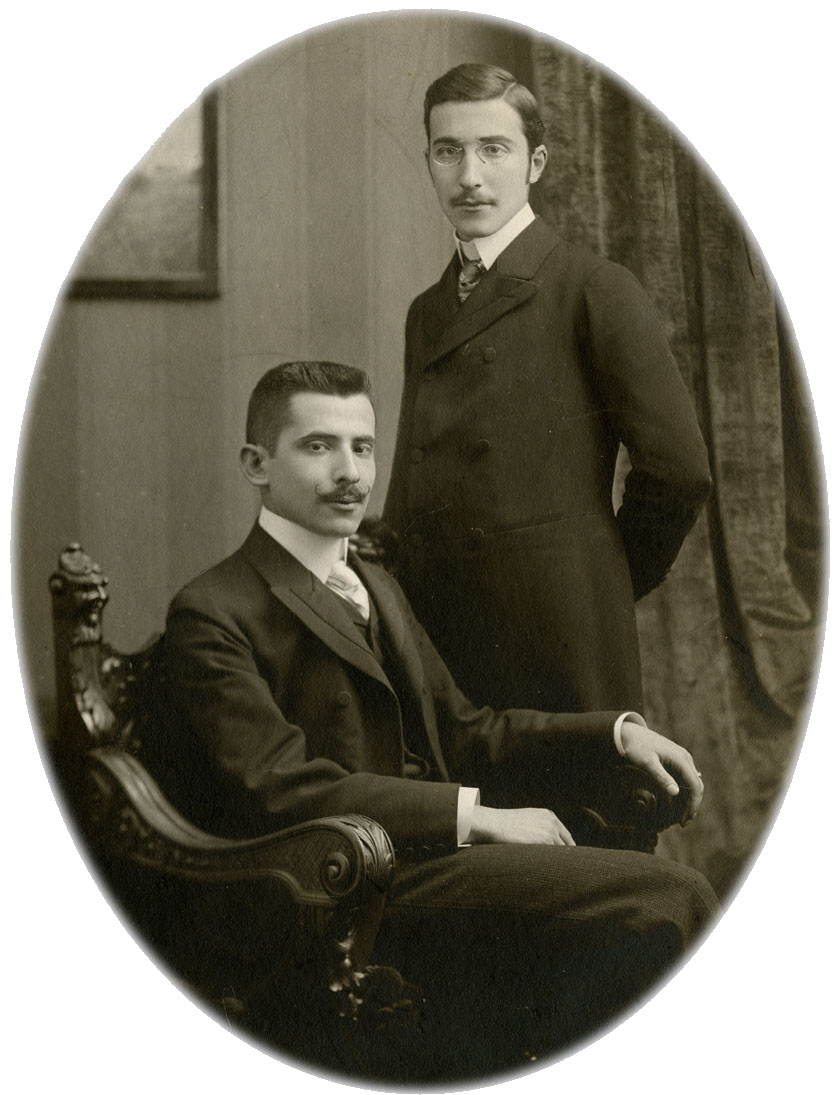
Stefan Zweig (standing) with his brother Alfred
A year or two ago my wife and I discovered Stefan Zweig (1881–1942), an Austrian writer whose memoir The World of Yesterday paints a lively picture of Europe before, during, and after World War I. Zweig knew every poet, novelist, dramatist, and artist on the scene; a devoted pan-Europeanist, he translated dozens of his friends’ works and wrote biographies of cultural figures ranging from Erasmus to Nietzsche to Balzac. In 1942, shortly after he finished the memoir, in exile in Brazil and despairing as Europe dove deep into another round of self-butchery, he and his wife took their own lives.
In the memoir’s last chapters, he speaks of the disbelief and agony that he and others like him experienced as they witnessed Hitler’s rise. On a Sunday morning he hears the radio news of the declaration of war, “a message which meant death for thousands of those who had silently listened to it, sorrow and unhappiness, desperation and threat for every one of us.”
After reading the memoir, we were moved enough to explore his other work. Despite his vast output of nonfiction and drama, Zweig found time for a number of novels, stories, and novellas—intense psychological works that examine the characters’ thoughts and emotions in exquisite, sometimes excruciating, detail. His writing is marvelous, his characters strange enough to feel very contemporary. And yet I have the typical problem of our A.D.D. age: attention span.
Look at the following passage from The Post-Office Girl (trans. Joel Rotenberg, New York Review Books, 2008). The title character, Christine, a penurious young woman from a small town, has been invited by a rich aunt to visit a magnificent resort in the Alps. When her aunt tells her to “freshen up” before lunch, Christine is amazed, bewildered, awed, and humbled by the luxurious hotel room she is given. We join the action, if it can be called that, about halfway through a two-page paragraph:
Discovery upon discovery: the washbasin, white and shiny as a seashell with nickel-plated fixtures, the armchairs, soft and deep and so enveloping that it takes an effort to get up again, the polished hardwood of the furniture, harmonizing with the spring-green wallpaper, and here on the table to welcome her a vibrant variegated carnation in a long-stem vase, like a colorful salute from a crystal trumpet. How unbelievably, wonderfully grand! She has a heady feeling as she imagines having all this to look at and to use, imagines making it her own for a day, eight days, fourteen days, and with timid infatuation she sidles up to the unfamiliar things, curiously tries out each feature one after another, absorbed in these delights, until suddenly she rears back as though she’s stepped on a snake, almost losing her footing. For unthinkingly she’s opened the massive armoire against the wall—and what she sees through the partly open inner door, in an unexpected full-length mirror, is a life-sized image like a red-tongued jack-in-the-box, and (she gives a start) it’s her, horribly real, the only thing out of place in this entire elegantly coordinated room. The abrupt sight of the bulky, garish yellow travel coat, the straw hat bent out of shape above the stricken face, is like a blow, and she feels her knees sag. “Interloper, begone! Don’t pollute this place. Go back where you belong,” the mirror seems to bark. Really, she thinks in consternation, how can I have the nerve to stay in a room like this, in this world! What an embarrassment for my aunt! I shouldn’t wear anything fancy, she said! As though I could do anything else! No, I’m not going down, I’d rather stay here. I’d rather go back. Bur how can I hide, how can I disappear quickly before anyone sees me and takes offense? She’s backed as far as possible away from the mirror, onto the balcony. She stares down, her hand on the railing. One heave and it would be over.
This scene goes on for another long paragraph in which Christine frets over what to wear, worries what the maid will think, and finally “scurries down the stairs with downcast eyes.”
I admire this writing tremendously—“timid infatuation,” a carnation like a trumpet’s salute—but at some point in the piling of detail upon detail, I become impatient. “I get the point!” my inner voice yells at the author; “let’s move on, OK?”
Then I remember what Stanley Fish once said to a seminar of undergraduates. The more the culture emphasized reading fast, he declared, the slower he read. He engaged us in examining Milton line by line, word by word, almost syllable by syllable.
I try to keep that perspective in mind. No, I lecture myself, don’t read Stefan Zweig while you’re simultaneously watching baseball, checking e-mail, and snacking on the delicious nut-cranberry mix from Trader Joe’s. Both hands on the book, please. Both eyes on the text. Slowly, patiently. Writers as good as Zweig deserve this much from us, and more.
Fishing for Readers: The Apostles Creed of Literature
October 15, 2010

“The two young men—they were of the English public official class—sat in the perfectly appointed railway carriage.”
We hear so much about the need for a “hook,” something to grab the reader immediately, that I take more and more pleasure in authors who ignore that dictum, or who wrote before it became the Apostles Creed of Literature.
The sentence quoted above opens Some Do Not…, the first novel in Ford Madox Ford’s magnificent trilogy Parade’s End. Does anything, other than the balance and rhythm of the style, hook us? What are the men doing? Merely sitting. Who are they? Members of a humdrum group of bureaucrats. Where are they? In a railway car whose principal attribute is that it has no faults. This is an anti-hook.
As those who’ve read the trilogy will remember, Ford’s purpose here is to establish the stasis of pre–World War I English society—a stability that will soon be rudely interrupted. Hence the men are seen first as unmoving stereotypes. But even after establishing their stillness, Ford is in no hurry to bring us action. Not until deep in Chapter IV do we reach the scene when Valentine Wannop alters Christopher Tietjens’ life forever by barging up to him on a golf course to demand that he save her friend and fellow suffragette from being manhandled. In the meantime, Ford treats us to, among other things, a description of Tietjens’ companion Macmaster, including his origins, current position, aspirations, and the thesis of the new book whose proofs he has been correcting on the train; a brief history of Tietjens’ disastrous marriage, which leads to an explanation of why the two friends have embarked on a golf outing; a mention of Tietjens’ pastime of finding errors in the Encyclopaedia Britannica; a philosophical discussion of monogamy; a long chapter with the wife, her mother, and a priest, who utters such observations as “’It’s a good maxim that if you swat flies enough some of them stick to the wall”; and, immediately after the opening quoted above, a leisurely survey of that boring railway carriage:
“The leather straps to the windows were of virgin newness; the mirrors beneath the new luggage racks immaculate as if they had reflected very little; the bulging upholstery in its luxuriant, regulated curves was scarlet and yellow in an intricate, minute dragon pattern, the design of a geometrician in Cologne. The compartment smelt faintly, hygienically of admirable varnish; the train ran as smoothly—Tietjens remembered thinking—as British gilt-edged securities. It travelled fast; yet had it swayed or jolted over the rail joints, except at the curve before Tonbridge or over the points at Ashford where these eccentricities are expected and allowed for, Macmaster, Tietjens felt certain, would have written to the company. Perhaps he would even have written to The Times.”
The writing is confoundedly leisurely, as Tietjens himself might have said. It’s also brilliant, pointed, and amusing.
No hooks. The reader isn’t treated as a fish. I admire that, and envy Ford for living in a time when it was possible.
I first read Ford when I was quite young, and now I’m wondering if my convictions about him would change during a new read. By accident in browsing, I discovered one person who has recently come to Parade’s End for the first time and finds it fascinating: see the entry in Hannah Stoneham’s Book Blog, http://hannahstoneham.blogspot.com/2010/04/read-along-of-ford-madox-fords-parades.html.
Interview with Noel Farrell
October 13, 2010

Many thanks to Noel Farrell, a.k.a. Don Booker, for posting an interview with me on his blog, The Writing Life and Other Absurdities. Click on the image above to go there.
In future posts I may try to explain some of the answers I gave him, such as why my favorite writer is Ford Madox Ford (is that still true? I have to figure it out).
 The News from Gridleyville