
An Early Call
December 31, 2014

On New Year’s Eve, here’s an early summons by the year 2015:
http://flashfictionmagazine.com/blog/2014/12/31/an-early-call/
It’s a very brief story of mine called “An Early Call” in Flash Fiction Magazine.
The first comment, before I even saw the story myself, was from Miles White, who I gather from his blog is a journalist, flash-fiction writer, and ethnomusicologist. He wrote, “Interesting. I think I got it but I’m not sure.”
Miles, I totally agree. If you figure out who’s calling, let me know, but I don’t think we should answer.
Peeping Devin
December 23, 2014
 At the risk of breaking my record for number of posts in a season and thereby alienating all those who count on me for blissful silence, I have to plug my latest publication, which appeared (to my belated surprise) a day after I got the acceptance email.
Called “The Upper Mahoney at Dawn,” the story is a sympathetic account of a man who becomes a Peeping Tom, more or less. His name is Devin, so let’s call him, avoiding stereotypes, the Peeping Devin. Does he really deserve sympathy? That’s for readers to say. Use the comment feature on this blog to let me know what you think.
The story can be found here at Turk’s Head Review, a cool publication that bills itself as “Blog meets literary magazine.” Many thanks to the editors for choosing the story.
Dear Author
November 4, 2014
One advantage of publishing in the distinguished Valparaiso Fiction Review, as I did earlier this year, is that Valparaiso University’s system sends you periodic updates about the readership. Here’s the latest message:
 Hey, that’s more people than I know, so it must mean that an actual Public out there is reading my work. Yay!
Just a minute, though. A “download” isn’t necessarily a reading. I sometimes download stuff myself, glance at it, say “What the hell do I want this for?” and discard it. How many people are trashing my work in that way? How dare they!
And 181 total downloads, that’s not much, is it? Hardly a bestseller.
Possibly this is a sad indication of the limited readership of literary magazines.
However, it’s also possible that other stories in the same issue are being downloaded much more often. That would be heartening. Wait, no it wouldn’t–who’s getting downloaded more than me, and why? Are some authors in the 200s, even 300s? Whatta they got that I don’t?
Maybe the counter isn’t right. Do I trust this technology? No way!
Now I’m all anxious.
Well, look, being listed in Valpo “Scholar,” that’s an honor, right? In there with all them university perfessers. For someone who hasn’t been a scholar in many years, that’s pretty, like, awesome.
OK, I’m at peace now.
But hurry up, number 182–put down the stupid comics and read my story!
Long Review of Brief Eulogies
November 1, 2014
I’m hastening to do a new post to bump down the appalling “catterel” of my last one. It wouldn’t do for newcomers to this site to peg me as a terrible poet. Okay, that happens to be true, but I commit poetry so seldom that I would hate to think it defines me. (I suppose murderers could say the same thing.)
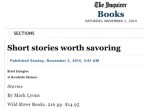 Luckily, I have something to say today: an excellent review of my friend Mark Lyons’s Brief Eulogies at Roadside Shrines appears in the Philadelphia Inquirer. The reviewer is Kevin Grauke, himself an accomplished writer of short stories, and he goes into more detail than I did in my post of October 16. As Grauke says, “While the image of the descanso may tie the stories together thematically, what truly unifies the collection is Lyons’ impressive ability to capture the voices of a wide range of characters. He’s so good that readers may find themselves wishing all 12 stories, rather than nine of 12, had been written in first person.”
I do hope this book gets the attention it deserves. Click the image to go to the review; click here to see the page on Amazon; and click here for a video clip of Mark reading from the book and talking about its background.
Depression Made Easy
October 27, 2014

A story of mine appears in the fall issue of Red Savina Review:
http://www.redsavinareview.org/sam-gridley/
Many thanks to the editors for publishing the piece despite the fact that it’s guaranteed to depress all readers. In fact, I’d like to nominate it for Most Depressing Story of the Year Not Involving Ebola or Terrorists, but I don’t know who gives such an award.
For more fiction in the same issue—not nearly so depressing—go here to the list of authors and then click on a particular author’s name.
Drawing from Life
August 19, 2014
Robin Black’s novel Life Drawing is remarkable in many ways. So many reviewers have praised the book already that there’s no need to add to the chorus, but I want to note one element in particular.
A ba d thing happens in this book. A big, bad thing, with a clear victim and a clear perpetrator. But what makes the act unusual is that everyone is guilty in some sense. The victim bears some guilt. So do three other people who did not commit or encourage or sanction the bad thing but nevertheless helped move it toward fruition.
That strikes me as more true to life than we care to acknowledge on a daily basis. We may nod at the author’s wisdom, but in real life we prefer to get outraged. We like to draw hard lines between the innocent and the guilty, point our fingers at the bad guys and clamor for justice. For just a moment, think of how often we do this when discussing, say, Palestine, gun violence, political rebellions, multigenerational poverty, _____ [insert controversial subject of your choice].
Ms. Black’s one sin against realism in Life Drawing is that she allows her characters to recognize how much they have all contributed to the evil. In real life, we won’t admit any such thing.
If only we could be as smart as our best novelists …
Literature and the Season of Depression
February 9, 2014
A rambling piece of mine on winter, depression, literature, religion, and my grandmother—how are those subjects linked?—appears as a guest post on the Superstition Review blog:
It talks about books by Lauren Grodstein and Joan Didion, among many other topics. Thanks to Superstition Review for inviting me to contribute.
A Fragrant Tragedy
June 10, 2013
From the opening of Ru Freeman’s ambitious and moving new novel, On Sal Mal Lane, set in her native Sri Lanka, we know that tragedy looms. The Prologue, in italics, sketches the background of the conflicts between Sinhalese and Tamils that erupted into war, and the first chapter of regular text begins in this way:
“God was not responsible for what came to pass. People said it was karma, punishment in this life for past sins, fate. People said that no beauty was permitted in the world without some accompanying darkness to balance it out, and, surely, these children were beautiful. But what people said was unimportant; what befell them befell us all.”
Lest we forget the context, this narrative voice from on high returns from time to time to update national political developments and remind us of the doom hanging over the characters.
Yet the novel’s basic action scarcely ventures beyond the tiny, flower-bedecked, semirural lane of the title, on the outskirts of the capital city, Colombo. The people there form a microcosm of Sri Lankan ethnicities and religions—Sinhalese, Tamils, mixed-race Burghers; Buddhists, Hindus, Muslims, Catholics—all in the space of nine households. Most of the plot centers on the children of Sal Mal Lane, especially the four Herath kids, who are sensitive, talented and a bit more upscale than their neighbors.
Perhaps the novel’s greatest achievement lies in the way it locates significance in the tiniest domestic actions. A wayward teenager, Sonna, quarreling with his father, is denied a birthday party. As a make-do, Sonna’s mother invites the Herath children over for an elaborate dinner without stating that it’s for the boy’s birthday. Later, discovering the truth, the Heraths feel bad that they didn’t take a present. They count out coins from their allowance to buy a chocolate for Sonna, put it in a shiny bag and try to deliver it. He isn’t home, though, so they stash it in their refrigerator to keep it from melting. The next day, Mr. Herath, rummaging for a sweet after lunch, finds the candy and eats it. The children are too abashed to stop him, afraid their mother will find out they’ve been associating with Sonna. Having no money to buy another treat, they reconcile themselves to feeling ashamed, and they let the matter drop.
Ending a chapter, this little tale hovers as a portent. How will the mistakenly consumed chocolate contribute to the slowly unfolding tragedy? This technique encourages the reader to focus on causes rather than on what comes next. For me, though, the weighty foreshadowing has its downside because it discourages page-turning; I was none too eager to arrive at the moment of implosion.
Another potential difficulty is that the profusion of characters makes it hard to become deeply invested in any one of them. Eventually the reader comes to care for several of these people, but it takes a while. Among the Heraths, there are four children of various ages, plus the father and mother. Five other children play significant roles, as do ten or more adults. The interplay is complex, and even the troublemakers and bigots have some redeeming features. The upside is that we get a rich, complex view of a neighborhood, both its uniqueness and its inability to escape the sociopolitical trends that are drawing the larger society into turmoil.
The language is often as fragrant as the blossoming sal mal trees that surround the lane and the spicy curries prepared by the women. In these lyrical passages Freeman’s affection for her homeland shines through. Here’s a paragraph plucked almost at random:
“The gusty wind that dominated a short respite from the monsoons was beginning to tease the children of Sal Mal Lane. It tugged at their school uniforms, inverted umbrellas held against the sun, and combed and recombed their hair, first this way then the other. It whispered stay! stay! to them as they stood waiting for their school buses, shivering in the cool morning hours, a request they tried not to hear. They giggled as their skirts and shirts lifted this way and that, their books fell out of their careless hands, and the ribbons tied into their braids and ponytails, blue and white for the Herath girls, green and white for the Bolling twins, refused to stay in their knots. But each evening the children acquiesced. They put down their books, put on their home clothes, and went outside. They went to fly kites.”
Another treat is the occasional profound remark that could be framed and mounted on the wall. At one point the younger Herath boy, Nihil, seeks reassurance about the rumors of civil war and the announced intention of other boys on the lane to join the army. He questions his friend, old Mr. Niles, who answers: “People do not go to war, Nihil, they carry war inside them.” At times such philosophizing can become a bit heavy-handed, but it serves to reinforce the themes of the novel.
When the long-awaited tragedy arrives, it occurs on two levels. On one level we witness a political event as the quiet street is overcome by the conflict raging around it. But the greater tragedy is rooted in the personal stresses we have seen developing: father vs. son, neighbor vs. neighbor, social outsiders trying to gain a place among those they admire and envy. No one on Sal Mal Lane is entirely innocent. As the second-oldest Herath child, Rashmi, reflects near the end, “Everybody was responsible for what had happened to their street.”
Even as calamity intrudes, however, the people of the lane bond together, across ethnic boundaries. The victims are cared for by their neighbors. The dénouement rekindles a sense of hope, and the novel ends with a young person reading from Malory’s Le Morte d’Arthur, “a tale of striving for high ideals amid human frailty, turmoil, and change.”
On Sal Mal Lane is not a quick read but one to savor, one whose images and ideas will linger in the reader’s mind.
The Mystery of Alice and Her Brothers
February 2, 2012

“Henry James was drunk.”
So begins an entertaining literary mystery by Paula Marantz Cohen, What Alice Knew (Sourcebooks, 2010), set in 1888 London during the rampage of Jack the Ripper. Cohen’s animating conceit is that the baffled London police call in the famous American psychologist-philosopher William James for consultation. This puts William in the same city as his brother, the novelist Henry, and their sister Alice, a professional invalid, and the three collaborate in the investigation.
The notion of police employing a psychologist/spiritualist/weirdo is commonplace now, at least in fiction. On TV there’s the popular series The Mentalist, among others. In print, Caleb Carr’s 1994 mystery bestseller, The Alienist, sets up a team of a psychologist, a writer, and a secretary to investigate a serial killer in 1896 New York.
Cohen’s basic set-up is far from original, then. But her Jameses, as eccentric as they are famous, become as psychologically interesting as the killer they track. Alternating their points of view, Cohen allows each to contribute a unique perspective to the investigation. The style is fluid, and the dialogue sparkles. Minor characters like Oscar Wilde and John Singer Sargent step in to enhance the ambiance. Sly humor undercuts the characters’ pretenses, especially Henry’s; the poor chubby aesthete never quite recovers from that classic opening line.
After the recent speculation on the Jameses, Cohen could have made their own relationships as lurid as the Ripper’s slashings. It’s to her credit, I think, that she does NOT put William in bed with Alice, Henry with the male artists’ model, or Alice with her devoted live-in companion. Cohen’s Jameses flout Victorian convention only in their unconventional thinking, which in itself offers plenty of sizzle for this fine novel.
A few announcements to conclude this post:
- The second installment of my story “End of the Ride” is up at The Piker Press. In place of similar annoying advertisements for the third and fourth parts, I’ll direct anyone who’s interested to this link to a page that should list each section as it becomes available.
- My story “MG Repairs,” which came out in Carve Magazine in 2010, will be included in the magazine’s 2009–2010 Anthology. Why two years late? Because editor Matthew Limpede has a sensible approach to the absurd rush of our lives. Myself, I favor setting the clock back to 1993.
- My novel The Shame of What We Are is now available as an e-book from Amazon and Barnes and Noble. Everybody who’s not reading it in paperback can now not read it on a screen as well. But they’ll be missing the wonderful illustrations by Tom Jackson, which come out surprisingly well in the e-book.
- “Wright has found a way to wed fragments of an iconic America to a luminously strange idiom, eerie as a tin whistle, which she uses to evoke the haunted quality of our carnal existence.” So said The New Yorker about poet C. D. Wright, who will be reading on February 2 at Villanova University’s Literary Festival. I love tin whistles. Complete info. about the festival, which will include William Kennedy and several other luminaries, is available here.
The Piker and the Long Story
January 23, 2012

Viewing, by Sand Pilarski
Many thanks to The Piker Press, and editor Sand Pilarski, for running my long story “End of the Ride” in four installments, beginning today. Linc, the story’s protagonist, attends the funeral of his scapegrace cousin, Wayne Shit-for-Brains, and tries to behave properly though he feels not a smidgen of sorrow at Wayne’s demise. Throughout the day—and this is the crux of the story—he tries to suppress his memory of a shameful escapade with Wayne when they were teenagers.
Sand herself created the accompanying illustration, and I think it expresses Linc’s conflictedness. Though he’s trying to appear nonchalant, you can see the stiffness and resistance in his posture.
Compared to print outlets, web magazines have an obvious cost advantage in publishing long stories, but most still prefer short pieces. Kudos to the few, like The Piker Press, that will give space to the long form. Serialization is one answer to the public’s supposed unwillingness to read long pieces online. Next Monday, after the latest episode of Downton Abbey on PBS, come back for more on The Piker Press.
 The News from Gridleyville