
Of Zweig and Patience
October 18, 2010
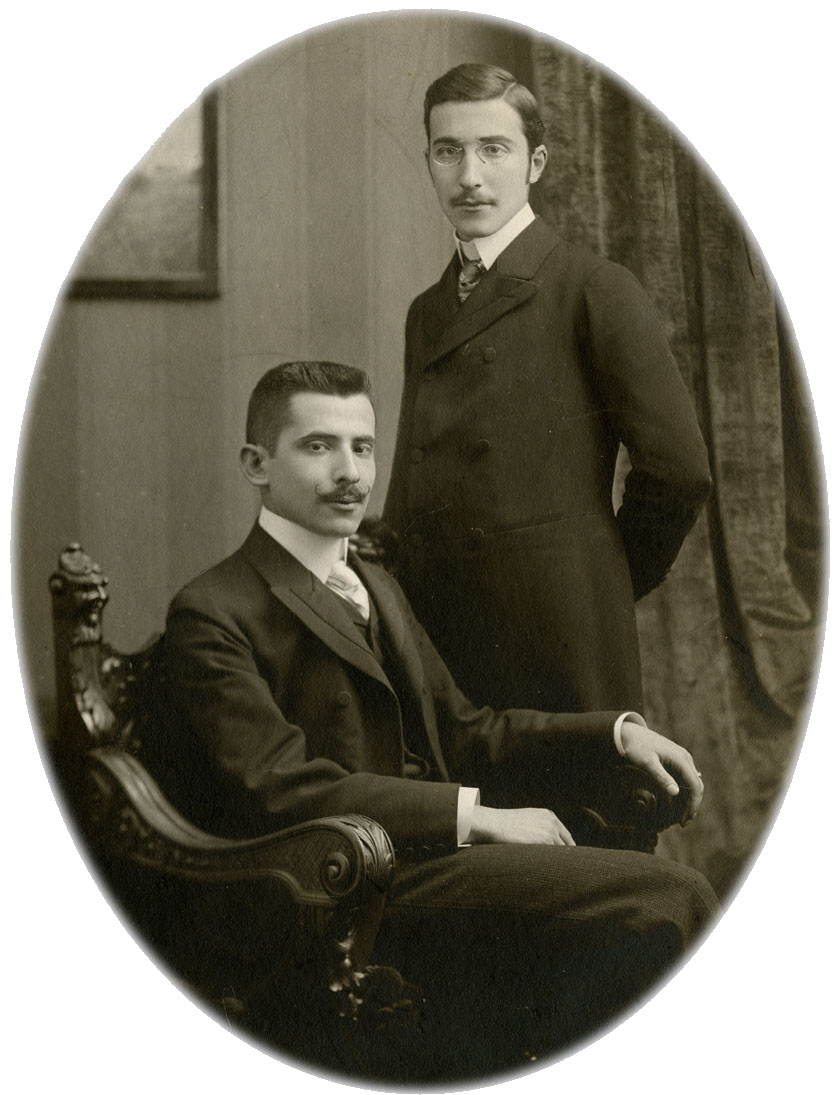
Stefan Zweig (standing) with his brother Alfred
A year or two ago my wife and I discovered Stefan Zweig (1881–1942), an Austrian writer whose memoir The World of Yesterday paints a lively picture of Europe before, during, and after World War I. Zweig knew every poet, novelist, dramatist, and artist on the scene; a devoted pan-Europeanist, he translated dozens of his friends’ works and wrote biographies of cultural figures ranging from Erasmus to Nietzsche to Balzac. In 1942, shortly after he finished the memoir, in exile in Brazil and despairing as Europe dove deep into another round of self-butchery, he and his wife took their own lives.
In the memoir’s last chapters, he speaks of the disbelief and agony that he and others like him experienced as they witnessed Hitler’s rise. On a Sunday morning he hears the radio news of the declaration of war, “a message which meant death for thousands of those who had silently listened to it, sorrow and unhappiness, desperation and threat for every one of us.”
After reading the memoir, we were moved enough to explore his other work. Despite his vast output of nonfiction and drama, Zweig found time for a number of novels, stories, and novellas—intense psychological works that examine the characters’ thoughts and emotions in exquisite, sometimes excruciating, detail. His writing is marvelous, his characters strange enough to feel very contemporary. And yet I have the typical problem of our A.D.D. age: attention span.
Look at the following passage from The Post-Office Girl (trans. Joel Rotenberg, New York Review Books, 2008). The title character, Christine, a penurious young woman from a small town, has been invited by a rich aunt to visit a magnificent resort in the Alps. When her aunt tells her to “freshen up” before lunch, Christine is amazed, bewildered, awed, and humbled by the luxurious hotel room she is given. We join the action, if it can be called that, about halfway through a two-page paragraph:
Discovery upon discovery: the washbasin, white and shiny as a seashell with nickel-plated fixtures, the armchairs, soft and deep and so enveloping that it takes an effort to get up again, the polished hardwood of the furniture, harmonizing with the spring-green wallpaper, and here on the table to welcome her a vibrant variegated carnation in a long-stem vase, like a colorful salute from a crystal trumpet. How unbelievably, wonderfully grand! She has a heady feeling as she imagines having all this to look at and to use, imagines making it her own for a day, eight days, fourteen days, and with timid infatuation she sidles up to the unfamiliar things, curiously tries out each feature one after another, absorbed in these delights, until suddenly she rears back as though she’s stepped on a snake, almost losing her footing. For unthinkingly she’s opened the massive armoire against the wall—and what she sees through the partly open inner door, in an unexpected full-length mirror, is a life-sized image like a red-tongued jack-in-the-box, and (she gives a start) it’s her, horribly real, the only thing out of place in this entire elegantly coordinated room. The abrupt sight of the bulky, garish yellow travel coat, the straw hat bent out of shape above the stricken face, is like a blow, and she feels her knees sag. “Interloper, begone! Don’t pollute this place. Go back where you belong,” the mirror seems to bark. Really, she thinks in consternation, how can I have the nerve to stay in a room like this, in this world! What an embarrassment for my aunt! I shouldn’t wear anything fancy, she said! As though I could do anything else! No, I’m not going down, I’d rather stay here. I’d rather go back. Bur how can I hide, how can I disappear quickly before anyone sees me and takes offense? She’s backed as far as possible away from the mirror, onto the balcony. She stares down, her hand on the railing. One heave and it would be over.
This scene goes on for another long paragraph in which Christine frets over what to wear, worries what the maid will think, and finally “scurries down the stairs with downcast eyes.”
I admire this writing tremendously—“timid infatuation,” a carnation like a trumpet’s salute—but at some point in the piling of detail upon detail, I become impatient. “I get the point!” my inner voice yells at the author; “let’s move on, OK?”
Then I remember what Stanley Fish once said to a seminar of undergraduates. The more the culture emphasized reading fast, he declared, the slower he read. He engaged us in examining Milton line by line, word by word, almost syllable by syllable.
I try to keep that perspective in mind. No, I lecture myself, don’t read Stefan Zweig while you’re simultaneously watching baseball, checking e-mail, and snacking on the delicious nut-cranberry mix from Trader Joe’s. Both hands on the book, please. Both eyes on the text. Slowly, patiently. Writers as good as Zweig deserve this much from us, and more.
Welcome Back, CARVE
October 17, 2010

A new story of mine, “MG Repairs,” which despite the title has nothing to do with old sports cars, is now live at the Carve Magazine site. More important, this issue marks the provocative magazine’s restart after a year’s hiatus, during which the editor, Matthew Limpede, must have been asking himself, “Why the hell do I publish a literary magazine?” Apparently he found a good reason, or else he decided there’s no sensible answer to a question like that. Anyway, welcome back Carve!
Clicking on the magazine’s title or the image will take you there.
Fishing for Readers: The Apostles Creed of Literature
October 15, 2010

“The two young men—they were of the English public official class—sat in the perfectly appointed railway carriage.”
We hear so much about the need for a “hook,” something to grab the reader immediately, that I take more and more pleasure in authors who ignore that dictum, or who wrote before it became the Apostles Creed of Literature.
The sentence quoted above opens Some Do Not…, the first novel in Ford Madox Ford’s magnificent trilogy Parade’s End. Does anything, other than the balance and rhythm of the style, hook us? What are the men doing? Merely sitting. Who are they? Members of a humdrum group of bureaucrats. Where are they? In a railway car whose principal attribute is that it has no faults. This is an anti-hook.
As those who’ve read the trilogy will remember, Ford’s purpose here is to establish the stasis of pre–World War I English society—a stability that will soon be rudely interrupted. Hence the men are seen first as unmoving stereotypes. But even after establishing their stillness, Ford is in no hurry to bring us action. Not until deep in Chapter IV do we reach the scene when Valentine Wannop alters Christopher Tietjens’ life forever by barging up to him on a golf course to demand that he save her friend and fellow suffragette from being manhandled. In the meantime, Ford treats us to, among other things, a description of Tietjens’ companion Macmaster, including his origins, current position, aspirations, and the thesis of the new book whose proofs he has been correcting on the train; a brief history of Tietjens’ disastrous marriage, which leads to an explanation of why the two friends have embarked on a golf outing; a mention of Tietjens’ pastime of finding errors in the Encyclopaedia Britannica; a philosophical discussion of monogamy; a long chapter with the wife, her mother, and a priest, who utters such observations as “’It’s a good maxim that if you swat flies enough some of them stick to the wall”; and, immediately after the opening quoted above, a leisurely survey of that boring railway carriage:
“The leather straps to the windows were of virgin newness; the mirrors beneath the new luggage racks immaculate as if they had reflected very little; the bulging upholstery in its luxuriant, regulated curves was scarlet and yellow in an intricate, minute dragon pattern, the design of a geometrician in Cologne. The compartment smelt faintly, hygienically of admirable varnish; the train ran as smoothly—Tietjens remembered thinking—as British gilt-edged securities. It travelled fast; yet had it swayed or jolted over the rail joints, except at the curve before Tonbridge or over the points at Ashford where these eccentricities are expected and allowed for, Macmaster, Tietjens felt certain, would have written to the company. Perhaps he would even have written to The Times.”
The writing is confoundedly leisurely, as Tietjens himself might have said. It’s also brilliant, pointed, and amusing.
No hooks. The reader isn’t treated as a fish. I admire that, and envy Ford for living in a time when it was possible.
I first read Ford when I was quite young, and now I’m wondering if my convictions about him would change during a new read. By accident in browsing, I discovered one person who has recently come to Parade’s End for the first time and finds it fascinating: see the entry in Hannah Stoneham’s Book Blog, http://hannahstoneham.blogspot.com/2010/04/read-along-of-ford-madox-fords-parades.html.
Interview with Noel Farrell
October 13, 2010

Many thanks to Noel Farrell, a.k.a. Don Booker, for posting an interview with me on his blog, The Writing Life and Other Absurdities. Click on the image above to go there.
In future posts I may try to explain some of the answers I gave him, such as why my favorite writer is Ford Madox Ford (is that still true? I have to figure it out).
The Violent Beauty of America: Scott’s “Other Likely Stories”
October 11, 2010
 My friend Debra Leigh Scott, a fiction writer, playwright, scriptwriter, dramaturg, writing teacher—an annoyingly multitalented person—has just published her first book-length collection of fiction, Other Likely Stories (Sowilo Press, available on Amazon and elsewhere). What follows is a brief and totally biased commentary.
Other Likely Stories brings together nine linked tales that follow two young sisters, Rachael and Valory Meade, and their cousin Marlena in the American South during the 1960s and early 1970s—the Vietnam War era. Debra typically packs more drama in a few paragraphs than I could manage in an entire novel, and these stories are no exception. In less than 200 pages we get child abuse, rape, arson, murder, war deaths, cancer, the Mafia, prostitution, a car crash, a mother’s desertion, insanity, and alcoholism. The characters are burdened by such cataclysmic pasts that it seems impossible for mere humans to bear the emotional load. Yet there’s an odd tenderness here, and a resilience in the three girls that keeps you reading, makes you think they’ll manage to overcome their personal traumas and the outrageous social tragedies of the era. It’s definitely a time for women’s toughness to emerge. Here’s an exchange between Valory and a college friend, Bina. Bina is describing her parents:
“Picture a grown man,” Bina said, handing me a joint, “sobbing through a Gene Autry record. His wife’s quoting Isaiah and ironing ferociously in the corner.”
“Where are you in that picture?” I asked, holding a hit and passing the joint back.
“Exactly,” she inhaled.
Though life deals out broad, hard swipes to the head and heart, there’s nothing broad about the characters’ reactions. In one story, when the sisters are living with their bitter mother at an army base, their long-estranged grandmother appears at the door, and it becomes apparent that she’s come to their house to die. The girls’ drunken grandfather, Billy, then shows up to reclaim his wife, and 12-year-old Rachael forms a bond with him, only to find that he’s not going to stick around. Look at the subtle interplay of compassion and cruelty here, in a scene on the morning of the grandmother’s funeral:
Shyly, I slid closer to him, gratified at how quickly he closed his roughened fingers around my chilled shoulder.
He looked down at me. “I’ll be goin’ away now, you know. I’m sure nobody in there’s gonna mind it,” he indicated with his head toward the house.
It hadn’t yet occurred to me that Billy wasn’t going to stay, that he wouldn’t stay for me. I hadn’t yet realized that these were my last moments of safety.
“I’ll go, too,” I said.
He removed his hand from my shoulder and nodded his head slowly. “That you will, someday,” he said, “and it will be a distance.”
He spoke the words easily, as if the torn fabric of my life could be tacked together by a simple pronouncement, as if the certainty of my mother’s uncontrollable fury was no concern of his.
I wrapped my arms tightly around my chest, where it felt, all of a sudden, as if something big had cracked.
“This is why my mother hates you,” I said, realizing the edges of something too vast to see all at once.
Billy’s face stayed empty. The blue of his eyes was too diluted, too watery; I saw no reflection of myself in them.
“They’re throwing the only one who ever cared about me in a fresh-dug hole today,” he said. “The rest of you can all go to hell, the whole stinkin’ lot of you.”
That’s powerful writing, and after scenes like that throughout the book, the reader emerges with a strange but genuine-seeming view of American life, one full of violent and complicated beauty.
“Nothing will ever feel the same again,” Rachael says in a later story, as the girls escape the scene of yet another disaster.
“It will,” Valory answers. “Once this is the sameness we mean.”
Bubba
October 6, 2010
 A quick note to say that a new story of mine, “What Bubba Saw,” is now posted at Prick of the Spindle, an online magazine that’s unusual in more than its name. Click on the magazine name above or on the image to go to the intro. page. Click HERE if you can’t wait to find out who Bubba is. (Hint: This story is from my collection in progress tentatively titled death, sex and dogs.)
Redoing First Grade
October 1, 2010
In my novel The Shame of What We Are, which follows a wimpy kid named Art Dennison from age 5 to 17, the 6-year-old version of Art grumbles about his first-grade teacher:
His new teacher’s rule was stupid, Art thought. Making him print when he had already begun using cursive last year in kindergarten. This was going backwards.
Though I refuse to specify how much of the novel is autobiographical, this part certainly is. Like Art, I learned cursive at a very young age, and I can proudly state that I maintained my expertise until recently.
In fact, despite year s at a keyboard, I thought I was still adept at cursive until I started signing complimentary copies of Art’s story. Confronted with a pen instead of little black keys, I couldn’t manage to put all the letters in each word, couldn’t keep words from jamming into each other, couldn’t keep them in a facsimile of a straight line, and couldn’t compose a short paragraph without at least three scratch-outs.
This is a painful indignity, and it adds to my other problem, which is finding dedicatory words that don’t sound effusive or insincere to my oversensitive ears. I’m comfortable in being jokey or ironic but not in telling people how much they mean to me.
If any first-grade teacher is willing to coach an adult in cursive, and in writing nice, polite messages, please drop me a note—handwritten, please, to prove you can still do it.
Regards, Sim sAn SAmm
Admiring the Young Adults
September 21, 2010
Later note: I’m told I should include a spoiler alert because this post reveals the general nature of the ending of Beth Kephart’s new book. So be forewarned—although I think, from the book’s tone, any reader will expect the book to end as it does.
—————————-
Normally I don’t read young adult fiction. I tried the first Harry Potter and gave up after a page and a half because it seemed to me a clever compilation of tiresome old conventions. (Okay, so I’ve just offended 17 kajillion loyal Potterites. See if I care!)
My avoidance of young adult titles has nothing to do with my level of sophistication. After years of scanning school reading lists brought home by my kids, I admit that at heart I’ve always been a ninth grader. The tenth-grade lists get too intellectual for my taste. Besides, anyone who reads my own fiction can vouch for my immaturity. It’s just that, with so much to read—so much that I guiltily know I’m not reading—there’s no time for anything that doesn’t at least purport to offer grown-up insights.
 But I was impressed when I read the new young adult novel Dangerous Neighbors and discovered that it dealt with a most adult theme, suicide. Not teen-angst suicide thoughts (which are serious enough), but a young woman protagonist who is profoundly depressed, carrying an adult load of grief about the death of her twin sister, for which she blames herself. From the outset of the novel, Katherine is determined to make amends by jumping into the blue sky from a point high above the earth.
Since the author, Beth Kephart, is a friend and marvelous writer who has published numerous memoirs and other works for big folks, the book’s vividness and delightful style were just what I expected; she brings the Centennial era startlingly to life. I’ve known, too, that recent books for teens offer edgy content. The surprise, for me, was the level of maturity with which Beth felt she could treat the theme without losing her audience. The book does have a happy ending, of course. Lovely young Katherine does not jump off the tower. Still, I’m thinking, if teens are reading about suicide, why are those of us in our supposed prime reading novels about tattooed, antisocial, obsessive, sexually casual computer hackers (see my previous post).
Note to self, and to other writers of so-called adult fiction: Grow up, wouldya?
Second note to self: The kid next door may know more than how to fix this computer. Say hello to him next time instead of grunting.
Vacation Technoreads
September 2, 2010
All current fiction must be historical, I decided some time ago. It’s a price we pay for technology.
What I mean is this: The details of our lives, the sights and sounds that give fiction its life, change so fast that anything written today will seem dated in a year or two. If that doesn’t sound obvious, take an example. A couple of years ago, a writer might have described a driver stopping to ask directions. Now readers will wonder why the GPS isn’t working, or worse, they’ll assume the driver is technologically inept.
Reasoning this way, I figure a novelist might as well date the tale immediately. If you’re writing today, place the story clearly in 2010, acknowledging that readers in 2013 will find it quaint.
 So, picking up a quick vacation read, The Girl with the Dragon Tattoo by Stieg Larsson—one of the few times I’ve managed to get to a bestseller within five years of its pub date—I was nonplussed to come across passages like the one below, when the heroine, punk hacker Lisbeth Salander, decides on a new computer:
Unsurprisingly she set her sights on the best available alternative: the new Apple PowerBook G4/1.0 GHz in an aluminium case with a PowerPC 7451 processor with an AltiVec Velocity Engine, 960 MB RAM and a 60 GB hard drive. It had BlueTooth and built-in CD and DVD burners.
Originally published in 2005, translation copyright 2008, and already so outdated that geeks might laugh. This confirms my argument, I suppose, though the excessive detail still makes the author’s point about Salander’s obsession, and perhaps will continue to do so 20 years from now. Maybe that’s another possible tack, then—wade so deep into the nitty-gritty of the characters’ environment that the reader can’t help but accept it as a world of its own, whether dated or not.
My “literary” opinion of Larsson’s mega-phenomenon? Its dense, driving plot, spiced with multifarious secrets, conspiracies, violence and sex, helped pass time on the airplane. Yet I didn’t care how the mystery turned out, and the characters developed so little that I feel no compulsion to read the other volumes in the trilogy. Until I’m stuck on another plane. (I do admit to a vague curiosity about what the dragon means.)
By the way, Larsson’s underlying assumption—that a girl with tattoos and facial pierces looks out of place in the workaday world—itself seems, by today’s standards, almost quaint. Maybe the Swedes are stuck on an old-fashioned twentieth-century airbus; if so, at least they aren’t being charged for luggage.
The Debate About “Literary” Fiction
August 18, 2010
Though an unabashed lover of the “L” word, I haven’t paid much attention to the recent debate about whether “literary” fiction is still relevant or even still alive. Such discussions are generally too abstract for my taste; I’d rather be reading or writing the stuff than arguing about it. A post by Pens with Cojones, however, has some challenging remarks and links to other comments on the subject; it’s worth a look for the “L” folks who haven’t yet hidden under their beds and stopped taking phone calls.

 The News from Gridleyville