
Dear Author
November 4, 2014
One advantage of publishing in the distinguished Valparaiso Fiction Review, as I did earlier this year, is that Valparaiso University’s system sends you periodic updates about the readership. Here’s the latest message:
 Hey, that’s more people than I know, so it must mean that an actual Public out there is reading my work. Yay!
Just a minute, though. A “download” isn’t necessarily a reading. I sometimes download stuff myself, glance at it, say “What the hell do I want this for?” and discard it. How many people are trashing my work in that way? How dare they!
And 181 total downloads, that’s not much, is it? Hardly a bestseller.
Possibly this is a sad indication of the limited readership of literary magazines.
However, it’s also possible that other stories in the same issue are being downloaded much more often. That would be heartening. Wait, no it wouldn’t–who’s getting downloaded more than me, and why? Are some authors in the 200s, even 300s? Whatta they got that I don’t?
Maybe the counter isn’t right. Do I trust this technology? No way!
Now I’m all anxious.
Well, look, being listed in Valpo “Scholar,” that’s an honor, right? In there with all them university perfessers. For someone who hasn’t been a scholar in many years, that’s pretty, like, awesome.
OK, I’m at peace now.
But hurry up, number 182–put down the stupid comics and read my story!
Long Review of Brief Eulogies
November 1, 2014
I’m hastening to do a new post to bump down the appalling “catterel” of my last one. It wouldn’t do for newcomers to this site to peg me as a terrible poet. Okay, that happens to be true, but I commit poetry so seldom that I would hate to think it defines me. (I suppose murderers could say the same thing.)
 Luckily, I have something to say today: an excellent review of my friend Mark Lyons’s Brief Eulogies at Roadside Shrines appears in the Philadelphia Inquirer. The reviewer is Kevin Grauke, himself an accomplished writer of short stories, and he goes into more detail than I did in my post of October 16. As Grauke says, “While the image of the descanso may tie the stories together thematically, what truly unifies the collection is Lyons’ impressive ability to capture the voices of a wide range of characters. He’s so good that readers may find themselves wishing all 12 stories, rather than nine of 12, had been written in first person.”
I do hope this book gets the attention it deserves. Click the image to go to the review; click here to see the page on Amazon; and click here for a video clip of Mark reading from the book and talking about its background.
Depression Made Easy
October 27, 2014

A story of mine appears in the fall issue of Red Savina Review:
http://www.redsavinareview.org/sam-gridley/
Many thanks to the editors for publishing the piece despite the fact that it’s guaranteed to depress all readers. In fact, I’d like to nominate it for Most Depressing Story of the Year Not Involving Ebola or Terrorists, but I don’t know who gives such an award.
For more fiction in the same issue—not nearly so depressing—go here to the list of authors and then click on a particular author’s name.
Descansos
October 16, 2014
 Descansos is the Mexican Spanish term for roadside shrines, the kind long seen along highways in the American Southwest. These small, spontaneous memorials have spread to cities, where people pay respect to a shooting victim or a bicyclist killed by a car with an arrangement of appropriate objects, such as flowers, photographs, signs, teddy bears. We’ve seen them all too often lately on the news if not in our own neighborhoods.
Some of the stories in Mark Lyons’s Brief Eulogies at Roadside Shrines are about descansos, and some are essentially descansos themselves, memorials to all manner of troubled folk, from a hobo to a war vet to a lonely kid who raises pigeons. The settings range all over America, even to Mexico and Japan, and they’re packed with remarkable imagery that made me think, Yes, that’s exactly right. Here’s one example, from a story about a woman whose husband has periodic outbursts of violence:
She can sense the rages coming, the way Seamus [a black lab] knows when a storm is moving in. A certain electricity in the air, a rise in the ozone level, a climb in atmospheric pressure. Then the color goes out of the room, like watching a movie in black and white. And just before—just before is this unbearable quiet, this silence, a space where direction could change, but won’t. [p. 187]
Those instants when the world loses all color and sound… Yes, we’ve all been there.
Though his protagonists are wounded in some way, Lyons resists attempts to sentimentalize or typecast them. For instance, that violent guy who beats his wife? When he’s not in a rage, he rescues wounded animals. And the wife, does she follow the typical pattern of resisting counselors who try to pull her free of the situation? No, she doesn’t bother with counseling; she handles the matter herself, in dramatic fashion. (Sorry, no spoiler.)
Since the author is a friend of mine, I fear that further praise of Brief Eulogies would be sentimental in a way the stories are not. Yet I do want to mention one other feature of this collection: an Afterword that discusses the “seeds” of each story. Normally I’m bored with writers talking about their craft. It’s the fiction I care about, not the mulling over it. In this case, though, the brief personal vignettes the author shares are almost as moving as the stories themselves.
For a quick introduction to Brief Eulogies, here’s a video clip of the author reading at the book launch.
Drawing from Life
August 19, 2014
Robin Black’s novel Life Drawing is remarkable in many ways. So many reviewers have praised the book already that there’s no need to add to the chorus, but I want to note one element in particular.
A ba d thing happens in this book. A big, bad thing, with a clear victim and a clear perpetrator. But what makes the act unusual is that everyone is guilty in some sense. The victim bears some guilt. So do three other people who did not commit or encourage or sanction the bad thing but nevertheless helped move it toward fruition.
That strikes me as more true to life than we care to acknowledge on a daily basis. We may nod at the author’s wisdom, but in real life we prefer to get outraged. We like to draw hard lines between the innocent and the guilty, point our fingers at the bad guys and clamor for justice. For just a moment, think of how often we do this when discussing, say, Palestine, gun violence, political rebellions, multigenerational poverty, _____ [insert controversial subject of your choice].
Ms. Black’s one sin against realism in Life Drawing is that she allows her characters to recognize how much they have all contributed to the evil. In real life, we won’t admit any such thing.
If only we could be as smart as our best novelists …
The Rabbi’s Wife’s Choice
June 1, 2014
 While waiting impatiently for the copy of Robin Black’s novel that I preordered last July (damn these publishers and their extended marketing campaigns!), I saw that she’d published a new story on Five Chapters, and I went to it eagerly. Called “The Rabbi’s Wife,” it’s as well-crafted and psychologically complex as the stories in her first book, If I Loved You, I Would Tell You This—and even more provocative.
To talk about it, I have to give away the surprise twist that emerges, so if you haven’t read it yet, go do that now, at this link. Then come back and argue with me about it. Because I’ve been arguing in silence with the author, and the main character, Hannah, and myself for several hours now, and I need somebody else to direct my rantings at.
OK, you’ve read it? So you know the story is about Hannah, nearing 70, widowed a few years ago when Ben, her rabbi husband, died. She stopped going to synagogue after his death and cut her ties with the congregation except for her best friend Myra. She wants to remember Ben as the man she married when they were both “graduate students in psychology, non-believers,” before he betrayed her, in a way, by becoming religious, essentially forcing her—though she agreed to it—into the role of “rabbi’s wife,” with all the public duties that entails: “Part of loving Ben meant accepting a kid of amputation of self.” And yet she realizes that she now is betraying him, in a way, by stripping him in her thoughts of the rabbi-role he cherished.
So far, this is typical of Black’s stories in its subtle moral insight and sharp analysis of the myriad small treacheries of everyday life. I can’t think of any contemporary writer who is better at this kind of vision. But then the story goes to another level as we learn more about Hannah’s current situation.
The immediate occasion of the story is Myra’s funeral—Hannah’s close friend and confidante has died suddenly. At the shiva, the gathering at Myra’s house, Hannah empathizes with Myra’s ex–daughter in law, who recently divorced Myra’s son. The young woman is too good for the son, and Myra had supported her in breaking free. As the story of the young people comes out, we learn more of Hannah and Myra, and we see that Hannah has a breaking-free for herself in mind.
Hannah has been dating a man, Peter, for eight months now. She likes him, even enjoys having him in her bed, where he forges “a shelter into which she, the old tired she, could disappear.” But now he has been diagnosed with lung cancer and given two years to live—the same prognosis her late husband was given. Having suffered through the years of chemo, surgery and radiation with her husband, and then the inevitable grueling death, Hannah doesn’t feel she can do it again with Peter. Myra, her confidante, urged her to break off with him immediately: “The fact that you were sleeping together doesn’t indenture you to him.” He has children, Myra pointed out. You’re not his wife, Myra argued. “He’s a perfectly nice man, but you do not owe him this.”
Now Myra is suddenly dead and Peter is waiting for Hannah to come to him after the funeral. This nice man—a “genial man,” a “gentle being”—expects her to stay with him through his crisis. But as she sits alone in Myra’s bedroom gathering her thoughts, Hannah determines that she will not. She refuses to stomach another excruciating death. Life is unfair, she knows, and “she will conspire in the cruelty it brings.” She marches out on the way to Peter’s house, where her “newly ruthless self” will tell him, no doubt in the kindest possible terms, that she’s through with him and he’ll have to find others to help him die.
Finishing the story, which I read on a printout, I tossed the pages down in a small spasm of disgust. Hannah values her own comfort and sense of identity over the needs of her dying lover. At first thought, this seems too easy an assertion of the primacy of women’s rights over obligations to oppressive males.
But it’s not easy, of course. Hannah wishes deeply that she were not in this position. She doesn’t admire herself for deciding to be selfish for once. Eight months, the length of her relationship with Peter, is a terribly ambiguous amount of time: beyond casual, in our current way of assessing these things, but nowhere near an ironclad commitment.
And I’ve skipped over some of the details that deepen the story: the profusion of funerals that the rabbi’s wife attended over the years, the sense that there was always a death on the horizon; Hannah’s negotiations with Ben about the public role she would play when he became a rabbi; some insights into Myra’s character that enrich the advice she gives to Hannah. But it comes down to Hannah’s choice to stay with Peter or abandon him, a choice fraught with moral and psychological angst.
It’s interesting that when we consider such matters on a large scale, our sense of morality tends to shift. Should a people under the sway of a relatively benign but oppressive foreign power value freedom over loyalty, even if obtaining freedom means cracking some skulls? Yes, we said in the American Revolution. Yes, we would still say today. We will sacrifice lives (especially those of others) for freedom and self-determination. Personally, when I think about matters on this scale, a vague utilitarian calculation prevails: if, in the long run, there will be more happiness with freedom, then…
On the personal level the moral sense doesn’t, and probably shouldn’t, yield to utilitarianism, and it’s harder to see justice in Hannah’s behavior. Yet it’s hard to blame her either. We can line up arguments for and against her:
For Hannah:
She surely doesn’t deserve the agony of nursing Peter to his death. Especially so soon after doing the same for Ben, her long-time husband.
Against Hannah:
Practically no one deserves the suffering life metes out. And Hannah’s total lifetime suffering, added up, doesn’t seem like a horrifying amount. She has had children she loved with a husband she loved; she has had friends in the congregation; she had her special friend, Myra. Yes, she lived a lie in some sense, but who doesn’t, in some sense?
For Hannah:
After surrendering to her husband’s desire to become a rabbi—because it amounts to that, ultimately, a surrender, even though we don’t see what particular dreams of her own she had to give up—she is not required to surrender to any other man’s needs.
Against Hannah:
Of course she’s not required to take care of Peter—and perhaps he’s wrong to assume she will—but we’re talking about what she ought to do. She deliberately chooses to be cruel to him to make her own life easier. She is not being asked to surrender anything except her own pleasure. That is selfishness, not good behavior.
How many more pro-con arguments could we list? Five, ten? Dozens?
I’m irritated with Robin Black for writing this story, and dazzled that she has created a text that provokes such dense reflection. I’ll keep thinking about the rabbi’s wife for a long while, and if I ever meet that old lady, I may scold her or hug her, or both.
One Reason I Like Fiction
December 18, 2013
My wife recently read Blue Nights by Joan Didion, a moving memoir about the author’s loss of her 39-year-old daughter. Like many other readers, Peggy admired the book but remained puzzled about what exactly killed the still-youngish woman. The memoir is “a little less than clear on the events that took place.”
I haven’t read the book myself and have little right to comment on it. The link on the quotation above leads to an article that discusses the possible diseases involved and reasons why Didion may have dodged the issue—if indeed “dodged” is an appropriate word for a deliberate decision by a well-respected writer whose recent work has courageously been “turning the scalpel on herself.”
My point here is that, in a novel, the author would not have been able to conceal or evade such a basic fact. If the daughter were a fictional character, readers would demand to know what was going on, and editors would demand that readers be satisfied. Perhaps one could structure a novel so that the mystery itself, the unknowability, became a central theme, but that’s a different question.
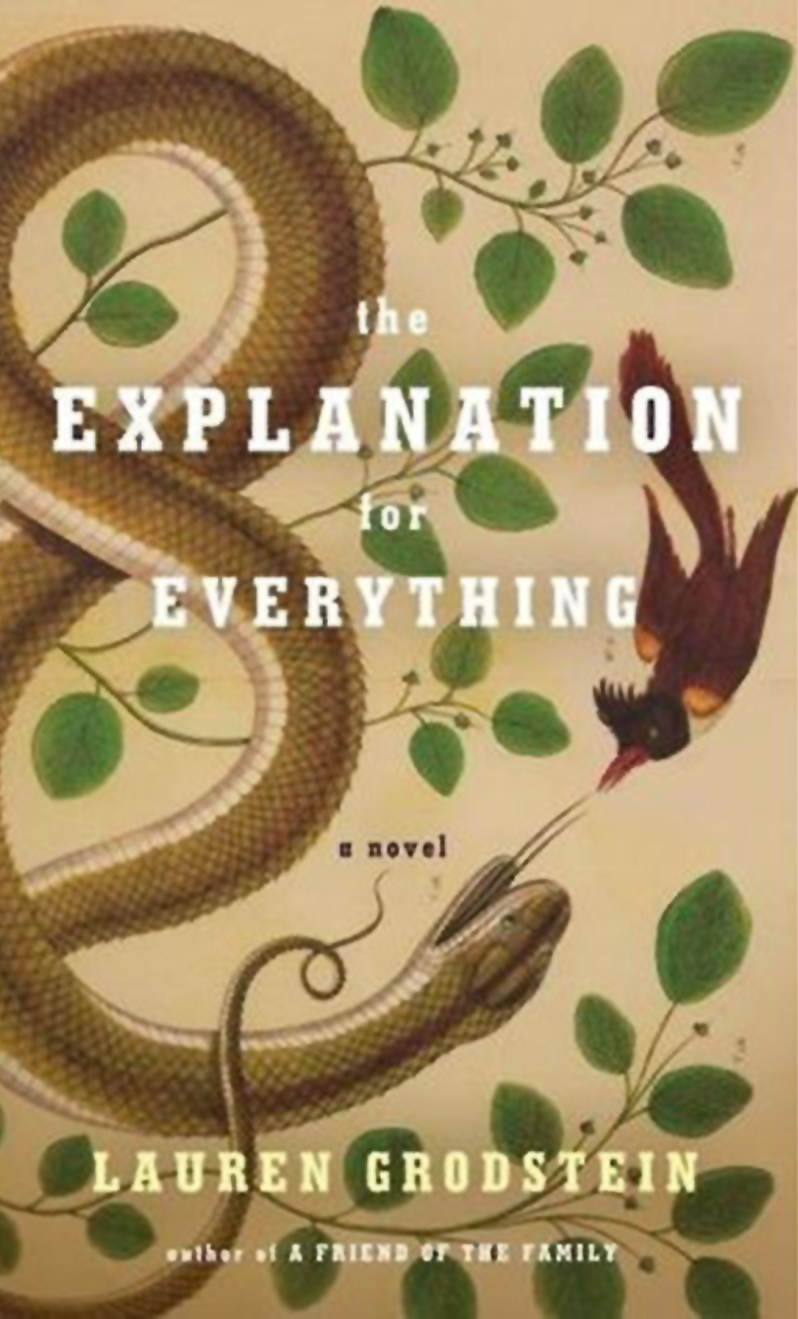 I’ve been pondering this matter in connection with two Philadelphia-area authors who will be reading at Musehouse in January: Lauren Grodstein and Susan Barr-Toman. Both tackle difficult subjects without flinching from the details. Grodstein’s 2009 novel A Friend of the Family centers on a suburban doctor who has clear and reasonable ideas about right and wrong and who gets into deep trouble, personal and moral, when he tries to act on those notions. Her latest novel, The Explanation for Everything, features a widowed biologist whose trust in science is challenged by a student who believes in God. Not the usual pattern of religious faith undermined by science, but the reverse—and though there’s plenty of humor in the situation, the novel takes the challenge by faith quite seriously. The protagonist’s science begins to fail him; his experiments go wrong, and his Darwinist convictions bring him little solace for the death of his wife. Enter a Christian student—a nubile female, no less—who offers both personal and spiritual comfort…
 Susan Barr-Toman’s novel When Love Was Clean Underwear, winner of the Many Voices Project award, was published by New Rivers Press in 2009. It begins with an elderly, terminally ill woman demanding that her live-at-home daughter help her commit suicide. The mother prepares a series of index cards with detailed instructions for each step: “Number One: Place pillow over my face and apply firm but gentle pressure for a minimum of five minutes.” After the suicide/murder in the first chapter, the introverted and now-culpable daughter has to make a life for herself—and that’s the story for the rest of the book.
Most fiction writers choose easier topics, of course. But the genre allows us—indeed, challenges us—to explore the hardest truths in depth, without flinching. And that’s why I think fiction is often truer than memoir, truer perhaps than what we call real life, which for many of us teems with artificialities.
Grunge in the Burbs
June 16, 2013
 Conquistador of the Useless, the first novel by Joshua Isard, teems with references to bands I’ve never heard of. The book is also way too cool to use quotation marks around dialogue. All this should annoy me, but I enjoyed the tale anyway.
The story is told in the first person by Nathan Wavelsky, an early-thirties guy with a boring desk job, a nice wife, Lisa, a new home in the suburbs and a passion for grunge and pre-grunge bands that speak to his alienation. How does a grunge couple end up in the burbs? Well, they left the hip inner city because they got tired of the noise and the hipsters’ pretense. Of course, Nathan doesn’t like the pretense of the suburbs either; he’s immediately snarky about the new neighbors who invite them for dinner:
So, Kristy [the neighbor wife], says, how long have you been married?
Four years, Lisa answers.
That’s wonderful, Kristy says, we’ve been married almost eight years now.
She says it like they’d beaten us at some contest.
That’s typical of Nathan’s sarcasm. There aren’t many people he cares for. What he does like is drinking tea in the tree-shaded quiet of his backyard, bothered by no one. He also loves listening to his music, reading his books. He has no ambitions and doesn’t see the need to develop any. Isard sets him up, in fact, as a prototype of his generation. Here’s Nathan describing himself and Lisa during and after college:
Neither of us were National Merit Scholars or Phi Beta Kappa members—we always studied, but refused to end up in the college’s counseling office because we had anxiety attacks over a B.
This is also the way we treated our jobs. We worked hard in the office, but tried not to think about it when we got home.
It wasn’t that we didn’t aspire to a promotion, it’s that we didn’t aspire to anything. We were the kids who heard their public school teachers tell them that they could be anything, even President of the United States; whose parents insisted that we would be the generation to change the world; who grew up in the age where everyone’s special.
Then we looked at the politicians, our teachers, our peers.
And we said, Horseshit.
And we were happy.
With Nathan thus coasting through life, Isard tosses him some trouble. Nathan’s best friend, who has become a rich adventurer, breezes into town and invites him to climb Mt. Everest. The thought intrigues Nathan because he has always liked climbing mountains (though he has no experience on difficult ones) and because he’s drawn to experiences that are “wonderful and useless.” But a trip to Everest, with the real possibility that he might freeze to death there, conflicts with Lisa’s sudden interest in beginning a family. Nathan finally grasps Lisa’s seriousness about nesting when she starts painting the house by herself and buying new furniture:
We’ve been here for five months, Nathan, and until today we had a hobo’s table next to our couch, a bedroom that makes a summer camp cabin look ritzy, and no plan for any of it. We’ve got a stove, a dishwasher, and a washer/dryer that came with the place because the last owners didn’t want them anymore.
Yeah, I say, but those things still work fine.
Who gives a shit if they work, she says, they’re not fucking ours.
It is, at this moment, that I realize the full gravity of the situation.
Nathan also gets into trouble by lending Vonnegut’s Cat’s Cradle to a teenage neighbor girl, Rayanne, a cultural faux-pas worsened by his indifference to propriety. He is shunned by the adult neighbors, who assume he’s been corrupting minors, and again Lisa is not amused:
What kind of relationship do you have with Rayanne?
The kind where I lend her books and music.
And where you think about how hot she’s going to be.
Oh come on—
Is it also the kind where you invite her into our house when I’m not home?
Yeah, I say, to give her a book.
You didn’t tell me that part of the story, she says, you didn’t tell me she came in here with you. How do you think that looks?
I don’t know, I say, polite?
The humor, as should be evident by now, keeps Nathan amusing even when his unwillingness to be impressed with life becomes profoundly unimpressive. Yet, since this is a Serious Novel, Nathan does at last experience Personal Growth—and though I’m capitalizing these concepts to poke fun at them as Nathan himself might, the end is genuinely moving as well as unexpected.
It’s a good read even if you’ve never heard of Pixies, Green Day, Social Distortion, Mudhoney, Screaming Trees, or Jane’s Addiction. Even better, I guess, if you have.
A Fragrant Tragedy
June 10, 2013
From the opening of Ru Freeman’s ambitious and moving new novel, On Sal Mal Lane, set in her native Sri Lanka, we know that tragedy looms. The Prologue, in italics, sketches the background of the conflicts between Sinhalese and Tamils that erupted into war, and the first chapter of regular text begins in this way:
“God was not responsible for what came to pass. People said it was karma, punishment in this life for past sins, fate. People said that no beauty was permitted in the world without some accompanying darkness to balance it out, and, surely, these children were beautiful. But what people said was unimportant; what befell them befell us all.”
Lest we forget the context, this narrative voice from on high returns from time to time to update national political developments and remind us of the doom hanging over the characters.
Yet the novel’s basic action scarcely ventures beyond the tiny, flower-bedecked, semirural lane of the title, on the outskirts of the capital city, Colombo. The people there form a microcosm of Sri Lankan ethnicities and religions—Sinhalese, Tamils, mixed-race Burghers; Buddhists, Hindus, Muslims, Catholics—all in the space of nine households. Most of the plot centers on the children of Sal Mal Lane, especially the four Herath kids, who are sensitive, talented and a bit more upscale than their neighbors.
Perhaps the novel’s greatest achievement lies in the way it locates significance in the tiniest domestic actions. A wayward teenager, Sonna, quarreling with his father, is denied a birthday party. As a make-do, Sonna’s mother invites the Herath children over for an elaborate dinner without stating that it’s for the boy’s birthday. Later, discovering the truth, the Heraths feel bad that they didn’t take a present. They count out coins from their allowance to buy a chocolate for Sonna, put it in a shiny bag and try to deliver it. He isn’t home, though, so they stash it in their refrigerator to keep it from melting. The next day, Mr. Herath, rummaging for a sweet after lunch, finds the candy and eats it. The children are too abashed to stop him, afraid their mother will find out they’ve been associating with Sonna. Having no money to buy another treat, they reconcile themselves to feeling ashamed, and they let the matter drop.
Ending a chapter, this little tale hovers as a portent. How will the mistakenly consumed chocolate contribute to the slowly unfolding tragedy? This technique encourages the reader to focus on causes rather than on what comes next. For me, though, the weighty foreshadowing has its downside because it discourages page-turning; I was none too eager to arrive at the moment of implosion.
Another potential difficulty is that the profusion of characters makes it hard to become deeply invested in any one of them. Eventually the reader comes to care for several of these people, but it takes a while. Among the Heraths, there are four children of various ages, plus the father and mother. Five other children play significant roles, as do ten or more adults. The interplay is complex, and even the troublemakers and bigots have some redeeming features. The upside is that we get a rich, complex view of a neighborhood, both its uniqueness and its inability to escape the sociopolitical trends that are drawing the larger society into turmoil.
The language is often as fragrant as the blossoming sal mal trees that surround the lane and the spicy curries prepared by the women. In these lyrical passages Freeman’s affection for her homeland shines through. Here’s a paragraph plucked almost at random:
“The gusty wind that dominated a short respite from the monsoons was beginning to tease the children of Sal Mal Lane. It tugged at their school uniforms, inverted umbrellas held against the sun, and combed and recombed their hair, first this way then the other. It whispered stay! stay! to them as they stood waiting for their school buses, shivering in the cool morning hours, a request they tried not to hear. They giggled as their skirts and shirts lifted this way and that, their books fell out of their careless hands, and the ribbons tied into their braids and ponytails, blue and white for the Herath girls, green and white for the Bolling twins, refused to stay in their knots. But each evening the children acquiesced. They put down their books, put on their home clothes, and went outside. They went to fly kites.”
Another treat is the occasional profound remark that could be framed and mounted on the wall. At one point the younger Herath boy, Nihil, seeks reassurance about the rumors of civil war and the announced intention of other boys on the lane to join the army. He questions his friend, old Mr. Niles, who answers: “People do not go to war, Nihil, they carry war inside them.” At times such philosophizing can become a bit heavy-handed, but it serves to reinforce the themes of the novel.
When the long-awaited tragedy arrives, it occurs on two levels. On one level we witness a political event as the quiet street is overcome by the conflict raging around it. But the greater tragedy is rooted in the personal stresses we have seen developing: father vs. son, neighbor vs. neighbor, social outsiders trying to gain a place among those they admire and envy. No one on Sal Mal Lane is entirely innocent. As the second-oldest Herath child, Rashmi, reflects near the end, “Everybody was responsible for what had happened to their street.”
Even as calamity intrudes, however, the people of the lane bond together, across ethnic boundaries. The victims are cared for by their neighbors. The dénouement rekindles a sense of hope, and the novel ends with a young person reading from Malory’s Le Morte d’Arthur, “a tale of striving for high ideals amid human frailty, turmoil, and change.”
On Sal Mal Lane is not a quick read but one to savor, one whose images and ideas will linger in the reader’s mind.
That Feeling of No Feeling
April 15, 2013
As I was reading J. M. Coetzee’s Disgrace recently—only 14 years after its publication, and 10 years since he won the Nobel Prize, so I must be catching up—a sentence struck me with enough force that I made a note to come back to it. And thus (after several weeks of forgetting my note, which I emailed to myself) I’ve done so. This is the sentence, written from the point of view of the middle-aged protagonist:
Again the feeling washes over him: listlessness, indifference, but also weightlessness, as if he has been eaten away from inside and only the eroded shell of his heart remains. (Chapter 18)
These words appealed to me as the quintessential expression of the postmodern character, one emptied of true emotion. Add a thick layer of irony as the outer lining of that eroded shell and you have the universal human that Western social evolution has produced.
At least one would suppose so from reading much contemporary fiction. In my own writing, too, the default fictional character seems to be psychologically worn out, spiritually moribund. But, oddly, I don’t feel that way myself most of the time—tired maybe, frazzled, but not listless or indifferent, and certainly not weightless. I’m still romantic at heart. Hopeful and fearful in equal measure. Appallingly juvenile in the imagination.
Most of my stories that begin with that default listless character turn out to be failures, and I discard them. Because real people, and in particular the ones I want to write about, aren’t like that. But it’s hard to change the default setting; I tend to begin with emptiness and then ponder what might fill it.
I wonder how much that has to do with our culture, the profusion of irony, the unwillingness to admit that we believe in and care deeply for certain values. We don’t dare appear foolish.
Coetzee’s protagonist, I should note, doesn’t start out emotionally dead. Though his life is rather barren, he at least keeps himself entertained (mainly with sexual pursuits) until a series of traumas, including the “disgrace” mentioned in the title, drop him to his nadir. The author then carries him through to a curious and bemusing sort of redemption.
My point, if I have any, is that it’s time to change the default setting—to be foolish enough to admit we care about some things, and to write about characters who care.
 The News from Gridleyville