
In the Season of Mud
March 21, 2016

A story of mine, “How I Found God in the Laundromat,” has just been posted at Mud Season Review:
http://mudseasonreview.com/2016/03/fiction-issue-18/
Many thanks to the editors there. And if you follow the link to look at my story, check out this month’s featured poetry, nonfiction, and art as well. The vagueness of the setting in my piece (an anonymous suburb) can be countered by the vivid Colorado landscape in Gretchen Comcowich’s nonfiction, “Garbage Heap Wonderland.”
I guess my story and its venue are both appropriate for the season, for these reasons:
- The tale’s about a Bar Mitzvah boy bucking and moaning through his ritual ascension to “manhood.” It’s appropriate for Passover, coming up next month, when Jews tend to muse on what their religious identification means to themselves and to others.
- We’re right in the middle of mud season, as my wife reminds me with curt emails about the clods my shoes have left on the rugs. And the boy in the story can be seen as trying to climb out of the mud he has created for himself.
- Mud Season Review, an outgrowth of the Burlington Writers Workshop, lies in the heart of Bernieland, so I’ll dedicate this story to the Grumpy Grandpa who has energized the Democratic primaries this year.
The Border Question, Part II
February 20, 2016
In the current atmosphere of polarization and vitriol, my important suggestions for resolving the U.S. immigration crisis (“Tzapping the Borders,” August 31, 2015) have been ignored. I take no personal offense. My wife generally ignores me too.
Perhaps, in fact, one fear I expressed in that essay—that mutant penguins might swarm our beaches—was overblown. As yet, I haven’t seen reports of any such invaders, though I doubt Governor Christie has been patrolling the Jersey coast as vigorously as he ought.
In any event, I realize it takes repeated iterations to make a truth sink in, as our presidential candidates demonstrate by uttering the same phrases a dozen times each day. In this post, though, I’m not going to replay my arguments from last August. Instead, to keep up with the evolving debate, I’ll offer a modified proposal.
Our composite Republican candidate for president, Dred Crumpio, insists on building a wall along the Mexican border, and reiterates the plan so often that we have to take it seriously. All right, then, let’s say we agree to it. Let’s look at the practical implications.
The expense of a wall will be enormous, and asserting that the Mexican government will have to pay for it is ludicrous. Mexico City doesn’t have bags of cash lying around, and any Mexican politician who agreed to such payments without getting, say, Texas in trade would be hounded out of office. (And you wouldn’t really trade Texas back to Mexico, would you? The Alamo, Davy Crockett and all that? Wait, you would?)
But there are nongovernmental entities in Mexico that could pay for a wall. Think a moment. Do you see where I’m going?
The drug syndicates! The Sinaloa Cartel! Los Zetas! Cártel del Golfo! Et al., al., al., al. They’re the ones with cash and valuables spilling out of every pocket, not to mention other orifices. But what would induce them to put up funds for a border wall?

A rational businessman
Well, it’s obvious: We install a few gates in the wall, which only the cartels can access. Then they’ll be able to bring in drugs without hassle, saving the ongoing costs of recruiting and compensating smugglers and bribing law enforcement. Those costs must be considerable, after all. Consider how difficult it must be to convince potential mules to carry bags of cocaine in their rectums, even if you threaten to slaughter their parents and torture their children. Besides, such threats are abhorrent to successful businessmen. It would make much more sense for the Cartel Lords to help us build a wall through which they, and only they, could export goods safely. And being eminently rational, undeterred by sentiment or idealism, the Lords will agree.
Naturally the gates’ existence must be kept secret. If we the public knew, we’d want to use them for importing other stuff, such as cheap pottery and tequila and underpaid labor. Therefore, for this plan to work, we need to elect a president who is adept at concealing the truth and lying to the American public.

Dred Crumpio, the new face of America
Luckily, we have just such a candidate. Dred Crumpio is our man! Can we all get together and support him now?
Nostalgia and Survival
February 18, 2016
Watching the Black Panthers documentary on PBS the other night (The Black Panthers: Vanguard of the Revolution by Stanley Nelson) made me predictably nostalgic, but I was also confused. What exactly had I thought of the Panthers, and their now-mythic confrontations with the cops, back in the day? In some cases I was just a few miles away when the events went down, but I don’t remember my attitude. Was I mostly on the Panthers’ side, somewhat on the cops’ side, or in my usual utterly muddled middle?

Jed Garoover, as immortalized in the Library of Congress
The documentary also brought up fond memories of San Francisco Chronicle columns by the late Art Hoppe, who turned political figures into comic characters such as Elbie Jay and Billy Boomer, Boy President. Parts of the documentary featured Washington’s arch-villain, the head of the FBI, and I was trying to recall: Did Hoppe invent the name Jed Garoover for that multi-chinned Mephistopheles? It seems to me he did, though I can’t now confirm that.
Most important, the documentary got me thinking about my faith in America—its culture, its political system, its fundamental being. Despite all the polarization and hatred in the Panther days, I didn’t feel, as I do now, the same overpowering sense that the American Soul was at stake. Maybe my youth made me optimistic. Maybe I believed that truth would win in the long run (hah!). Maybe I trusted in the innate sense of the common people who supposedly have the final say in a democracy.
Now I know that we commoners are marginalized by power brokers and fixers, and many of us don’t give a shit anyway. A friend with relatives in Jerusalem tells me that many young Jewish Israelis have given up on politics, neither believing in the long-assumed “two-state solution” nor searching for an alternative. Instead, she says, they live for the moment; they go to cafes and dance on the beach. Is that what we’ve come to now in America?

My new home? (Courtesy of Google Maps)
Though we survived the empty-pated Reagan and the crook Nixon, not to mention earlier embarrassments like Harding and Grant, can we survive the new Republican, Dred Crumpio? (For a sketch of Crumpio, see my previous post.) In the event that the White House, as well as Congress, becomes the fiefdom of demagogic frauds, I’m at least half-seriously considering a move to Canada. I’ve already picked out a neighborhood with a large dog park (green area on the map), though I haven’t yet researched the regulations for exporting dog and family.
So: Would I be wrong to give up on the US of A? Would that be (a) cowardly, (b) a sign of clinical depression, or (c) sane?
The Composite Candidate
February 5, 2016

Dred Crumpio
Now that the presidential campaign season is truly underway, the composite candidates have begun to emerge.
Back in 2012, the composite Republican contender, whom I named Mick Somnorich, was kind of feckless, hard to take seriously. He was, in fact, boring, and everyone’s already forgotten him.
This year’s version is truculent and malevolent, much more exciting to watch in the present and likely more memorable in the long term. For those who haven’t tuned in yet, here is his message in a poetic nutshell:
Ready for a New American Century?
Calling the enemy by its name,
I’m the conservative who Democrats
fear most. I won’t let them take away
our giveaway to the corporate patrons.
They’re rapists on the lookout!
It is our job to kill terrorists. Weakness is
provocative. I would bomb the shit out of them.
And believe me, my temperament is very good,
very calm, I’m proud to have an “A” rating
from the American Rifle Association.
We stop bad guys by using our guns!
If I become president, Americans can work
together to revive Merry Christmas
and infringe on the rights of good, law-abiding
citizens. The whole world is on fire!
Look at that face! Pathological,
there’s no cure for that.
This composite’s name is Dred Crumpio, and he believes everything he says, even if he knows it’s a lie. Because talk is just talk, after all. It’s another thing entirely to whomp the bad guys, and believe you me, Americans don’t care about the actual score as long as we can pretend we’re winning.
The Resilience of Evil
December 7, 2015
 In the wake of the most recent mass killings on U.S. soil, and the various posturings and evasions of our politicians, it’s time for another political column. However, in contrast to my usual rant, I’ll endeavor to make this post well-reasoned and scholarly. In the style of a philosophical treatise, the separate arguments will be enumerated, and footnotes will document the sources.
I. “We have met the enemy and he is us.”1
I.a. Syed Farook, a U.S. citizen, born and raised here.
I.b. Dylann Roof, a U.S. citizen, born and raised here.
I.c. Adam Lanza, a U.S. citizen, born and raised here.
I.d. James Holmes, a U.S. citizen, born and raised here.
I.e. Eric Harris, a U.S. citizen, born and raised here.
I.f. Dylan Klebold, a U.S. citizen, born and raised here.
I.g.–I.z. Et al., et al., et al.
II. Evil cannot be eliminated from the world.
II.a. Evil has been with us since the first human beings.2
II.b. Evil will not succumb to bombs, ground troops, atomic weapons or—except in fantasy movies—magic light sabers.
II.c. Indeed, the resilient, slippery and protean nature of evil—its ability to pop up in new forms in new places—suggests a popular game whose name now connotes a repetitive and impossible task.3
II.d. As point I above indicates, evil lives in all of us, not in any particular place.
II.d.1. Hence there is no one place to attack it.
III. Nor can the enticement of evil be eliminated.
III.a. Some types of evil will always look prettier or sound more convincing than good.4
III.b. In the basic sense, each person is tempted not by outsiders, but by his or her own desire.5
So, if we can’t get rid of evil, what might we do as a society? No easy solution exists. But we could try to make the good—that is, sane, peaceful, life-respecting behavior—more attractive. For instance, we could work to reduce poverty and the huge gap between the privileged and underprivileged. By doing so, we would boost the sense that everyone has something to live for rather than commit murder-mayhem-suicide for. Instead of empty patriotism, we Americans could then speak with a justified pride in our country, as one wild-eyed Revolutionary-era radical suggested:
When it shall be said in any country in the world, my poor are happy; neither ignorance nor distress is to be found among them; my jails are empty of prisoners, my streets of beggars; the aged are not in want, the taxes are not oppressive; the rational world is my friend, because I am the friend of its happiness: when these things can be said, then may that country boast its constitution and its government.6
Notes
- Pogo the Possum, 1971; see https://en.wikipedia.org/wiki/Pogo_(comic_strip).
- Genesis, 300 B.C.E. or earlier.
- Whac-A-Mole; see https://en.wikipedia.org/wiki/Whac-A-Mole.
- John Milton, Paradise Lost, 1667.
- James 1:14, c. 100 C.E.
- Thomas Paine, Rights of Man, 1791.
Guns and Cheesesteaks
November 22, 2015
![s[r]headline](https://gridleyville.blog/wp-content/uploads/2015/11/srheadline.jpg?w=300&h=268) I have a new guest post on the “s [r] blog” from Superstition Review. Here’s the link.
I have a new guest post on the “s [r] blog” from Superstition Review. Here’s the link.
The post is titled “Guns and Cheesesteaks,” and it’s probably not quite as silly as the title suggests. In fact, I believe it’s as meaningful as any recent utterances by Donald Trump.
Welcoming Pope Francis to Our Neighborhood
September 28, 2015
This past weekend, my neighborhood in Philadelphia had the privilege of hosting Pope Francis. The Pope’s outdoor mass took place roughly two city blocks from my house. What a momentous celebration!
Reporters and bloggers have already published hundreds of commentaries and thousands of pictures about his visit (see, for instance, this post by the inimitable Liz Spikol), so I won’t attempt to talk about the religious, social or political aspects. This essay offers a micro view, focusing on snapshots taken within one block of my house—some within a dozen steps of my front door—to show how we readied the place for the pontiff. I hope our way of honoring a great dignitary will become a model for other localities.
Because this was the largest National Special Security Event (NSSE) ever, we took extra care to make our little community safe and appropriate for the Pope and his million-odd admirers. To begin, we closed the streets to traffic and towed away any parked cars left behind:

Above: Before the preparations began. Below: Afterward.

We installed extra trash cans, and they were prettier than our usual ones:

We removed the mailbox, which might conceal bombs, weaponized hoagies or other dangerous objects:

The sign says: “Please be advised that this collection box will be removed on Thursday, September 24th, 2015 and will be reinstalled on Monday, September 28th, 2015. This is Due to the Papal visit to Philadelphia.”
We blocked access from side streets:


We also blocked the sidewalks of intersecting streets, leaving just enough room for pedestrians to squeeze through. This was to prevent terrorists from swooping in on golf carts or riding mowers:

We installed air-quality monitors to warn of chemical and radiation attacks (though some residents who tend to be gaseous worried about setting them off accidentally):

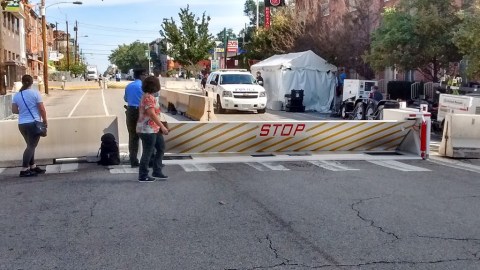
We set up checkpoints:
We placed sharpshooters on rooftops. (Sorry, no picture. You know what guys with high-powered rifles look like.)
We brought in large groups of friendly young men in camouflage uniforms:

We conducted constant surveillance from helicopters:

Looks like a spider up there, but it was much louder.
A little farther from our house, I spotted one low-flying Osprey, barely a hundred yards over the rooftops. This is an aircraft used only by the Marines and Air Force. Even the National Guard guys stared up at it in wonder, perhaps worried about its notorious crash record.
Of course we closed our schools and most of our small businesses. We detoured or stopped buses. To make room for the faithful, about half of our residents left town. Restaurants, if they stayed open, were empty.
Even the multigenerational Catholic family next door—a family that’s lived in the neighborhood for more than half a century—departed when they were unable to get tickets to the event. They planned to watch on TV from the Jersey shore.
So our neighborhood was all prepared to welcome Pope Francis. Proud of our efforts, we were ready to celebrate with him.
The only problem?
Our neighborhood wasn’t here anymore.

Our thriving city block
ABC: Educational Success Stories
September 17, 2015
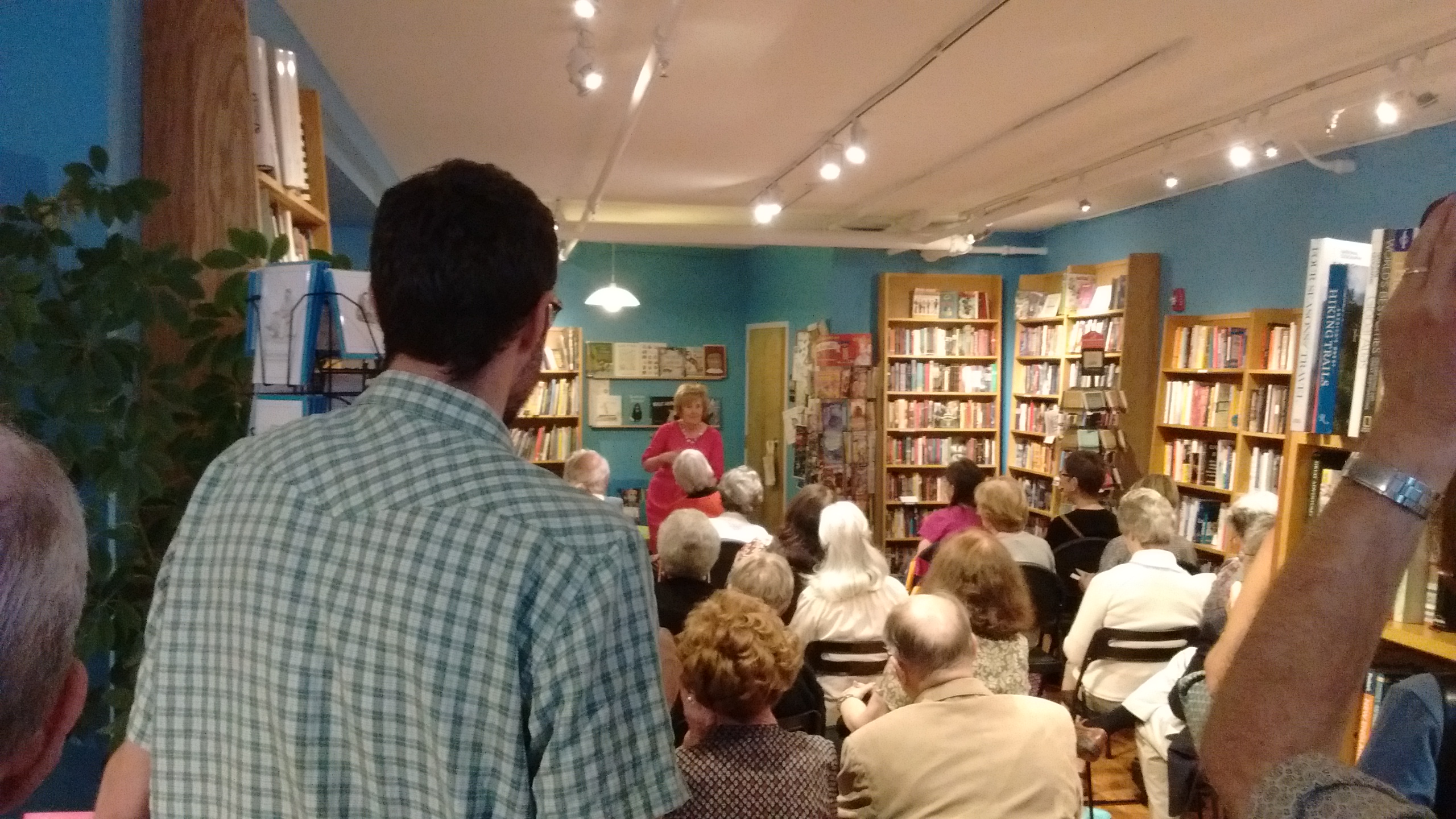 Here’s a photo from another standing-room-only book launch. I like that tall guy’s shirt, but I’ve got to start arriving early enough to grab a seat! Or I should remember to claim a chair before I linger at the wine table.
The book being celebrated, last night at Main Point Books in Bryn Mawr, PA, was A House Alive with Words by Patricia Zita Krisch (the person way up front in the red dress). Subtitled Stories from the ABC Program, a path to college for inner-city youth, it focuses on eight boys from the ABC House in Lower Merion Township, a well-to-do suburb of Philadelphia. Part of a national program called “A Better Chance,” ABC House takes academically talented, economically disadvantaged boys of color and houses
them together while they attend Lower Merion High School. Along with a home, the program provides academic and personal counseling and guidance. The goal is to get the boys into college and on the path to success.
 You’ve heard of programs like this. Do they really work? Trained as a sociologist, Krisch understands the social and educational problems the kids face—such as being singled out, in a class of white students, to give the “African American view” on an issue—but she goes beyond those to portray each of the boys as an individual with his own experiences, insights, struggles, and delights. One of her significant observations is that the boys’ greatest resource turns out to be their group itself, the camaraderie they develop and the support they give each other.
Nationally, ABC graduates include well-known people like Tracy Chapman and Deval Patrick. But the program is not about making governors or Grammy winners, it’s about giving ordinary smart kids a chance at a successful life. Krisch’s “stories” from the program, including the tale of one boy who was kicked out, help us comprehend the scale of changes that will be needed for everyone to have a better chance.
The publisher’s site is here, and the book’s Amazon page here.
Escaping the Nazis: One Family’s Story
September 10, 2015
I’ve discovered that part of the art of promoting books is to post pictures of the large, rapt audience at the book launch. Last night I attended the launch celebration of a fine historical book, Against Time: Letters from Nazi Germany, 1938–1939, published by the American Philosophical Society. The audience was indeed enthusiastic and numerous—standing room only in a spacious hall! Here’s a photo from my point of view:
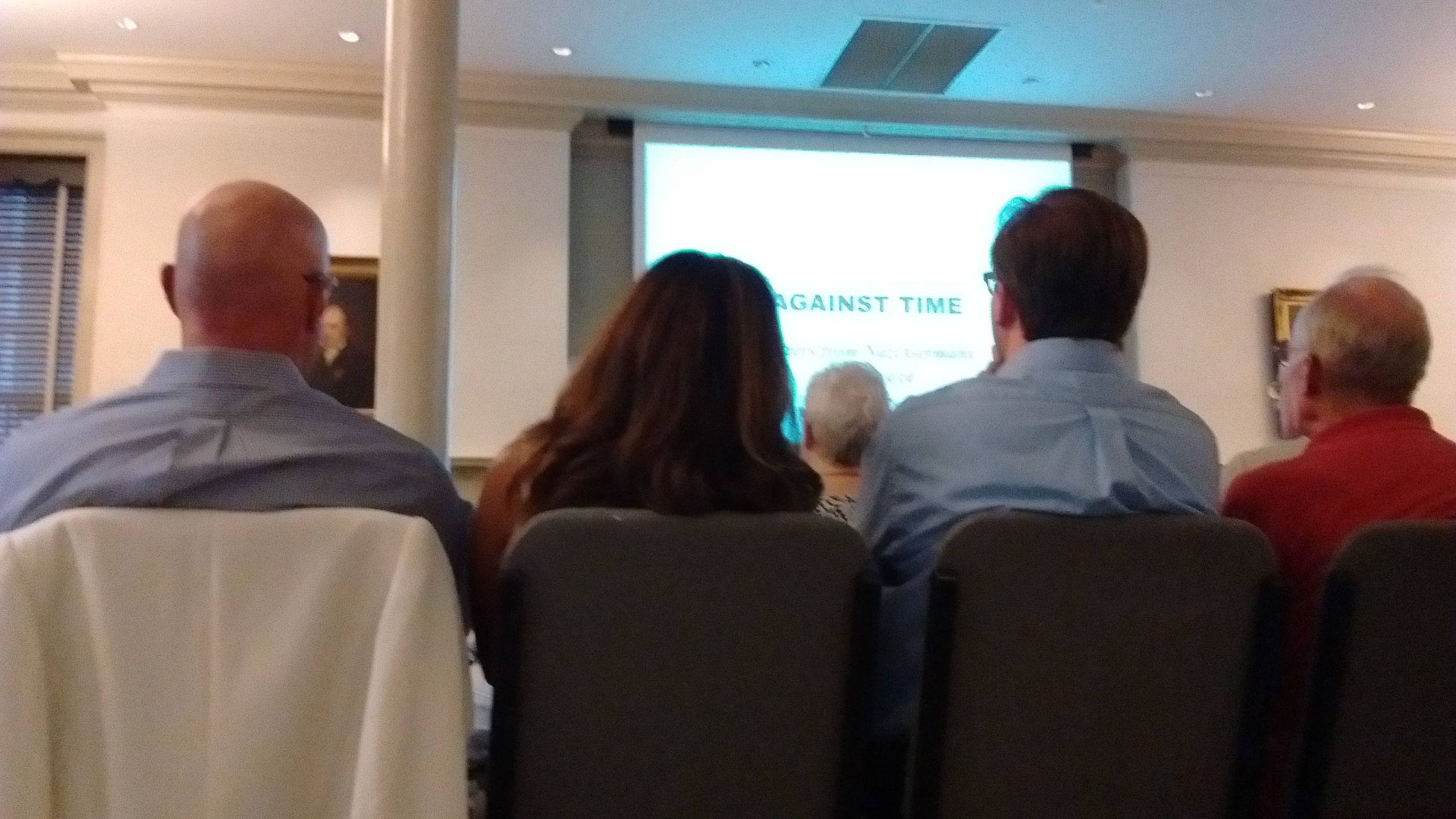
As you can tell, I converted the standing room only into sitting-on-the-floor room only. The author, Francis W. Hoeber, was giving a spirited presentation from somewhere behind those heads.
The heart of the book is a collection of letters between Hoeber’s father, who escaped Nazi Germany in 1938, and his mother, who was trapped in Germany for another year with her young daughter. These letters, which Hoeber discovered accidentally in his mother’s file cabinet many decades later, form a moving and detailed view of daily life under the Nazis and the complicated maneuvers that people performed to escape persecution. It’s one Holocaust story with a happy ending, in that all the main characters survive. Hoeber adds his own lucid commentary, rich with historical and personal information. Most of all, the book is enlivened by the personalities that emerge from the letters, including his mother’s acerbic wit. If wit were only as lethal as guns, that lady could have defeated the Nazis by herself.
Since the author is a friend of a friend, I did summon the energy to stand up after a while to see him:

That’s Frank Hoeber at the lectern with an image of his father on the screen. The volume has a number of interesting photos and facsimiles, and it’s nicely designed and printed.
For anyone who’s interested, here are some links:
Tzapping the Borders
August 31, 2015
I’ve never before used this blog to endorse a commercial product—other than my own books, of course—but a special case has arisen concerning the very integrity of our country, and I feel I must alert my fellow Americans to what I’ve discovered.
We’ve all listened to the proposals from presidential candidates to build a wall along the Mexican border to stem illegal immigration, and Governor Scott Walker of Wisconsin has logically extended the proposal to the Canadian line as well. There is nothing hysterical or paranoid about these concerns. Just pause a moment to think what would become of this country if we allowed the Mexican-Canadian rapist-murdering-drug-dealers to steal the lawn-care jobs of American workers!
There is a major problem, however, that none of the candidates has addressed. The barriers would be enormously expensive to construct, possibly requiring a rise in taxes that no patriotic American would support. (Those who suggest that cinder block and labor could be imported cheaply from Mexico miss the point entirely.)
Moreover, the Great Wall advocates have overlooked thousands of miles of other entry points: the Gulf Coast, the Great Lakes and the Atlantic and Pacific oceans. Who knows when Mediterranean people-smugglers will invest in better boats so they can drop off Syrian refugees on the Boardwalk in Atlantic City? There’s also the possibility, remote at this time but certainly a concern for the future, that alien shark-creatures might swarm ashore and apply for work cooking fish fillets at McDonald’s. And what about mutant penguins? Has anyone considered the mutant penguins?
Thus it’s apparent that the political debate has been riddled with gaps in logic as huge as the holes in Carly Fiorina’s resume. Luckily, technology—American technology, best in the world!—can again save our butts as well as our souls. A leading innovator in the security industry, Pharr Integrated Security Solutions of southern Texas, is now marketing the Tzapp Total Border System, and this is the product I’m compelled to tell you about.
Based on the groundbreaking work of legendary physicist Seymour Tzapp, the laser-based system is both efficient and economical. One relatively inexpensive laser weapon, adjusted properly, can protect 425 miles of border or coastline; hence a complete system would cost a fraction of a Great Wall.

One unit of the Tzapp Total BS
How does it work? When any object larger than a hare begins to move across the secured line, the Tzapp Total BS delivers a pulsed, narrow-beam wallop strong enough to enforce immediate retreat. In tests conducted in the Rio Grande Valley, the system has scattered deer, terrified ocelots and caused skunks to spray themselves uncontrollably. The Texas tortoise (Gopherus berlandieri), once Tzapped, has been timed at 30 mph, outrunning a raccoon.
One additional feature: The Total BS leaves a prominent raised scar, curved like a Nike swoosh in bright orange. This will prove as embarrassing to a Mexo-Canadian rapist-murderer as to a nefarious opossum, and a single Tzapp will be enough to discourage future transgressions, especially if the lasers are aimed to strike a delicate part of the anatomy. During the beta test, the tortoise was so mortified he never came out of his shell again.
I would supply a link to further information about the Tzapp system, but in its haste to bring this amazing product to the American public, the company has not yet developed an online presence. However, all interested parties—politicians, military officers, gun freaks and ordinary citizens—are invited to visit corporate headquarters in Pharr, a lovely community just a few miles from the McAllen Miller International Airport. Although it’s a small and unprepossessing city, you can’t miss the signal that you’ve arrived: a sign at the border tells you that you’ve gone to Pharr.
 The News from Gridleyville