
Elvis and the Season of Light
December 16, 2014

Photo by Ed Roberts via Wikimedia Commons
I’m pretty much a bah-humbug person, especially now that Santa sends me spam emails. (Really, Big Guy? I’m much more likely to open an offer of gifts from someone called Ashley or Courtney or Svetlana. Try changing your name.) Yet, though I refuse to celebrate in an outward fashion, I do love the so-called “spirit” of the winter holidays. Last year about this time I wrote a little essay about the “season of depression,” which ended up on the Superstition Review blog in February. That post mentioned in passing a church tradition of lighting candles on Christmas Eve, typical of the way many (or most?) religions counter the winter darkness by celebrating light. In fact, Chanukah, the Festival of Lights, begins tonight.
This year, then, I’ll post a passage relating to our reverence for light and all that it suggests. What follows is an excerpt from my novel The Big Happiness, which I’m preparing for republication as a Kindle ebook. A kind of warped love story, the novel features two protagonists who are each disabled in some way. Allison Roarty (a.k.a. Allison Wonderland) is a 45-year-old, divorced, wacky, sexually adventurous, somewhat overweight alcoholic with brain damage. By sheer accident she meets Leigh Berry, a gangling, half-blind, reclusive, 62-year-old devotee of ancient music. She seduces him and the novel is off and running—or rambling, stumbling and blundering after these weird characters.
Leigh’s language, like his mind, is often archaic and tortured. Through his relationship with Allison he has to learn to communicate again. He also has to deal with the “light,” both literal and figurative, that she insists on shining into the dim haunts of his life. One of her first acts is to throw open his curtains, and being an oddly mystical sort—though an atheist—he begins to suspect that the Light he encounters has meaning for him. On Christmas morning in Allison’s apartment, he wakes before she does and senses rays of a peculiar color—a silvery, otherworldly blue-white—on the windowsill. He’s intrigued and also scared, afraid he won’t live up to what Allison, and the God he doesn’t believe in, are demanding of him.
Then Allison wakes up. The two exchange presents, fool around in bed and listen to Elvis Presley’s recording of “White Christmas.” (It’s Allison, of course, who’s an Elvis fan—she “loved him even before he was dead.”) At last the lovers decide to venture outside:
She yawned, stood up, kissed him and proposed breakfast. “What say we splurge, sweetie? You think that coffee shop around the corner’s open today? Let’s go look. I could use a huge stack of pancakes and I think my Aunt Jemima mix has bugs in it—at least it did a few months ago.”
She dressed quickly and they bundled in their coats and gloves. Down the steps they went, arm in arm, out the door to the sidewalk. But there Allison jerked to a stop and grabbed him with both hands. “My God, look what happened! Careful, don’t fall—there’s ice all over. See it? The whole street’s coated! The rain must’ve froze, why didn’t somebody tell us?”
Leigh tried to peer about but he had forgotten his opticals. That odd silver light glittered everywhere.
“See the streetlight pole? That’s ice on it all the way up, like a, like a real cold condom, honey. It’s beautiful. The city’s deserted, no one’s going out in this. It’s all ours! Let’s pretend everybody else is dead. I mean, except the cook who’s gonna make our pancakes, he better be alive and working today or I’ll kill him.”
She nudged Leigh a step or two forward and pointed. “Look, right next to the building it’s dry, so if we take it real slow and stay close to the wall we can walk. You grab me and I’ll hold you. Those sparkly humps are parked cars, baby. That one that’s like a frozen little man, it must be the fire hydrant ’cause I don’t remember any midgets on this block. This is so cool! Hey, it’s a white Christmas, or close to white, just like Elvis said, sugar.”
The slicing crystal light reverberated in Leigh’s eyes, producing scattered bright spots, ghosts, shadows. He was reassured to learn of a meteorological explanation for the disconcerting rays through the curtains, but the direct glare was most confusing. He crept along beside the building with one arm up to shield himself.
Unearthly quiet in the city. The still air wrapping him in its cloak of silver wintriness. A dream of the afterlife come to this planet in overpowering brilliance.
“Neat-o,” exclaimed Allison when they eased round the corner. “That tree’s got, like, every tiny branch covered in ice.” She was suddenly gone a moment, during which he closed his eyes tight and faced the wall. Then she was back, tugging on one of his hands. “Here, feel this, slip off the glove so you can touch it, it’s so perfect. Trust me, Leigh, take your glove off, it won’t bite you.”
In his hand he felt a thin, hard, angular shape, sucking frostily at his fingers.
“It’s just a twig,” she said. “Off the tree. But see how perfect the ice coats it? It sparkles like diamonds. Or rhinestones anyway.”
The sharp light winked up from his palm, teasing him. A blued bodiless light of the soul—was it indeed God’s own?
“Now you have to admit,” she said, “Elvis can do magic, honey.”
Whether from heaven, humans or the spirit of Elvis, the lights of this season can indeed be magical—and challenging. May we all try to live up to their promise.
New Stories
December 13, 2014
Two of my recent stories have come out this month, and a third is evidently on the way:
 “Commitment,” a tale of tornadoes, family relationships, and a young woman’s struggles to find peace with herself, appears in the fall issue of Rathalla Review. Thanks to fiction editor Joe Magee and the rest of the staff for choosing the piece and interspersing some great photos by Enrico Pagliarulo.
 I’ve also been indulging in some flash fiction, and one of those pieces, “A Little Girl’s Mouth,” is in the fall issue of Tethered by Letters. The contributions in this issue aren’t yet accessible online, but the print version can be purchased at the magazine’s store. This story took shape in my mind after I read the phrase “a little girl’s mouth” in Diane McKinney-Whetstone’s wonderful novel Tumbling. The story has no other relationship to the novel, but that phrase stuck with me. Thanks to DMW for writing so well that even my sluggish brain gets energized!

Election Results
November 8, 2014
On a truly bad night, with so much
at stake, after particularly ugly
activity in the worst possible group
of states, the voting culture conceded
that cynicism had won the day.
Doomed from the start, both sides
are strongly discouraged from taking
any such action. Stay tuned for updates.
That little “found poem” was constructed from phrases in online reports. Sorry, I was too depressed to do more.
Dear Author
November 4, 2014
One advantage of publishing in the distinguished Valparaiso Fiction Review, as I did earlier this year, is that Valparaiso University’s system sends you periodic updates about the readership. Here’s the latest message:
 Hey, that’s more people than I know, so it must mean that an actual Public out there is reading my work. Yay!
Just a minute, though. A “download” isn’t necessarily a reading. I sometimes download stuff myself, glance at it, say “What the hell do I want this for?” and discard it. How many people are trashing my work in that way? How dare they!
And 181 total downloads, that’s not much, is it? Hardly a bestseller.
Possibly this is a sad indication of the limited readership of literary magazines.
However, it’s also possible that other stories in the same issue are being downloaded much more often. That would be heartening. Wait, no it wouldn’t–who’s getting downloaded more than me, and why? Are some authors in the 200s, even 300s? Whatta they got that I don’t?
Maybe the counter isn’t right. Do I trust this technology? No way!
Now I’m all anxious.
Well, look, being listed in Valpo “Scholar,” that’s an honor, right? In there with all them university perfessers. For someone who hasn’t been a scholar in many years, that’s pretty, like, awesome.
OK, I’m at peace now.
But hurry up, number 182–put down the stupid comics and read my story!
Long Review of Brief Eulogies
November 1, 2014
I’m hastening to do a new post to bump down the appalling “catterel” of my last one. It wouldn’t do for newcomers to this site to peg me as a terrible poet. Okay, that happens to be true, but I commit poetry so seldom that I would hate to think it defines me. (I suppose murderers could say the same thing.)
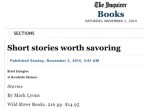 Luckily, I have something to say today: an excellent review of my friend Mark Lyons’s Brief Eulogies at Roadside Shrines appears in the Philadelphia Inquirer. The reviewer is Kevin Grauke, himself an accomplished writer of short stories, and he goes into more detail than I did in my post of October 16. As Grauke says, “While the image of the descanso may tie the stories together thematically, what truly unifies the collection is Lyons’ impressive ability to capture the voices of a wide range of characters. He’s so good that readers may find themselves wishing all 12 stories, rather than nine of 12, had been written in first person.”
I do hope this book gets the attention it deserves. Click the image to go to the review; click here to see the page on Amazon; and click here for a video clip of Mark reading from the book and talking about its background.
A Philistine’s Complaint
October 31, 2014

John Keats, looking poetic in a portrait by Joseph Severn
In my day job I often work with contemporary poetry that I don’t understand. Far too much a prose guy, I like passages that start here and go there, and if detours are taken along the way, fine, but I want to be able to look back and see where I came from, trace the route, and if all I see is a jumble of trees and broken glass and pizzas and penguins and other stuff that doesn’t seem to belong on the same street or even in the same country—and to me much recent poetry is like that—I wonder why I began the trip. In other words, I want poetry to be like that preceding sentence, difficult to diagram but coherent.
Clearly, then, I’m an idiot when it comes to present-day poems, and the following catterel* could be called “A Philistine’s Complaint.” Instead, being pretentious, I chose a clumsy echo of Keats for the title. Today being Halloween, I present this as a tiny contribution to our holiday of horrors.
*Catterel, of course, is verse not good enough to qualify as doggerel.
On First Looking into the Esteemed Poet’s Latest Volume
I don’t get this poem, do you?
The lines skitter
this way and
that, with no reason I can discern
and naturally no
rhyme, except from time
to time, seemingly at
random
and the images dance even more
W * I * L * D * L * Y
about in fervid or perhaps ironic
f r e n z y , punctuated
oddly:
and though I mildly admit my slavery
to logical thought, it’s hard to guess
what this mess
might signify.
It’s profound, I’m sure. In a way, dreamlike.
Yet in earlier centuries the author of such tum-
bling imaginations
would have been burned or be-
headed for witchcraft. Surely this punishment is too dire
for a poet who
teaches other poets
at a poetically
ivied university,
and yet one could hope for
a true witch to boil
this cauldron of wordy gratifications,
stir it, curse it,
drain it
down
revealing a single tough
idea
stuck
to the bottom, like a burnt strip
of meat.
That, I could get my teeth into.
Depression Made Easy
October 27, 2014

A story of mine appears in the fall issue of Red Savina Review:
http://www.redsavinareview.org/sam-gridley/
Many thanks to the editors for publishing the piece despite the fact that it’s guaranteed to depress all readers. In fact, I’d like to nominate it for Most Depressing Story of the Year Not Involving Ebola or Terrorists, but I don’t know who gives such an award.
For more fiction in the same issue—not nearly so depressing—go here to the list of authors and then click on a particular author’s name.
Descansos
October 16, 2014
 Descansos is the Mexican Spanish term for roadside shrines, the kind long seen along highways in the American Southwest. These small, spontaneous memorials have spread to cities, where people pay respect to a shooting victim or a bicyclist killed by a car with an arrangement of appropriate objects, such as flowers, photographs, signs, teddy bears. We’ve seen them all too often lately on the news if not in our own neighborhoods.
Some of the stories in Mark Lyons’s Brief Eulogies at Roadside Shrines are about descansos, and some are essentially descansos themselves, memorials to all manner of troubled folk, from a hobo to a war vet to a lonely kid who raises pigeons. The settings range all over America, even to Mexico and Japan, and they’re packed with remarkable imagery that made me think, Yes, that’s exactly right. Here’s one example, from a story about a woman whose husband has periodic outbursts of violence:
She can sense the rages coming, the way Seamus [a black lab] knows when a storm is moving in. A certain electricity in the air, a rise in the ozone level, a climb in atmospheric pressure. Then the color goes out of the room, like watching a movie in black and white. And just before—just before is this unbearable quiet, this silence, a space where direction could change, but won’t. [p. 187]
Those instants when the world loses all color and sound… Yes, we’ve all been there.
Though his protagonists are wounded in some way, Lyons resists attempts to sentimentalize or typecast them. For instance, that violent guy who beats his wife? When he’s not in a rage, he rescues wounded animals. And the wife, does she follow the typical pattern of resisting counselors who try to pull her free of the situation? No, she doesn’t bother with counseling; she handles the matter herself, in dramatic fashion. (Sorry, no spoiler.)
Since the author is a friend of mine, I fear that further praise of Brief Eulogies would be sentimental in a way the stories are not. Yet I do want to mention one other feature of this collection: an Afterword that discusses the “seeds” of each story. Normally I’m bored with writers talking about their craft. It’s the fiction I care about, not the mulling over it. In this case, though, the brief personal vignettes the author shares are almost as moving as the stories themselves.
For a quick introduction to Brief Eulogies, here’s a video clip of the author reading at the book launch.
Drawing from Life
August 19, 2014
Robin Black’s novel Life Drawing is remarkable in many ways. So many reviewers have praised the book already that there’s no need to add to the chorus, but I want to note one element in particular.
A ba d thing happens in this book. A big, bad thing, with a clear victim and a clear perpetrator. But what makes the act unusual is that everyone is guilty in some sense. The victim bears some guilt. So do three other people who did not commit or encourage or sanction the bad thing but nevertheless helped move it toward fruition.
That strikes me as more true to life than we care to acknowledge on a daily basis. We may nod at the author’s wisdom, but in real life we prefer to get outraged. We like to draw hard lines between the innocent and the guilty, point our fingers at the bad guys and clamor for justice. For just a moment, think of how often we do this when discussing, say, Palestine, gun violence, political rebellions, multigenerational poverty, _____ [insert controversial subject of your choice].
Ms. Black’s one sin against realism in Life Drawing is that she allows her characters to recognize how much they have all contributed to the evil. In real life, we won’t admit any such thing.
If only we could be as smart as our best novelists …
Reading DUBLINERS
June 25, 2014
[In honor of this month’s 100th anniversary of Joyce’s Dubliners, here’s a guest post from Peggy Gordon, whose relationship to the blogger shall remain unspecified.]
 A few nights ago when Letterman was over but I was not quite ready to go to bed, I spent some time browsing on the overburdened bookcases in our family room. With the lifetime collections of two English majors in the room, I can always find something I want to read or read again—especially now when the first reading could possibly have been over 50 years ago. I came across Ulysses, which has been on my bucket list for many years, but did not feel up to that challenge yet. Luckily, Dubliners was right next to it, and I had just seen or heard a suggestion from some scholar who said that if you want to read Ulysses you should read Dubliners first. Bingo, I had found my book.
The copy of Dubliners that I now held in my hands had been printed in 1963. Its overall condition was what the online booksellers call “fair”: the pages were fairly yellow but—horror of horrors—the previous owner had taken voluminous notes on every story in the collection. Words were circled, sentences underlined, paragraphs called out with asterisks, and long summaries written in the white space at the end of each story. This was all done in sloppy handwriting in light pencil. Much of it was faded and hard to read. The book would not even merit the usual 75-cent paperback purchase price on Half.com. But lucky me … the previous owner was my husband, a studious young lad back in the ’60s, who clearly had taken a course on Joyce (and done very well in it, I’m sure). So I was presented with the exciting adventure of reading not just Joyce but also my husband’s annotations—whether notes from his Berkeley professor’s lecture or his own thoughts on the story or what were clearly my husband’s comments on what the professor had just said. This turned out to be a multilayered adventure indeed.
And what of Joyce readers in the future? When the Kindles and Nooks have been replaced and the backup files forgotten, how will the aging spouses or children or grandchildren share the reading experience of a great book in this way? Oh, the loss if the world really does become completely digitized!. But my luck continues: my husband read—and annotated—Ulysses that same semester, and I might just get to that item on my bucket list next.
 The News from Gridleyville