
A Seasonal Post
December 28, 2013
Courtesy of the December concert of Piffaro: The Renaissance Band, a verse from an old carol, 16th–17th century, with jaunty internal rhymes:
All hail to the days that merit more praise
Than all the rest of the year,
And welcome the nights with double delights,
As well for the poor as the peer.
Good fortune attend each merry man’s friend
That doth but the best that we may;
Forgetting old wrongs, with carols and songs,
To drive the cold winter away.
A History of Accidents
September 24, 2013
In an early draft of a novel about a klutzy historian, I used the subtitle “A History of Accidents,” appropriate for the silly coincidences that bedeviled the protagonist. Recently, though, my wife and I witnessed a series of circumstances far weirder than I could have invented. It’s a long story with many dull bits of trivia and a big POW at the end.
In an apartment tower downtown, an air conditioning water line sprang a leak. The water dripped down for ten stories, ruining carpets, furniture and hardwood floors. Weeks of repairs ensued. A friend who lives in the building had to pack up her belongings in order to have her floors refinished. To do so, she stopped at a liquor store for cardboard boxes, and luckily she found eight or ten there.
When the floors were done, she reassembled her living space and prepared to throw out the empty boxes. But my wife was packing up old books and papers in the back room of our office, so the boxes came to us. They went into the garage next to the office until she could get around to using them.
Soon after, in a house our daughter owns, the tenants moved out and a new pair of tenants was set to move in. With only one day to clean the place, there was no way to dispose of half a dozen huge bags of trash the departing tenants had left behind. Being accommodating parents, we said they could be stored in our garage until trash day.
Meanwhile, the little old car that we usually kept in the garage had died, out on the street, where it remains until we can donate it to charity. Thus we decided to park our remaining car, a bit larger, in the garage, but space was now cramped with the empty boxes and the trash bags. So my wife carried the boxes into the office, where she eventually intended to use them.
Where she first dropped them, they got in the way. One day about 2 p.m., therefore, she shoved them into an empty cubicle in the back room, where she could pile them up without interfering with anything. The ceilings there are about 20 feet high.
At about 4 p.m. the same day, the tenant in the apartment over the office went out onto the roof deck to water her plants. She stepped beyond the fence around the deck in order to reach some pots that she’d set on the roof itself. Somehow she lost her balance and fell—POW, CRASH, THUMP—directly through a skylight into our office below.
A 20-foot tumble could easily have killed her. In fact, when we heard the crash and found her unconscious, we thought at first she was dead. But she had landed on those empty boxes, which helped cushion her fall. She’s alive and intact—and very sore.
So I’ve been trying to figure out what this string of coincidences means. Here are some options:
- The old saw: Truth is stranger than fiction.
- Life consists of many dull bits of trivia with big POWs and THUMPs every now and then.
- Leaks may be a message from God, if we could only read the language of dripping water.
- Liquor stores serve more important social functions than most people realize.
- It is good karma when an old car dies, even if you’re mad because it leaves you stranded.
- Never throw out empty boxes. If you keep them around, some use will turn up—or just, you know, drop from the sky.
- “It ain’t no use to sit and wonder why, babe. It don’t matter, anyhow.” (Bob Dylan)
Splintering of the Tribes
July 26, 2013
 A recent article by Tom Purdom, “The Tribalizing of America” (Broad Street Review, 7/23/13), talks about the way Americans are increasingly “sorting themselves into like-minded communities in which no one ever encounters anyone who disagrees with them about a public issue.” Summarizing a 2008 book on this topic—The Big Sort by Bill Bishop—Purdom surveys various symptoms of the phenomenon, not just the obvious example of politics but also the manifestations in living arrangements (“Liberal Democrats … prefer denser, more urban communities”) and religion (“Democrats go to one church on Sunday morning, Republicans to another”).
Why is this pattern so dangerous? We know from sociological studies that “Like-minded groups tend to move toward the extremes.” As time passes, the groups will have less and less in common and be more inclined to mutual distrust—not that they will often encounter each other except on the TV news, but on the rare occasions when they do cross paths, they’re more likely to have a Trayvon Martin–George Zimmerman kind of confrontation, unhealthy for society at large as well as for the individual participants.
Purdom cites technology as one factor in our increasing tribal isolation. “Like has always attracted like, but modern technology has made it easier to form tribes. Church shoppers can sample churches scattered through an entire metropolitan area, thanks to the automobile. The Internet and cable TV offer access to a kaleidoscope of information and opinion, but they make it easier to filter out sources that make us uncomfortable.”
I began to muse about the origins of this trend. Though I haven‘t read Bishop‘s book, I did check out his website, where he traces the changes to about 1965. Sometime around then, statistics suggest, broad-based, “mainline” institutions (such as traditional churches and Elks lodges) began to decline as people migrated to more specific, “targeted” groups (evangelical churches, Common Cause). Was that really the beginning, though? The John Birch Society was founded in 1958, the Campus Crusade for Christ in 1951—organizations that seem to fit Bishop’s model.
In looking for social origins, I’d go back even further than the 1950s, as Purdom does in mentioning the automobile as a contributing technology. And I’d go beyond America’s borders. After all, the violent 20th century was dominated by clashing far-right and far-left ideologies like fascism and communism, and the reaction to them. We’ve been tending toward extreme groupings for a long while now, perhaps ever since industrialization gave the working classes cause to get angry.
What’s new, definitely, is the efficiency with which we can sort ourselves. With cheap assault weapons, militias can ethnically “cleanse” entire regions. In suburban environs, gated communities can keep the neighborhood pure. The Internet allows new meeting points for those who detest Republicans, Obamacare, Israel, Hezbollah, or the new royal baby, His Royal Highness Prince George Alexander Louis of Cambridge. (Actually, I don’t know of an anti–Prince George site, but I’m sure one will pop up soon.)
What’s also new, or old, is our reliance on religion for much of our sorting and other-hatred: Islamism (itself splintered into mutually intolerant sects), the fervent Zionism of the Israeli settler movement, the rise of radical Buddhism in Burma, etc. When Yeats asked in 1919,
what rough beast, its hour come round at last,
Slouches towards Bethlehem to be born?
it seemed he was imagining a new theology that might arise with the turn of the millennium. Instead, lacking imagination, we’ve returned to the ancient faiths to animate our divisions. We could create a novel creed, but that would terrify most of us, especially if it implied we should let others in instead of keeping them out.
That Feeling of No Feeling
April 15, 2013
As I was reading J. M. Coetzee’s Disgrace recently—only 14 years after its publication, and 10 years since he won the Nobel Prize, so I must be catching up—a sentence struck me with enough force that I made a note to come back to it. And thus (after several weeks of forgetting my note, which I emailed to myself) I’ve done so. This is the sentence, written from the point of view of the middle-aged protagonist:
Again the feeling washes over him: listlessness, indifference, but also weightlessness, as if he has been eaten away from inside and only the eroded shell of his heart remains. (Chapter 18)
These words appealed to me as the quintessential expression of the postmodern character, one emptied of true emotion. Add a thick layer of irony as the outer lining of that eroded shell and you have the universal human that Western social evolution has produced.
At least one would suppose so from reading much contemporary fiction. In my own writing, too, the default fictional character seems to be psychologically worn out, spiritually moribund. But, oddly, I don’t feel that way myself most of the time—tired maybe, frazzled, but not listless or indifferent, and certainly not weightless. I’m still romantic at heart. Hopeful and fearful in equal measure. Appallingly juvenile in the imagination.
Most of my stories that begin with that default listless character turn out to be failures, and I discard them. Because real people, and in particular the ones I want to write about, aren’t like that. But it’s hard to change the default setting; I tend to begin with emptiness and then ponder what might fill it.
I wonder how much that has to do with our culture, the profusion of irony, the unwillingness to admit that we believe in and care deeply for certain values. We don’t dare appear foolish.
Coetzee’s protagonist, I should note, doesn’t start out emotionally dead. Though his life is rather barren, he at least keeps himself entertained (mainly with sexual pursuits) until a series of traumas, including the “disgrace” mentioned in the title, drop him to his nadir. The author then carries him through to a curious and bemusing sort of redemption.
My point, if I have any, is that it’s time to change the default setting—to be foolish enough to admit we care about some things, and to write about characters who care.
Anna K. and the Tragic Emotions
December 26, 2012

Leo Tolstoy, in a 1901 painting by Ilya Repin (from Wikipedia)
After seeing the Joe Wright/Tom Stoppard film version of Anna Karenina a few weeks ago, I was reflecting about the way we approach classic tragedies. The film heaps multiple layers of artificiality on Tolstoy’s master work. It places the tale on a stage set and, even when venturing into the outer world, shatters any semblance of reality with devices like obviously fake snow (worse than you get from a spray can) and movements choreographed to resemble high school dance routines. It’s all very clever, but Anna’s ultimate tragedy failed to affect me, and I was reminded of recent stage adaptations of Cyrano and Romeo and Juliet in which the amped-up comedy worked well and the tragedy fizzled.
It seems that we no longer trust tragedy enough to play it straight. We have to skew it to suit our ironic, sophisticated sensibilities—and the result is that the tragedy itself has no impact.
One recent exception was Inis Nua’s highly artificial stage drama Dublin by Lamplight, which provided a surprising jolt of tragic loss after an evening of gags. In an earlier post I reflected about what made that particular stylization work when so many others fail, and my tepid response to Anna Karenina sent me back to similar musings.
While I was meditating about this aesthetic problem—and whether we should even bother staging, filming, or writing tragedies if we don’t believe in their premise—the gunman opened fire at Sandy Hook Elementary School in Connecticut. Twenty young children slaughtered, plus six educators, plus the shooter and his mother. The outpouring of grief and outrage was immediate and nationwide, and my thoughts about literary tragedy seemed insipid and irrelevant.
“There are degrees of tragedy, and this is the highest degree,” said local resident Dan Zimmerman (as quoted by the Associated Press). But technically, in the classical sense, Sandy Hook is not a tragedy; it’s something worse. As Jay Heinrichs argues in his blog about language,
“Don’t call it a tragedy. ‘Tragedy’ implies an act of the gods, something terribly sad but inevitable. Instead, call it a massacre. A massacre is the most violent kind of crime, and it implies that more than one person was involved.”
Whatever term we use for Sandy Hook and other mass murders, it’s good to know that our campy culture can still respond with deep emotion. But, after the initial shock passed, I came back to pondering why occasional stories tap this feeling while so many leave us unmoved. The easy answer is that the Sandy Hook bloodbath was real, whereas Anna Karenina and Shakespeare’s star-crossed lovers are merely characters in stories. But this ignores the fact that all disasters except the ones we experience personally come to us as stories. And there are plenty of reality-based narratives that bounce daily off the shell of our indifference: Fatal expressway crash detailed on the evening news, with the reporter standing by the skid marks—yawn. Assassination of courageous reform leader in Wherezatistan, the last great hope for his nation—yeah, what did you expect from those people?
Jonathan Gottschall’s book The Storytelling Animal points out that stories have always been central to human cognition, a primary way we give shape and meaning to our world. Yet, in our current culture, what does it take for a painful story to make an impact?
It does seem that size matters—sheer numbers make us pay attention. Any one of those little kids in Sandy Hook would have made an affecting story, but one or two would not have drawn the visceral response we gave to twenty.
Youth and innocence also count for a lot. If the victims are young and blameless—too pure to have the traditional “tragic flaws” or to be held responsible for their fate—we’re much more likely to care. As for a guilty person like Anna K., well, maybe she had it coming, maybe she didn’t, but evil happens to everyone. Classical tragedy no longer creates enough shock to the system. After what the world has been through in the past century, I suppose this is not surprising.
Further, inexplicability helps. If we can rationalize away a dark incident, we forget it. If it’s inconceivable that such an awful thing could happen, then we’re stirred.
A well-known quote from Donald Barthelme goes like this:
“The loss of experience is a major 20th-century theme. One makes love with The Joy of Sex hanging over one’s head, and so on.…Unmediated experience is hard to come by, is probably reserved, in our time, to as yet undiscovered tribes sweltering in the jungles of Bahuvrihi.” [A thoughtful comment that ends in a joke, since bahuvrihi is not a place but a type of compound word.]
I’d argue that wherever human beings have culture, experience is never unmediated. We interpret in terms of the categories we know. But there’s a difference between a 13th-century peasant whose mediators are confined to parents, other family members, neighbors, and the village priest and us modern hyper-connected techies with cultural referents bombarding us via TV, Internet, movies, music, books, magazines, etc. We have too many stories colliding in our heads. We’re also ultra-aware of possible fakery, from the tricks of Photoshop to the lies of politicians to the distortions of hurried or irresponsible journalists. Only a truly real story breaks through the layers of mediation. And to be counted as real it must be BIG, SHOCKING, SCARY.
Which leads to the question of which is scarier: the fact that we need major catastrophes to register such pain, or that our civilization presents us with these events with such reliable frequency.
Traditional Sights
December 4, 2012

It’s the time of year when we Americans like to sentimentalize about domestic traditions. While it’s dark and cold beyond the walls, we fondly picture cozy family times with holiday lights, hot food, cuddly kids, shaggy collies. We revel in images of items so antique we may never have seen them in use: sleighs, carriages, top hats, roaring hearths with real logs. We long for drinks with the ancient names: nogs, grogs, toddies.
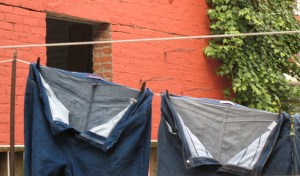
In that spirit, I was pleased to come across the scene pictured above, though it has nothing to do with winter holidays. Those blue patches represent what is now a rarity in our yuppifying city—laundry hung out to dry. The sight is so unusual in the middle-class districts that young tourists probably don’t know what Claes Oldenburg’s monumental Clothespin imitates.
Though many folks raised with electric or gas dryers consider clothes on a line sloppy, faintly embarrassing or even squalid, I find the old-fashioned practice appealing. I like homey items in general: well-worn rugs, cottage-style houses, women in flannel nightgowns. Such things speak of humanity. They are sturdy and unpretentious. Also, in practical terms, a woman under a flannel nightgown is a heck of a lot warmer on a winter night than one who’s been prancing around in a silk negligée.
I have to admit, though, that the admirable lineup of jeans shown above is nontraditional in one important respect. Look at the size of those waistbands—truly 21st century. Our ancestors could have fit a family in one pair, even after turkey, stuffing and multiple toddies.
A Very Tender Topic
October 5, 2012
 Having ignored the political conventions this year, I felt a tiny obligation to subject my ears to the first presidential debate. To build motivation, I set up a project: jot down phrases from the candidates and use them to make a sort of “found” poem, like a sculpture of found objects. Of course I’m not a poet, but incompetence never stopped any writer worth his pint of lager.
As I arranged the phrases yesterday, drawing more or less equally from Obama and Romney, a couple of things surprised me. Almost by chance, the poem came out with each stanza one line longer than the previous—kind of like the way politicians grow windier as they ramble on. (Is there a name for that poetic structure?) More important, some nonsensical sense seemed to emerge from the jabberwocky, and maybe—dare I say it?—an element of hope.
I’m curious to know what anyone else makes of it. Here it is:
A Very Tender Topic
A very tender topic, it’s on the brink of collapse,
and the reason is, is because
there’s a reason that indicates the degree
to which there may not be as much of
a focus on the fact that the path
we’re on has been unsuccessful.See, there is no better way of dealing with
a fight we needed to have
and this is an example of where
those people who are less fortunate
can make a difference because
to promote and protect those principles
occasionally you gotta say no.The proof of that is that
you can look at the record,
people are really hurting today,
and what ends up happening
is some people end up not,
and if the determination of the American people
has not displayed that willingness to say no,
that’s how we’re gonna wind down.The question here tonight is not
where we’ve been but where we’re going.
So let’s get all the doctors together at once,
because we’ve seen progress even when
we were fighting about whether or not
to create frameworks where
we care for those that have difficulties,
at a time when it’s vitally important
to pursue their dreams.Math, common sense, and our history,
we all know that that doesn’t get the job done.
What’s happening is, America
may not be the place to clear up
the record, where everybody’s playing
by the same rules. Let’s grade them,
I propose we grade the creativity and innovation
that exists in the American people, picking
winners and losers, the vitality we can
step in and see, a whole different way of life.Thank you for tuning in, I have no idea
what you’re talking about, but there’s
still a problem as Abraham Lincoln
understood, endowed by our Creator.
Let me give you an example: Gas in the U.S.
is up under any circumstances, the biggest kiss
that’s been given to a baby out of work
since May. Can you help us? At the mercy
of your policies, it’s simply not moral—
the course of America, the great experience,
the burden paid, the bottom line.
Extravaganzas
September 6, 2012
Gold Medal Speaker
My fellow Americans (and others who find Americans amusing),
I hear there have been political conventions in the past couple of weeks. Unlike my family and friends, I haven’t been watching or listening, and before that I similarly ignored the Olympics, to the point of avoiding any room with a tuned-in television.
Yet I like sports and care deeply about American politics. Why such deliberate dodging of the media blitz?
- Empty spectacle offends me with its soullessness, especially high-tech razzle-dazzle created for TV. Probably the Olympics are worse in this respect than the conventions—those increasingly absurd closing ceremonies! As for political candidates, what does it matter whether the stage set behind them offers Greek columns, American flags, Mount Rushmore or naked belly dancers? Why do we need to be dazzled? Isn’t anyone else suspicious of the trend to make everything a glitzy extravaganza?
- I hate sappy stories. How such and such an athlete trained so hard for so many years, overcoming adversity, setting his or her heart on the one big goal. How such and such a small businessperson/immigrant labored so hard for so many years, overcoming adversity, setting his or her heart on the one big goal. Bleaaah!
And since I work with words daily, there’s the extra pain of hearing the language mangled by sports announcers and politicians. Now, for a few favorite sports, such as baseball, I’ve developed a trained indifference to subject-verb disagreement, mismatched tenses, standardized platitudes and modifiers so dangling that their referent inhabits a different zip code. For some reason, though, I’ve never reached that level of tolerance for political jargon; maybe because it’s more important, it’s more deeply offensive?
It’s not that politicians are clumsy and ungrammatical, though they certainly can be. What I find so painful is the knowledge that every phrase was crafted, reviewed, tweaked, vetted to touch a particular nerve in a certain set of voters. I wish I had Jay Heinrichs’ appreciation for the way politicians use the tricks and tropes of rhetoric (see his Figures of Speech blog for his humorous insights). Instead, political verbiage has the same effect on me as a whiff of rancid tuna. Even Barack Obama, one of the finest political speakers in recent memory, appalls me with stock phrases and applause lines. I’ll vote for him but I won’t listen.
Perhaps there’s some depression at work, too, in my political reactions. For my whole adult life, politicians have managed to trick huge numbers of Americans into voting against their own interests—or convinced them that a trip to the polls isn’t worth the effort. If our citizens are so profoundly stupid or indifferent, is the country worth saving?
I will admit, though, that when a bit of news or imagery sneaks past my media blockade, it can be fascinating. The dress Michelle Obama wore for her speech—I saw it on Facebook—so cooooool! Can we imagine Barbara Bush dressed that way?
Whatever: Sam’s Official Old-Fogey Complaint of 2012
May 26, 2012

A once-tragic figure (from Wikipedia)
At a party not long ago, a friend of mine, a dramatist who teaches film history among other subjects, launched into—or perhaps was provoked into—a sad critique of today’s students. As recently as a decade ago, he said, when he showed films that displayed sexist or racist attitudes or callous violence, he’d get a strong reaction. Today, the students seem indifferent, unprovoked, unimpressed. Nothing moves them.
My friend is of an age (as am I) when old-fogey-style complaints are natural, even expected. I withhold his name, though, to avoid informing his students that he criticizes them in public. But they wouldn’t care anyway, would they? “Whatever,” they’d yawn.
Normally I don’t indulge old-fogeyism except in private. But my friend’s remarks came to mind when I read an interview with Marc Schuster, whose new novel The Grievers was featured in my last post. Marc had this to say about American culture and in particular about his own still-youthful generation:
There’s such an emphasis upon entertainment in our culture that we’re losing the ability to take things seriously. We’re really into melodrama, into quick laughs, into anything that amuses us. Look at The Daily Show for example. I love watching it, but there’s something mildly disturbing about the fact that I get a lot—if not most—of my news from John Stewart. It’s like I can’t digest serious information without a heaping teaspoon of humor to help me get it down. What does this say about me? About people of my generation? When am I going to start taking things seriously? Questions like these were in the back of my mind as I was writing the novel, and they’re also the kinds of questions that plague its narrator.
Let me add a third comment to these two: In the past couple of years, as a subscriber to Philadelphia’s excellent Arden Theatre, I’ve seen two plays that offer a classic mix of comedy and tragedy: Cyrano this past season—a new translation and adaptation of Rostand’s 1897 warhorse—and Romeo and Juliet in 2010. In both cases, the productions had me laughing with the comic bits but utterly unmoved by the tragedy, which seemed as extraneous as a sticky note thumbed onto a computer screen. When the heroes and heroine keeled over dead, I merely noted that they had ceased to be funny. In each case the director (Aaron Posner and Matt Pfeiffer, respectively) was experienced and talented and known for drawing the best out of actors. So I had to blame either myself (have I lost the ability to appreciate tragic deaths on stage? admittedly melodrama has never been my favorite genre) or the actors as a group or the culture as a whole.
I’ll take the broad, easy approach, blaming the culture, and extend what honorary old fogey Marc Schuster said a step further. Not only do we demand “a heaping teaspoon of humor” (or, better yet, a campy irony) with our seriousness, but maybe we’re fundamentally desensitized in some important way.
What’s the reason? Video games! Violence on TV! The Internet! Lying, untrustworthy politicians! Loss of faith! Decline in moral standards! Televised wars from Vietnam to Afghanistan! Facebook! Cell phones!
But notice what most of these comments have focused on: our reaction to pretend-reality. Films, theatrical productions, even the news, which we access through the tinted glass of mass media. What happens when we move into real life? When a young ironist witnesses, say, a bicyclist run over by a truck?
Whatever. Don’t ask me. Just pass the pretzels, dude. What’s on Law and Order tonight?
Keeping Up with the Ancestors
December 24, 2011

In keeping with the holiday tradition of honoring ancestors, even those long forgotten, this item from the 12/9/11 edition of the Gridley Herald (published in Gridley, CA) caught my eye:
75 Years Ago (1936)
Following complaint by W.P. Smith of Live Oak of violations of the State wage act, Sam Gridley, local grower, appeared in the Live Oak Justice Court yesterday settled his account with Smith in full and paid a $15 fine.
Though I’m not aware of any Gridley relatives in that part of California (near Yuba City), I’m happy that my namesake was brought to justice. If he has any remaining debts, I disown them and him. I swear that the only field hand I employ is my wife, who makes the garden grow and always exacts a fair wage from me for the basil and parsley she produces. Peace and good will to all.
 The News from Gridleyville