
For the Love of Rubble
September 21, 2016
 Decades ago, in my neighborhood, the city tore down an entire block of traditional row houses on our main street to build a new public school. But neighbors objected to the plan because it’d supposedly create an influx of young people with dark skins. The total pale-people outrage was sufficient to preserve the lot for many years as a debris- and weed-filled mess, which came to be greatly beloved by the residents—because it afforded free parking.
Now, just one block away, a developer has demolished a small, ugly, respectable office building in order to build upscale condos. However, neighbors are again objecting to the new construction, this time because it’ll create extra traffic on the tiny street (barely an alley) at the rear of the property.
Again, as the photo shows, we possess a huge lot full of rubble that may be with us for a long while. And no one seems to mind.
I’m beginning to think, actually, that we have a love for rubble. It’s kind of cool in its own way. It appeals to the common folk. It’s not all rich and snooty like prospective condo buyers, and unlike the developers, rubble is not beholden to political insiders.
If we had a neighborhood vote, Pile of Rubble vs. Designer Condos, I think Rubble might win.
Besides, as I’ve noted in in recent posts about the political landscape, we Americans just like knocking things down and admiring the carnage.
Lesser and Greater Evils
August 10, 2016

Image from O’Hehir’s article in SALON
A short post to offer some informative links (the phrases in red) about Trumpageddon:
Back in June I surmised that Americans might have, in essence, a national death wish, a desire to just blow up the system out of spite, frustration and boredom. Now Andrew O’Hehir has offered a similar, though more complicated, argument in Salon. “As I see it,” he writes, “Trump is on a suicide mission, acting out a deep-seated national desire for self-destruction that runs alongside America’s more optimistic self-image and interacts with it in unpredictable ways” (my boldface). Definitely worth reading.
To that I’ll add a link to an On the Media radio show/podcast in which host Bob Garfield interviews Nathan Robinson, editor of Current Affairs. (The linked page contains a transcript as well as the audio clip.) For those who refuse to vote for either Trump or Clinton, Robinson provides a strong argument for choosing one or the other to avoid a repeat of the 2000 election, when progressives’ votes for Ralph Nader led to the victory of George W. Bush (who, to this point, may be the worst president in U.S. history—a record Trump would have no difficulty in toppling).
“The basic premise” of Robinson’s argument “is that we should think about voting differently. The way I think of voting is that you should think about the potential consequences of your vote. That’s the most important thing. Voting isn’t necessarily a way to say who you are and what you care about. It’s something that has consequences” (my boldface).
Robinson continues, “If 500 Nader voters in Florida had changed their minds we probably wouldn’t have had the Iraq war, so I think those consequences are the most important thing. You know, people are critical of the term ‘lesser evil’—well, you just want us to vote for the lesser evil. Of course we do, because you want less evil in the world.”
My take on the issue is simple: If you’re a grownup, and not suicidal, you should face the fact that the election is not about you or your ideological or moral purity. It’s about who will run the United States and possibly, or not, blow up the whole effing planet.
The Truth About the Trump-Putin Partnership
August 2, 2016
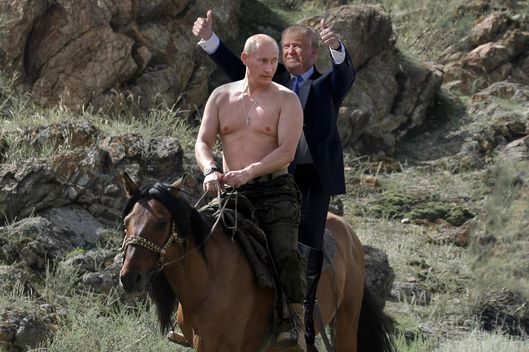 American public, pay attention! The media have misled you about the Trump-Putin Partnership (#therealTPP).
The reason for Donald Trump’s peculiar affinity for Vladimir Putin is not:
(a) his admiration for bullies like himself;
(b) his dependence on Putin’s oligarch pals as investors;
(c) his prurient craving for Hillary’s emails; or
(d) his belief that minor countries, such as Ukraine and Estonia, do not deserve to exist.
No, Mr. Trump’s rapport with the Russian leader stems from their shared devotion to the Art of the Deal.
As a Gridleyville exclusive, we can now report that the two leaders have negotiated a remarkable bargain to profit both the United States and Russia. This dispatch relies on numerous sources, including our trusty underground informant in Moscow, Deepska Throatsky.
The groundbreaking agreement, dubbed the Stolichnaya Accord after the four bottles of vodka consumed during the talks, is based on the irrefutable fact that Putin has already snatched large portions of Ukraine, is likely to take more, and will not be deterred by the United States, NATO, the EU, or the weird spellings of Ukrainian place names. Why not, reasoned Mr. Trump, give Putin our blessing to proceed in that region, but extract an equally valuable commodity as a quid pro quo? Isn’t that what the Art of the Deal is about?
Thus the terms of this historic covenant:
- The United States agrees to make only faint grumbling noises as Russian “aid workers” overrun Kiev in unmarked trucks.
- In return, Russia agrees to make only faint sniffing noises while the United States annexes Mexico.
The net result: Russia gains 233,000 square miles and a few good basketball players. The United States gains 760,000 square miles and the beautiful blood sport of bullfighting.
No doubt you are STUNNED by the audacity of the pact! Your first reaction may be: “But Trump hates Mexicans. Why would he want to seize their country?”
As The Donald himself has told us, his policy statements—in fact, his innermost beliefs and values—are mere negotiating positions. He does not, in reality, hate Mexico or its citizens. His only true problem with Mexicans is that they come here to mow lawns and wash dishes without the permission of affluent white men.
So look at the bold logic of the arrangement: Mexicans will no longer be illegal immigrants in the United States because they will be part of us. Officially, they will become American second-class citizens, much like Puerto Ricans and coal miners.
And the famous wall that Mr. Trump has promised? It will indeed be built—along our new border with Guatemala! This boundary is much shorter and easier to defend than the nearly 2,000 miles of desert between Matamoros and Tijuana. Although the Guatemalans cannot afford to pay for such a wall, we will use our new Mexican-American citizens to do the work at $1.25 per hour.
Unfortunately, the Stolichnaya Accord cannot be officially acknowledged until after the election and inauguration, when Mr. Putin will be invited to the White House for a dinner of gourmet tacos and calabacitas con elote. In the meantime, we can have faith that all of Mr. Trump’s secret deals will live up to this very, very high standard.
What’s Wrong with Hillary
July 25, 2016
To kick off the Democratic convention, Michelle Goldberg wrote a long, thoughtful piece in Slate about why so many people hate Hillary. It’s worth reading if you haven’t seen it already.
Studying polls and interviews, Goldberg finds that people’s disdain and distaste for the pantsuited whipping-girl have remained constant for decades even as the reasons for those emotions have changed. For some people, for instance, it’s policy: Hillary was too liberal in the 1990s and she’s too conservative now—and she has never, apparently, passed through a stage of being just right. For others it’s a character issue: because Hillary has changed her positions over the years, we can’t trust her, even though other politicians do the swivel-dance daily.
“In other words,” Goldberg says, “people hated Hillary for being one sort of person, and in response to that she became another sort of person, who people hated for different reasons. But this doesn’t explain why the emotional tenor of the hatred seems so consistent, even as the rationale for it has turned inside out. Perhaps that’s because anti-Hillary animus is only partly about what she does. It’s also driven by some ineffable quality of charisma, or the lack of it.”
As Goldberg goes on to point out, people who meet Hillary in person tend to like her a lot. But in public she fails to convey the warm, mischievous, funny and charming qualities that her acquaintances know and love.
Of course, she’s not the only political figure whose public persona fails to reflect her private attractiveness. But a wooden, artificial Mitt Romney attracts less vitriol (and more bored sighs), so again we’re left wondering, “Why Hillary? What makes her so abhorrent?”
Ultimately, Goldberg decides, the answer is “gendered”: “Americans tend not to like ambitious women with loud voices.” I think that’s true, and I would add the adjective smart—we especially don’t like an ambitious woman who seems to know uncomfortably more than we do on just about every topic except the state of our own toothbrushes.

Hillary at a Planned Parenthood event, Washington, DC, June 2016 (photo by Lorie Shaull from Wikimedia Commons)
My explanation, then, expands on Goldberg’s to focus on the aura of superiority Hillary manages to convey. When she ramps up her public persona, trying her best to be cool, authoritative, masterful—to stand up to the alpha politicomales she must challenge—she comes off, to me, as smug. Look at that facial expression, that little smirk. Even if you admire her, isn’t it a bit annoying? Don’t you feel slightly put down?
We Americans, famously, and stupidly, want our president to be someone we can have a beer with. I bet that, in private, Hillary can swill a brew as well as her Bubba—maybe better because her heart is stronger. But she gives the impression of sipping an expensive white wine—one of those Coche-Dury Grand Cru thingies?—whose name we can’t even pronounce.
Admittedly, it’s probably “gendered”—nay, sexist—to care about the way a woman grins. After all, George W. Bush had the stupidest grin ever, and THAT wasn’t what we denounced him for.
The Great Bug Spray Conspiracy
June 20, 2016
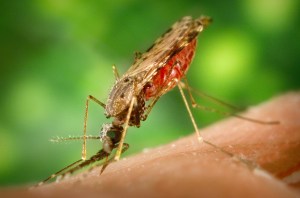
Photo by James Gathany via the Centers for Disease Control and Prevention’s Public Health Image Library; found on Wikipedia
As a straight guy of a certain age (SGOACA), I’ve long been aware of a central fact of male aging: We become invisible to young women. This week, on vacation in Mosquitoland USA, I’ve discovered what appears to be a corollary: Female mosquitoes, the only ones who suck blood, are also no longer drawn to me.
While I sit here totally unaffected by the insect population, all the others in my family are getting eaten alive. My companions have slathered on multiple types of bug lotion, applied half a dozen sprays, including those with extra-strength DEET, added citronella bracelets and ankle bands, and still they suffer big itchy welts on arms, necks, elbows, even the crown of the head. I have used no repellent at all except coffee breath and my natural blandness.
Oh god, does this mean that we SGOACAs are unattractive to females of ALL species? Turtles? Hamsters?
There goes my dream of romance with a shapely porpoise.
Wait, though, there’s another possibility, less devastating to the male ego. Maybe the corporate plutocrats deliberately make bug sprays and lotions ineffective so the deluded public will use gallons of the stuff and then buy more. In fact, come to think of it, these products must contain a secret ingredient that attracts mosquitoes, black flies and other nemeses. Why else would the bugs ignore me and swarm round those covered with so-called repellent?
I’m going to write to Donald Trump about this. I hear he may be running out of his own conspiracy theories.
Armageddon, Anyone?
June 3, 2016
 “You, reader, I, writer,” said Mrs. Gaskell, “have each our great sorrow bearing down upon us.”* A telling and poetic sentiment. True, there’s a certain aura of First World comfort about it—the sorrow is singular, and it hasn’t arrived yet, unlike the multiple present agonies of so many around the globe—but it’s a good reminder that none of us is ultimately secure.
Reading Mrs. Gaskell the other day (more evidence of First Worldism: having the leisure to enjoy a 19th-century novelist), I wondered how her insight would apply to the specter of Donald Trump—because in the United States right now, it seems everything has to be measured in DTs.
Is it the lost sense of security that drives so many white working-class Americans toward The Donald’s blustering fraudulence? That’s what the standard analysis suggests.
Or, I wonder, is it just that so many don’t give a shit anymore? They don’t care if he tosses insults like a fifth grader, offends allies or even starts a new war. It’s time for revenge on the elites, folks—meaning those people who’ve been running things while the rest of us watch sit-coms and football. The elites deserve whatever mockery the Donald can dish out, the more vulgar the better.
And if this means a great sorrow is bearing down on us all, so what? We’ll go down in a blaze of glory—that is, a flaming spew of intolerance, ignorance and spite. It’ll be fun! Like Armageddon. Like The Hunger Games. Time to die, everyone!
Is it possible to have a national death wish?
I think it is.
*The quote is from Elizabeth Cleghorn Gaskell, A Dark Night’s Work (1863), Chap. 4.
The Border Question, Part II
February 20, 2016
In the current atmosphere of polarization and vitriol, my important suggestions for resolving the U.S. immigration crisis (“Tzapping the Borders,” August 31, 2015) have been ignored. I take no personal offense. My wife generally ignores me too.
Perhaps, in fact, one fear I expressed in that essay—that mutant penguins might swarm our beaches—was overblown. As yet, I haven’t seen reports of any such invaders, though I doubt Governor Christie has been patrolling the Jersey coast as vigorously as he ought.
In any event, I realize it takes repeated iterations to make a truth sink in, as our presidential candidates demonstrate by uttering the same phrases a dozen times each day. In this post, though, I’m not going to replay my arguments from last August. Instead, to keep up with the evolving debate, I’ll offer a modified proposal.
Our composite Republican candidate for president, Dred Crumpio, insists on building a wall along the Mexican border, and reiterates the plan so often that we have to take it seriously. All right, then, let’s say we agree to it. Let’s look at the practical implications.
The expense of a wall will be enormous, and asserting that the Mexican government will have to pay for it is ludicrous. Mexico City doesn’t have bags of cash lying around, and any Mexican politician who agreed to such payments without getting, say, Texas in trade would be hounded out of office. (And you wouldn’t really trade Texas back to Mexico, would you? The Alamo, Davy Crockett and all that? Wait, you would?)
But there are nongovernmental entities in Mexico that could pay for a wall. Think a moment. Do you see where I’m going?
The drug syndicates! The Sinaloa Cartel! Los Zetas! Cártel del Golfo! Et al., al., al., al. They’re the ones with cash and valuables spilling out of every pocket, not to mention other orifices. But what would induce them to put up funds for a border wall?

A rational businessman
Well, it’s obvious: We install a few gates in the wall, which only the cartels can access. Then they’ll be able to bring in drugs without hassle, saving the ongoing costs of recruiting and compensating smugglers and bribing law enforcement. Those costs must be considerable, after all. Consider how difficult it must be to convince potential mules to carry bags of cocaine in their rectums, even if you threaten to slaughter their parents and torture their children. Besides, such threats are abhorrent to successful businessmen. It would make much more sense for the Cartel Lords to help us build a wall through which they, and only they, could export goods safely. And being eminently rational, undeterred by sentiment or idealism, the Lords will agree.
Naturally the gates’ existence must be kept secret. If we the public knew, we’d want to use them for importing other stuff, such as cheap pottery and tequila and underpaid labor. Therefore, for this plan to work, we need to elect a president who is adept at concealing the truth and lying to the American public.
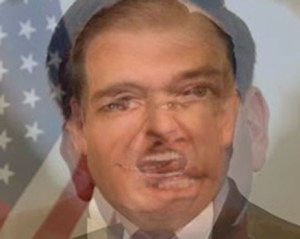
Dred Crumpio, the new face of America
Luckily, we have just such a candidate. Dred Crumpio is our man! Can we all get together and support him now?
Nostalgia and Survival
February 18, 2016
Watching the Black Panthers documentary on PBS the other night (The Black Panthers: Vanguard of the Revolution by Stanley Nelson) made me predictably nostalgic, but I was also confused. What exactly had I thought of the Panthers, and their now-mythic confrontations with the cops, back in the day? In some cases I was just a few miles away when the events went down, but I don’t remember my attitude. Was I mostly on the Panthers’ side, somewhat on the cops’ side, or in my usual utterly muddled middle?

Jed Garoover, as immortalized in the Library of Congress
The documentary also brought up fond memories of San Francisco Chronicle columns by the late Art Hoppe, who turned political figures into comic characters such as Elbie Jay and Billy Boomer, Boy President. Parts of the documentary featured Washington’s arch-villain, the head of the FBI, and I was trying to recall: Did Hoppe invent the name Jed Garoover for that multi-chinned Mephistopheles? It seems to me he did, though I can’t now confirm that.
Most important, the documentary got me thinking about my faith in America—its culture, its political system, its fundamental being. Despite all the polarization and hatred in the Panther days, I didn’t feel, as I do now, the same overpowering sense that the American Soul was at stake. Maybe my youth made me optimistic. Maybe I believed that truth would win in the long run (hah!). Maybe I trusted in the innate sense of the common people who supposedly have the final say in a democracy.
Now I know that we commoners are marginalized by power brokers and fixers, and many of us don’t give a shit anyway. A friend with relatives in Jerusalem tells me that many young Jewish Israelis have given up on politics, neither believing in the long-assumed “two-state solution” nor searching for an alternative. Instead, she says, they live for the moment; they go to cafes and dance on the beach. Is that what we’ve come to now in America?

My new home? (Courtesy of Google Maps)
Though we survived the empty-pated Reagan and the crook Nixon, not to mention earlier embarrassments like Harding and Grant, can we survive the new Republican, Dred Crumpio? (For a sketch of Crumpio, see my previous post.) In the event that the White House, as well as Congress, becomes the fiefdom of demagogic frauds, I’m at least half-seriously considering a move to Canada. I’ve already picked out a neighborhood with a large dog park (green area on the map), though I haven’t yet researched the regulations for exporting dog and family.
So: Would I be wrong to give up on the US of A? Would that be (a) cowardly, (b) a sign of clinical depression, or (c) sane?
The Composite Candidate
February 5, 2016
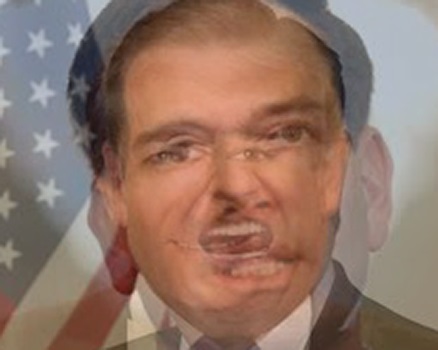
Dred Crumpio
Now that the presidential campaign season is truly underway, the composite candidates have begun to emerge.
Back in 2012, the composite Republican contender, whom I named Mick Somnorich, was kind of feckless, hard to take seriously. He was, in fact, boring, and everyone’s already forgotten him.
This year’s version is truculent and malevolent, much more exciting to watch in the present and likely more memorable in the long term. For those who haven’t tuned in yet, here is his message in a poetic nutshell:
Ready for a New American Century?
Calling the enemy by its name,
I’m the conservative who Democrats
fear most. I won’t let them take away
our giveaway to the corporate patrons.
They’re rapists on the lookout!
It is our job to kill terrorists. Weakness is
provocative. I would bomb the shit out of them.
And believe me, my temperament is very good,
very calm, I’m proud to have an “A” rating
from the American Rifle Association.
We stop bad guys by using our guns!
If I become president, Americans can work
together to revive Merry Christmas
and infringe on the rights of good, law-abiding
citizens. The whole world is on fire!
Look at that face! Pathological,
there’s no cure for that.
This composite’s name is Dred Crumpio, and he believes everything he says, even if he knows it’s a lie. Because talk is just talk, after all. It’s another thing entirely to whomp the bad guys, and believe you me, Americans don’t care about the actual score as long as we can pretend we’re winning.
The Resilience of Evil
December 7, 2015
 In the wake of the most recent mass killings on U.S. soil, and the various posturings and evasions of our politicians, it’s time for another political column. However, in contrast to my usual rant, I’ll endeavor to make this post well-reasoned and scholarly. In the style of a philosophical treatise, the separate arguments will be enumerated, and footnotes will document the sources.
I. “We have met the enemy and he is us.”1
I.a. Syed Farook, a U.S. citizen, born and raised here.
I.b. Dylann Roof, a U.S. citizen, born and raised here.
I.c. Adam Lanza, a U.S. citizen, born and raised here.
I.d. James Holmes, a U.S. citizen, born and raised here.
I.e. Eric Harris, a U.S. citizen, born and raised here.
I.f. Dylan Klebold, a U.S. citizen, born and raised here.
I.g.–I.z. Et al., et al., et al.
II. Evil cannot be eliminated from the world.
II.a. Evil has been with us since the first human beings.2
II.b. Evil will not succumb to bombs, ground troops, atomic weapons or—except in fantasy movies—magic light sabers.
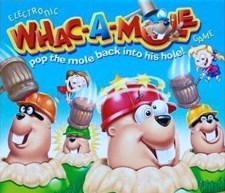
II.c. Indeed, the resilient, slippery and protean nature of evil—its ability to pop up in new forms in new places—suggests a popular game whose name now connotes a repetitive and impossible task.3
II.d. As point I above indicates, evil lives in all of us, not in any particular place.
II.d.1. Hence there is no one place to attack it.
III. Nor can the enticement of evil be eliminated.
III.a. Some types of evil will always look prettier or sound more convincing than good.4
III.b. In the basic sense, each person is tempted not by outsiders, but by his or her own desire.5
So, if we can’t get rid of evil, what might we do as a society? No easy solution exists. But we could try to make the good—that is, sane, peaceful, life-respecting behavior—more attractive. For instance, we could work to reduce poverty and the huge gap between the privileged and underprivileged. By doing so, we would boost the sense that everyone has something to live for rather than commit murder-mayhem-suicide for. Instead of empty patriotism, we Americans could then speak with a justified pride in our country, as one wild-eyed Revolutionary-era radical suggested:
When it shall be said in any country in the world, my poor are happy; neither ignorance nor distress is to be found among them; my jails are empty of prisoners, my streets of beggars; the aged are not in want, the taxes are not oppressive; the rational world is my friend, because I am the friend of its happiness: when these things can be said, then may that country boast its constitution and its government.6
Notes
- Pogo the Possum, 1971; see https://en.wikipedia.org/wiki/Pogo_(comic_strip).
- Genesis, 300 B.C.E. or earlier.
- Whac-A-Mole; see https://en.wikipedia.org/wiki/Whac-A-Mole.
- John Milton, Paradise Lost, 1667.
- James 1:14, c. 100 C.E.
- Thomas Paine, Rights of Man, 1791.
 The News from Gridleyville